What’s the Difference Between 'Stop Buying' and 'Stop to Buy'?
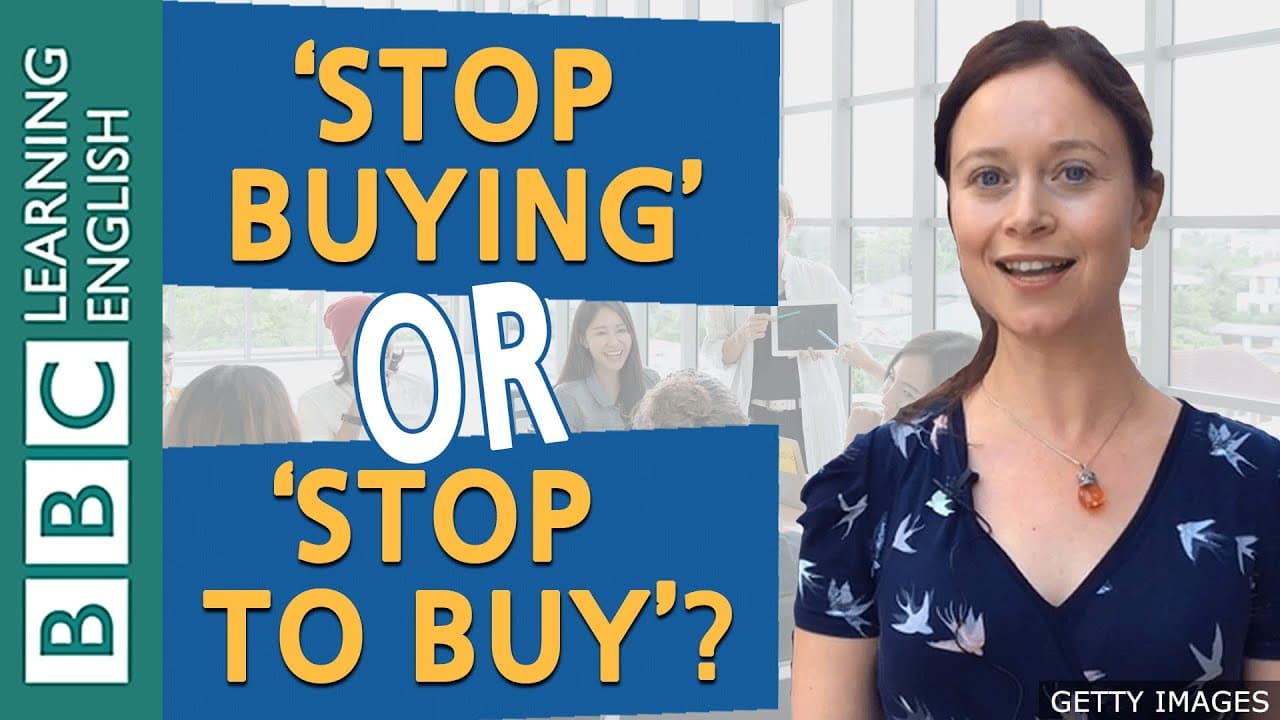
TL;DR
'Stop buying' means to completely cease a particular action, while 'stop to buy' implies taking a break from one activity to do something else, like purchasing coffee. Similarly, 'regret' and 'go on' also change meaning depending on whether they are followed by gerunds or infinitives, highlighting the importance of verb forms in English.
Transcript
Hi Sian here for BBC Learning English. Now lots of people stop to buy a coffee on their way into work, but not me - I've stopped buying coffee. What's the difference - 'stop buying' 'stop to buy'? You'll find out in this Masterclass. In English we have a group of verbs that can be followed by the gerund or the infinitive, but with a change in meani... Read More
Key Insights
- The verb 'stop' followed by a gerund indicates cessation of the action, whereas followed by an infinitive, it indicates pausing one action to start another.
- 'Regret' with a gerund implies remorse over a past action, while with an infinitive, it is used to convey upcoming bad news.
- 'Go on' followed by a gerund suggests continuation of the same action, whereas with an infinitive, it indicates a transition to a new action.
- Understanding the difference between gerunds and infinitives is crucial in mastering English verb usage.
- Gerunds often imply continuity or completion of an action, while infinitives can suggest purpose or intention.
- The context in which verbs are used can significantly alter their meaning, especially with verbs like 'stop', 'regret', and 'go on'.
- Formal contexts often prefer infinitives, especially in written communication, to convey politeness or formality.
- Learning the nuances of verb usage can enhance both spoken and written English proficiency.
Install to Summarize YouTube Videos and Get Transcripts
Explore YouTube Video Summarizer or Get YouTube Transcript Extractor
Questions & Answers
Q: What is the difference between 'stop buying' and 'stop to buy'?
The difference lies in the subsequent action. 'Stop buying' uses a gerund, indicating that the action of buying has ceased entirely. In contrast, 'stop to buy' uses an infinitive, meaning that the speaker paused another activity to perform the action of buying.
Q: How does 'regret' change meaning with gerunds and infinitives?
When 'regret' is followed by a gerund, it expresses remorse for an action that has already occurred. For instance, 'I regret telling you' implies sorrow for having shared information. When followed by an infinitive, it typically introduces bad news, as in 'We regret to inform you'.
Q: What does 'go on talking' versus 'go on to talk' imply?
'Go on talking' uses a gerund to indicate that the action of talking continues without interruption. On the other hand, 'go on to talk' uses an infinitive, suggesting that after completing one action, the subject proceeds to a different action, such as starting a new topic.
Q: Why is it important to understand the use of gerunds and infinitives?
Understanding gerunds and infinitives is crucial because they can change the meaning of verbs significantly. This knowledge allows for more precise communication, helping learners to convey their intended message accurately and understand the nuances in others' speech or writing.
Q: Can you give an example of 'regret' in a formal context?
In formal contexts, 'regret' followed by an infinitive is often used to deliver bad news politely. For example, 'We regret to inform you that your application has been unsuccessful' is a common way to convey unfortunate news while maintaining a respectful tone.
Q: How does context affect the use of gerunds and infinitives?
Context plays a vital role in determining whether a gerund or an infinitive should follow a verb. Gerunds often imply ongoing or completed actions, while infinitives suggest purpose or intention. The choice between them can alter the meaning and tone of a sentence significantly.
Q: What is a common mistake learners make with gerunds and infinitives?
A common mistake is using a gerund or infinitive interchangeably without considering the verb's specific meaning change. For example, using 'stop to buy' instead of 'stop buying' can confuse the listener about whether the action was paused for another or ceased entirely.
Q: Why might one choose an infinitive over a gerund in writing?
Infinitives are often chosen over gerunds in writing to convey formality, politeness, or intention. In formal or written English, infinitives can soften the delivery of bad news or make requests sound more polite, as seen in phrases like 'We regret to inform you'.
Summary & Key Takeaways
-
In this lesson, Sian from BBC Learning English explains the difference in meaning when using gerunds versus infinitives with certain verbs. The verbs discussed are 'stop', 'regret', and 'go on', each having distinct meanings based on their following form.
-
The verb 'stop' changes meaning based on whether it is followed by a gerund or an infinitive. With a gerund, it indicates stopping an action altogether, while with an infinitive, it means pausing one action to start another.
-
Similarly, 'regret' and 'go on' also change meanings. 'Regret' with a gerund shows remorse for a past action, while with an infinitive, it introduces bad news. 'Go on' with a gerund means the action continues, and with an infinitive, it indicates a new action.
Read in Other Languages (beta)
Share This Summary 📚
Summarize YouTube Videos and Get Video Transcripts with 1-Click
Try YouTube Summary with ChatGPT & Claude or YouTube Transcript Generator
Explore More Summaries from BBC Learning English 📚

Summarize YouTube Videos and Get Video Transcripts with 1-Click
Try YouTube Summary with ChatGPT & Claude or YouTube Transcript Generator