How to Express cos(arcsinx) as an Algebraic Expression
TL;DR
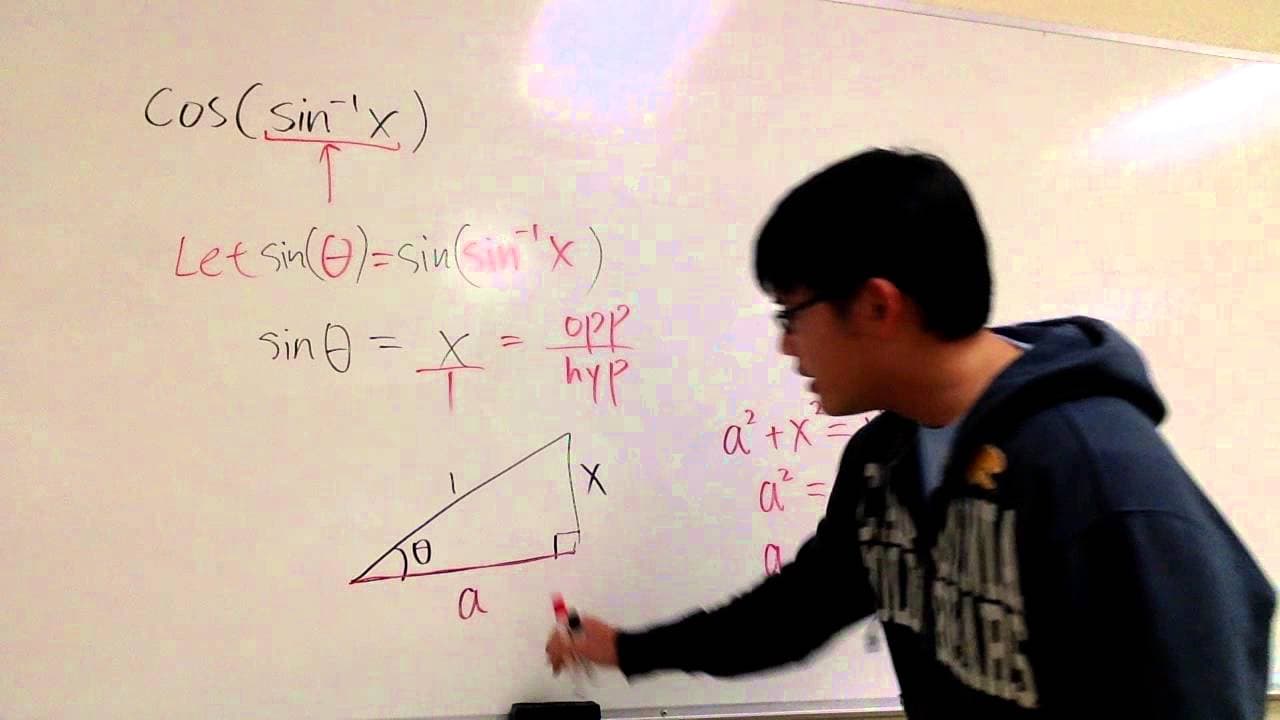
To express cos(arcsinx) algebraically, visualize a right triangle where the opposite side is x and the hypotenuse is 1. Using the Pythagorean theorem, the adjacent side is √(1 - x²). Thus, cos(arcsinx) simplifies to √(1 - x²) over 1, or simply √(1 - x²).
Transcript
let's see how we can write cosine of the in person X as an algebraic expression and Akira here is that for all the interest rate functions they all represent an angle so right here for import side X I can begin by saying that theta equals to the inverse sine step back your limits and once I have this equation I can apply the original sine of both s... Read More
Key Insights
- 🔺 Inverse trig functions can be represented as angles in a right triangle.
- 🔺 The sine of an angle in a right triangle represents the ratio of the opposite side to the hypotenuse.
- 😑 By constructing a right triangle and using trigonometric ratios, algebraic expressions for inverse trig functions can be derived.
- 🗯️ The opposite side in a right triangle can be represented as a fraction by considering X as X/1.
Install to Summarize YouTube Videos and Get Transcripts
Explore YouTube Video Summarizer or Get YouTube Transcript Extractor
Questions & Answers
Q: How can cosine of inverse trig functions be expressed algebraically?
To express cosine of inverse trig functions algebraically, start by finding theta using inverse sine. Then, apply the trigonometric ratios of a right triangle to determine the values of the sides. Finally, use the values to construct an algebraic expression for cosine.
Q: What does sine of an angle in a right triangle represent?
Sine of an angle in a right triangle represents the ratio of the length of the side opposite the angle to the length of the hypotenuse. It can be expressed as opposite/hypotenuse.
Q: How can the opposite side in a right triangle be represented as a fraction?
To represent the opposite side in a right triangle as a fraction, consider the side length X as X/1. This allows us to view X as the numerator (opposite side) and 1 as the denominator (hypotenuse).
Q: What is the equation to determine the length of the adjacent side in a right triangle?
The equation to determine the length of the adjacent side in a right triangle is cosine(theta) = adjacent/hypotenuse. In this case, cosine(theta) would be equal to the square root of 1 - x^2, which represents the adjacent side.
Summary & Key Takeaways
-
The content discusses how to write cosine of the inverse trig function as an algebraic expression.
-
It explains that all inverse trig functions represent angles, and theta can be found using inverse sine.
-
By using a right triangle and understanding the trigonometric ratios, the content shows how to express cosine of inverse trig functions algebraically.
Read in Other Languages (beta)
Share This Summary 📚
Summarize YouTube Videos and Get Video Transcripts with 1-Click
Try YouTube Summary with ChatGPT & Claude or YouTube Transcript Generator
Explore More Summaries from blackpenredpen 📚


Summarize YouTube Videos and Get Video Transcripts with 1-Click
Try YouTube Summary with ChatGPT & Claude or YouTube Transcript Generator