Unit 5: Mechanics of Simulation, Video 4: Decision Rules and Unit Closure
TL;DR
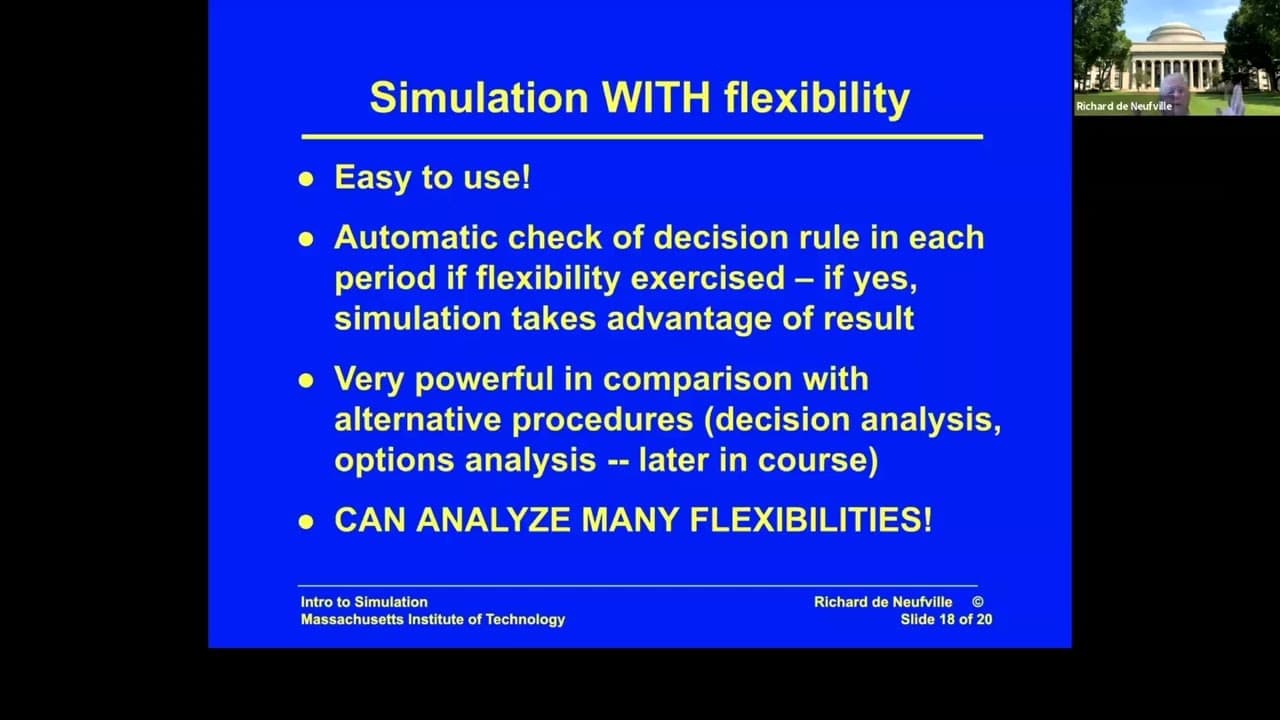
Using simulation, we can determine the value of flexibility in decision making by comparing outcomes with and without flexibility.
Transcript
[SQUEAKING] [RUSTLING] [CLICKING] RICHARD DE NEUFVILLE: We don't have a way of calculating when's the optimal time. There are some methods for dealing with that, such as dynamic programming. But dynamic programming implies there's nothing you can do about it to affect future aspects. This is the so-called path independence function. And the whole p... Read More
Key Insights
- 🏃 There is no precise method for calculating the optimal time for exercising flexibility.
- 😫 Decision rules for flexibility can be set by mandates or management preferences.
- 👻 Simulation allows for the analysis of multiple flexibilities simultaneously.
- ❓ The value of flexibility can be determined by comparing outcomes with and without flexibility.
- 🍵 Simulation is computationally efficient and can handle various uncertainties.
- ❓ It is relatively easy to explain simulation to decision makers compared to other complex mathematical models.
- 🎯 The outcomes of simulation, such as target curves, help determine the value of flexibility.
Install to Summarize YouTube Videos and Get Transcripts
Explore YouTube Video Summarizer or Get YouTube Transcript Extractor
Questions & Answers
Q: What is dynamic programming and why is it ineffective in evaluating the optimal time for flexibility?
Dynamic programming assumes there is nothing you can do to affect future aspects, making it unsuitable for determining the optimal time for exercising flexibility.
Q: How are decision rules for flexibility set?
Decision rules for flexibility can be set by higher-level mandates or management preferences, defining conditions for when flexibility should be exercised.
Q: Can decision rules for flexibility be modified over time?
Yes, decision rules for flexibility can be modified, taking into account factors like the length of a lease or specific stages of a project's life cycle.
Q: How does simulation automate the implementation of flexibility?
Simulation evaluates decision rules at each time period and checks if conditions have been met. If so, it triggers actions such as investments or capacity expansions, incorporating them into the analysis for future periods.
Summary & Key Takeaways
-
Flexibility in decision making is essential, but there is no optimal time to exercise it, making dynamic programming ineffective.
-
Decision rules, set by higher-level mandates or management preferences, define when flexibility should be exercised.
-
Simulation can analyze multiple flexibilities simultaneously and help determine the value of flexibility.
Read in Other Languages (beta)
Share This Summary 📚
Summarize YouTube Videos and Get Video Transcripts with 1-Click
Try YouTube Summary with ChatGPT & Claude or YouTube Transcript Generator
Explore More Summaries from MIT OpenCourseWare 📚



Summarize YouTube Videos and Get Video Transcripts with 1-Click
Try YouTube Summary with ChatGPT & Claude or YouTube Transcript Generator