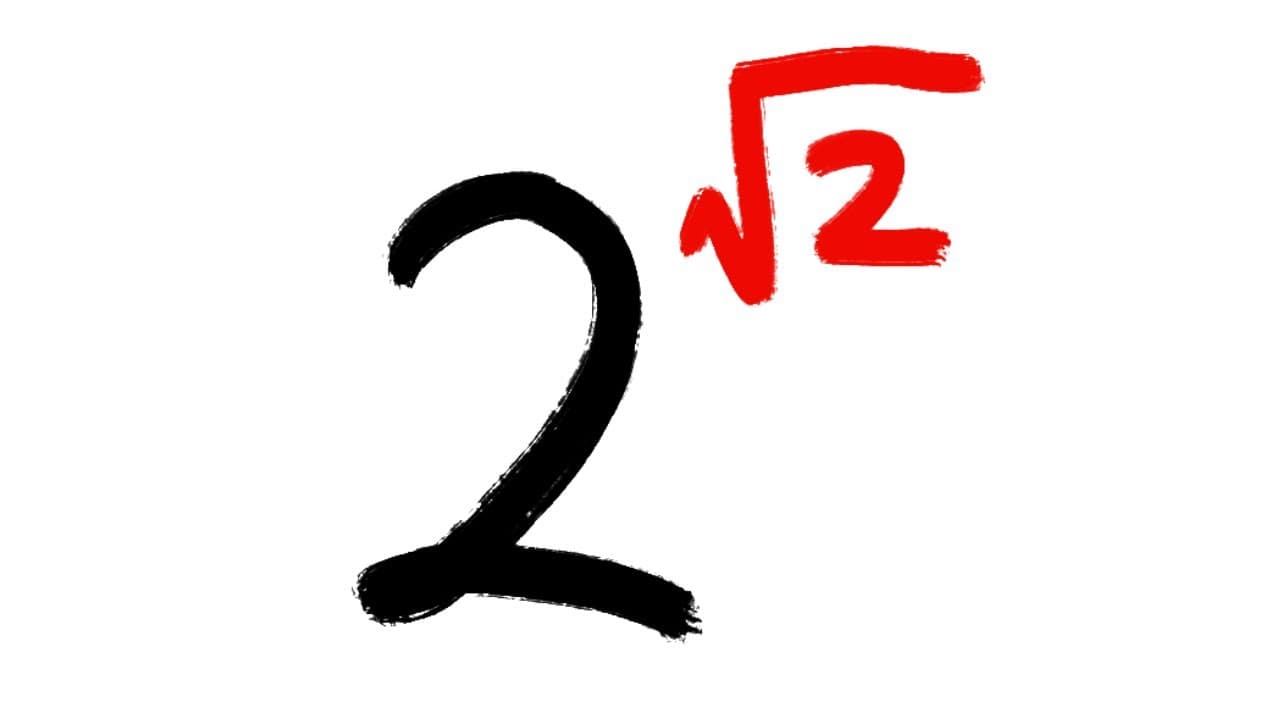
What does an irrational exponent mean?
TL;DR
Learn how to handle irrational exponents by approximating them with a sequence of rational numbers.
Transcript
as we all know when we have a whole number exponents such as 2/3 power this means 2 times 2 times 2 which is 8 and when we have negative exponent such as 2 to the negative 3 power we just do 1 over 2 to the third power which is 1 of 8 and if you have a rational exponent that's a 1 over 3 for the exponent this means the third root of 2 right namely ... Read More
Key Insights
- 🔁 Whole number exponents can be calculated easily through repeated multiplication.
- 🤨 Negative exponents can be evaluated by taking the reciprocal of the base raised to the positive exponent.
- 💭 Rational exponents involve finding the nth root of the base.
- #️⃣ Irrational exponents can be approximated using a sequence of rational numbers that converge to the irrational number.
- 🥡 An approximation of an irrational exponent can be obtained by taking the limit of the sequence of rational numbers.
- 😒 Calculating exponents with irrational numbers can be time-consuming without the use of a calculator.
- 🍵 The mathematical definition provides a systematic approach to handling irrational exponents.
Install to Summarize YouTube Videos and Get Transcripts
Explore YouTube Video Summarizer or Get YouTube Transcript Extractor
Questions & Answers
Q: How do you handle exponents with whole numbers?
Exponents with whole numbers can be calculated by multiplying the base by itself the number of times indicated by the exponent. For example, 2^3 is equal to 2 x 2 x 2, resulting in 8.
Q: What is the method for evaluating exponents with negative numbers?
Exponents with negative numbers can be evaluated by taking the reciprocal of the base raised to the positive exponent. For example, 2^-3 is equal to 1/(2^3), which simplifies to 1/8.
Q: How can rational exponents be handled?
Rational exponents can be evaluated by finding the nth root of the base, where n is the denominator of the exponent. For example, 2^(1/3) is equal to the cube root of 2.
Q: How can irrational exponents be calculated?
Irrational exponents can be handled by approximating them with a sequence of rational numbers. By taking the limit of the sequence as it approaches the irrational number, an approximation of the value can be obtained.
Summary & Key Takeaways
-
Exponents with rational numbers can be easily calculated by repeated multiplication or division.
-
Negative exponents can be evaluated by taking the reciprocal of the base raised to the positive exponent.
-
When dealing with irrational exponents, they can be approximated using a sequence of rational numbers that converge to the irrational number.
Read in Other Languages (beta)
Share This Summary 📚
Summarize YouTube Videos and Get Video Transcripts with 1-Click
Try YouTube Summary with ChatGPT & Claude or YouTube Transcript Generator
Explore More Summaries from blackpenredpen 📚
Summarize YouTube Videos and Get Video Transcripts with 1-Click
Try YouTube Summary with ChatGPT & Claude or YouTube Transcript Generator