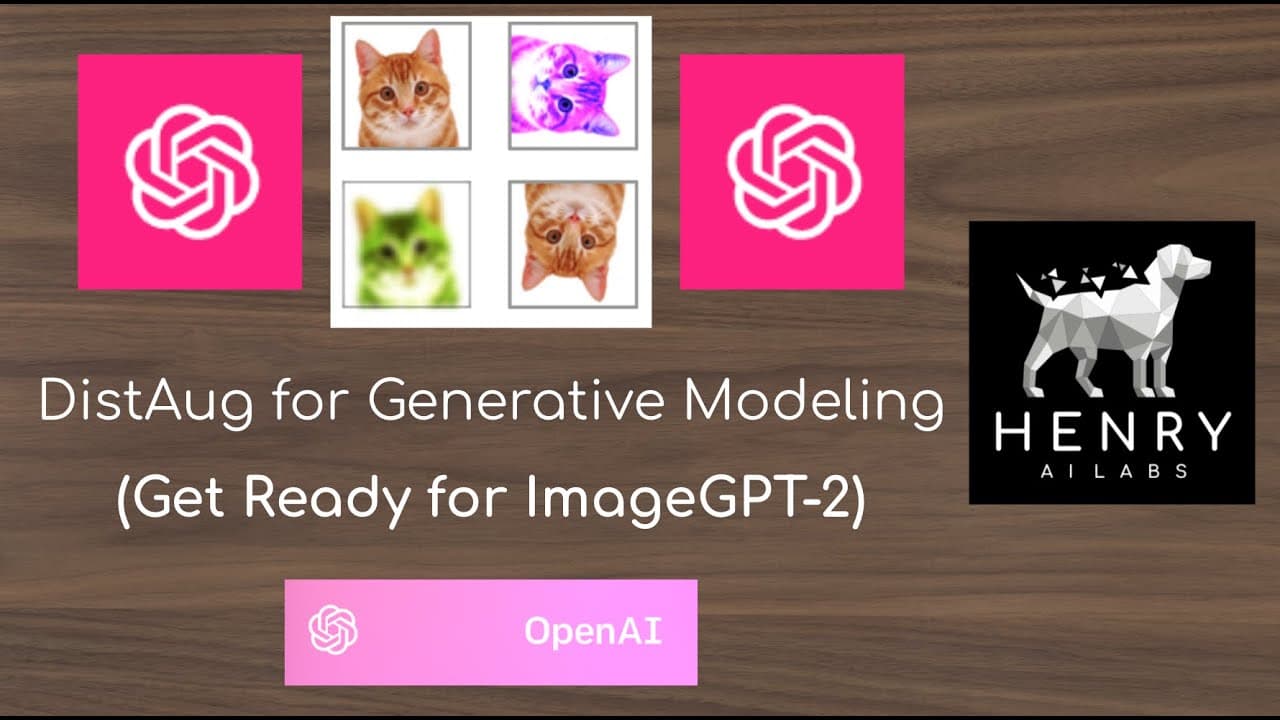
Distribution Augmentation for Generative Modeling
TL;DR
Researchers explore distribution augmentation to enhance generative modeling in image generation.
Transcript
this video will explore distribution augmentation for generative modeling developed by researchers at open AI in addition to excitement about GPT three and its ability to generate stories and write code open AI has also recently published their imaged GPT model this was a 6.8 billion parameter auto regressive generative model similar to how GPT thr... Read More
Key Insights
- ❓ Distribution augmentation is crucial for improving generative modeling techniques and preventing overfitting while enhancing generalization.
- 👻 The integration of inductive biases through data transformations allows models to maintain semantic meanings across various augmented images.
- 👨🔬 Research shows that the scope and effectiveness of augmentations can significantly influence the performance of generative models, hinting at potential efficiencies in training.
- 🚗 Advancements in auto-regressive generative models may revolutionize how AI systems generate creative outputs by utilizing multi-task learning approaches.
- 🧩 Experiments indicated that simple geometric transformations like rotation outperform more complex jigsaw augmentations, showcasing the importance of choosing effective methods for data augmentation.
- 🤗 The relationship between the strength of data augmentation and model performance suggests the need for optimizing augmentation strategies based on the task at hand.
- 📱 The findings emphasize a shift from merely enlarging datasets to incorporating smart augmentation strategies that mold the understanding and learning of generative models.
Install to Summarize YouTube Videos and Get Transcripts
Explore YouTube Video Summarizer or Get YouTube Transcript Extractor
Questions & Answers
Q: What is distribution augmentation and why is it important for generative modeling?
Distribution augmentation is a technique developed by researchers at OpenAI that uses data augmentation to enhance generative modeling. It allows models to learn from transformed data, increasing diversity and generalization capabilities while preventing overfitting. This technique has shown promise for improving results in generative image models like Image GPT, making it crucial for advancing AI capabilities in creative and analytical tasks.
Q: How does data augmentation impact the training of deep learning models?
Data augmentation plays a dual role in training deep learning models. It not only increases the size of the training dataset through transformations like rotations and color adjustments but also injects inductive biases. This means models can learn invariant representations, which helps them generalize better across different data inputs. This capacity to recognize similarities despite variations enhances overall model performance and robustness against overfitting.
Q: What experiments were conducted to assess the effectiveness of distribution augmentation?
Researchers conducted experiments using a range of neural network architectures, measuring how various data augmentations affected generative performance. Specifically, they compared the generation capabilities of models with and without such augmentations. They sought to understand how the frequency and types of transformations influenced the quality of generated images, demonstrating that certain augmentations, like rotation, yielded better results than others, such as jigsaw partitioning.
Q: In what ways does distribution augmentation differ from traditional data augmentation methods?
Traditional data augmentation methods generally focus on enlarging datasets to prevent overfitting without necessarily considering the semantic meanings of the transformations applied. In contrast, distribution augmentation integrates augmentation strategies with generative modeling principles, conditioning models on the data transformations. This allows for more sophisticated learning, enabling models to differentiate between original data distributions and those altered by specific augmentations, thereby enhancing their generative capabilities.
Q: What are the implications of the findings for future models like Image GPT-2?
The findings suggest that incorporating more extensive distribution augmentation techniques could significantly improve upcoming generative models like Image GPT-2. By scaling both the number of model parameters and the strength of augmentations applied, researchers anticipate achieving better performance on complex datasets. This approach may lead to more effective generalized models that can adeptly generate high-quality images and represent diverse data distributions.
Q: How does conditional modeling enhance the performance of generative models?
Conditional modeling enhances generative models by allowing them to adjust their output based on specific information about data transformations. By embedding transformation data at the start of the generation sequence, models can produce outputs aware of these conditions, such as recognizing that an over-rotated image still represents the same object. This embedded understanding leads to greater accuracy and creativity in the generated images, as the models can effectively learn and adapt their generation strategies.
Summary & Key Takeaways
-
This video discusses distribution augmentation developed by OpenAI, aimed at improving generative modeling through data augmentation techniques, focusing especially on image generation.
-
The concept involves enhancing models like Image GPT by integrating multiple transformations into their training data, preventing overfitting and incorporating inductive biases to better understand data distributions.
-
Key findings illustrate that both the scale of augmentations and the specific types of transformations significantly influence performance improvements, hinting at future potential for scaled-up generative models.
Read in Other Languages (beta)
Share This Summary 📚
Summarize YouTube Videos and Get Video Transcripts with 1-Click
Try YouTube Summary with ChatGPT & Claude or YouTube Transcript Generator
Explore More Summaries from Connor Shorten 📚
Summarize YouTube Videos and Get Video Transcripts with 1-Click
Try YouTube Summary with ChatGPT & Claude or YouTube Transcript Generator