An overview of Solid and a comparison to Sovrin
TL;DR
Solid is a privacy standard for personal user data focused on social applications, while Sovereign is a more web 3-like standard with stronger credentialing and cryptographic guarantees.
Transcript
hello this is Alan from authorities CTO and founder partner with me is the Turner technology analyst and today we will talk about solid to solid project initiated by Sir Tim berners-lee and compare it to sovereign especially on the identity part now other ventures has been we've been active in the blockchain tokens let's count the world for for man... Read More
Key Insights
- 🤳 Solid is a privacy-focused data standard that aims to give users control over their personal data, while Sovereign focuses on self-sovereign identity with stronger credentialing and cryptographic guarantees.
- 🕸️ Solid is based on existing web standards, such as web ID, and integrates with social applications, while Sovereign is a more web 3-like standard with a wider scope, including financial aspects and payment functionalities.
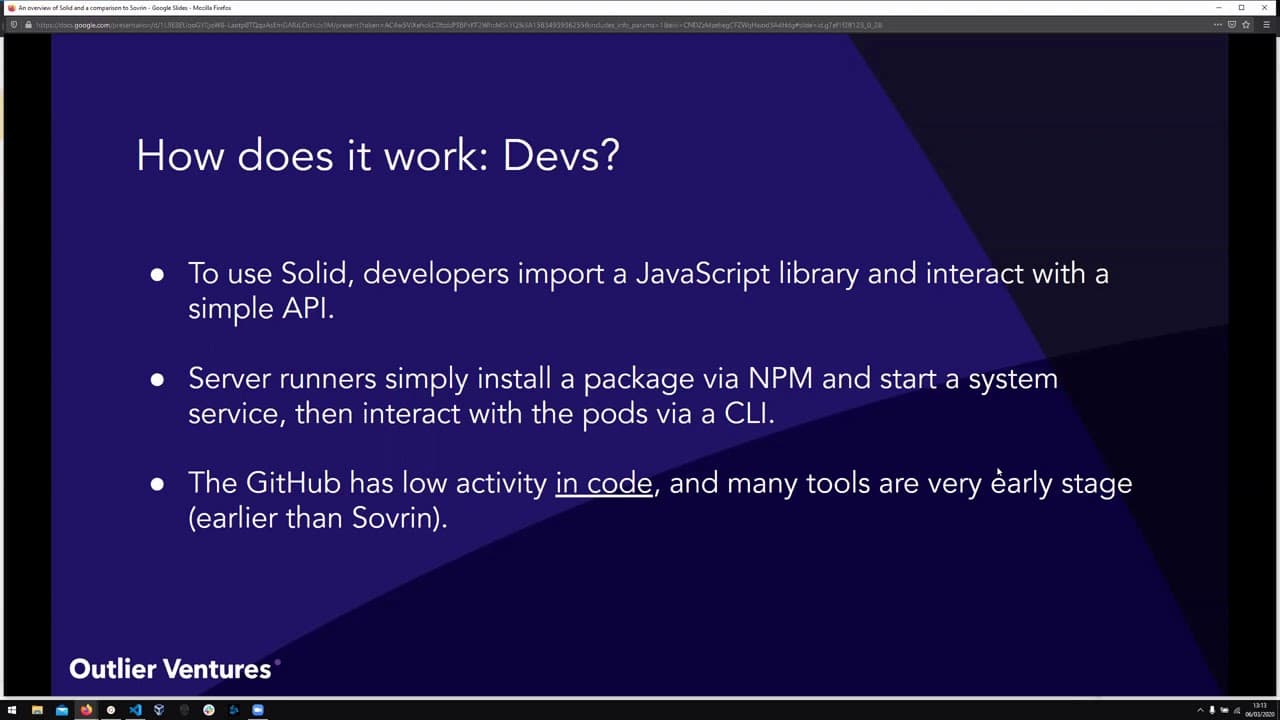
- 👤 Solid allows users to store their data in pods controlled by themselves or trusted custodians, while Sovereign utilizes distributed ledger technology to store user data.
- 👤 Solid does not encrypt user data at the storage level by default, but it keeps the data encrypted during transport using transport layer security.
- 😄 Solid is focused on user-friendliness and ease of integration with existing social app companies, while Sovereign covers multiple programming languages but is currently more developer-oriented.
- 😌 Solid relies on the credibility of end-users, while Sovereign relies on trusted issuers for credentialing.
- 🏛️ Sovereign supports revocation of credentials, while Solid does not have this functionality built into its protocol.
Install to Summarize YouTube Videos and Get Transcripts
Explore YouTube Video Summarizer or Get YouTube Transcript Extractor
Questions & Answers
Q: What are the three key principles of Solid?
The three key principles of Solid are self-sovereign identity, persistency (having a single identity across applications), and reusability (allowing apps to reuse identity information without requesting it again).
Q: How does Solid differ from Sovereign in terms of storing user data?
Solid focuses on giving users control over their data by allowing them to store it in pods that can be controlled by either the users themselves or trusted custodians. Sovereign, on the other hand, utilizes distributed ledger technology to store user data.
Q: Does Solid encrypt user data at the storage level?
By default, Solid does not encrypt user data at the storage level, but it does keep the data encrypted during transport using transport layer security.
Q: How does Solid handle authentication for web apps?
Solid uses web ID, which is similar to a decentralized identifier (DID), as an access point for users' personal information. Users can use their web ID to authenticate web apps, similar to logging in with Google for various web apps today.
Summary & Key Takeaways
-
Solid is a privacy-focused data standard for the web that allows users to store their personal data in pods controlled by themselves or trusted custodians.
-
It is based on existing web standards, such as web ID, and aims to enable users to own and control their personal data.
-
Sovereign, on the other hand, is a web 3-like standard that focuses on self-sovereign identity, providing stronger credentialing and cryptographic guarantees.
Read in Other Languages (beta)
Share This Summary 📚
Summarize YouTube Videos and Get Video Transcripts with 1-Click
Try YouTube Summary with ChatGPT & Claude or YouTube Transcript Generator
Explore More Summaries from Outlier Ventures 📚






Summarize YouTube Videos and Get Video Transcripts with 1-Click
Try YouTube Summary with ChatGPT & Claude or YouTube Transcript Generator