Sect 2.3 #29 Algebraic Limit: Combine two algebraic fractions , Stewart Calculus Solutions
TL;DR
The video explains the process of simplifying and calculating limits, specifically focusing on a limit approaching zero.
Transcript
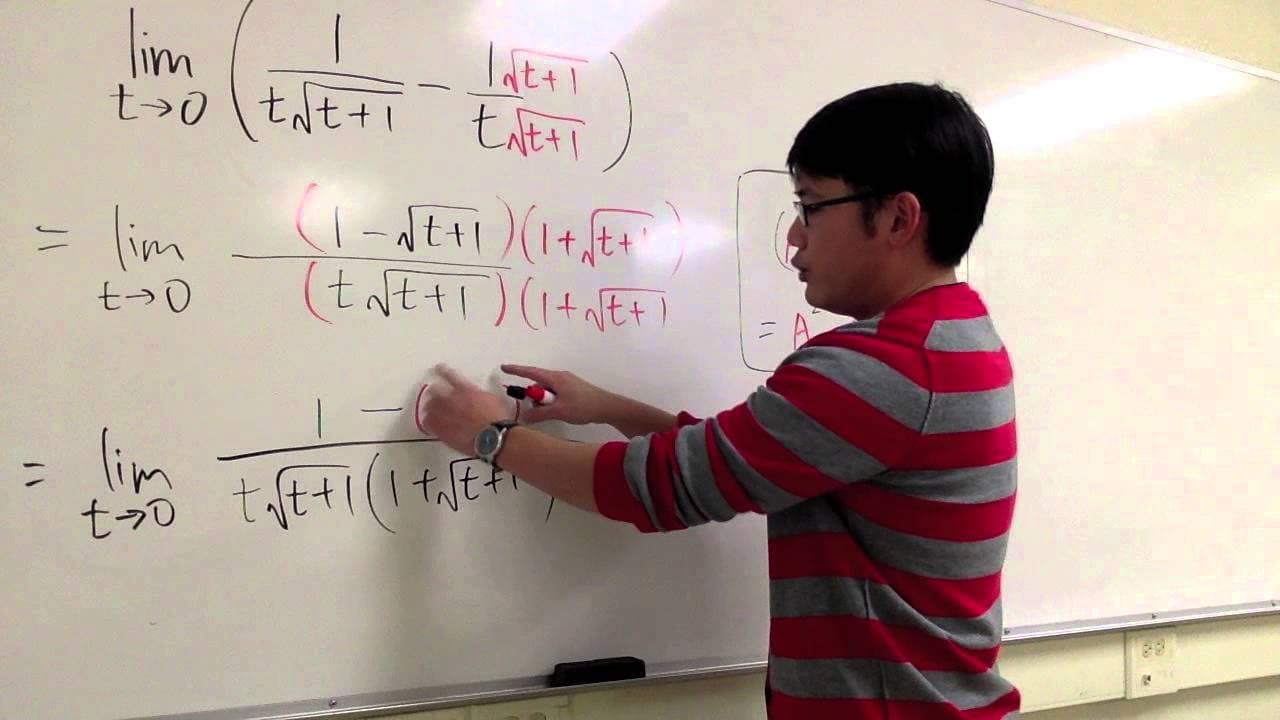
okay let's look at this limit the limit when t approaches to zero we have one over t times square root of t plus one minus one over t and let's just plug in zero into all t's to see what we get in the first fraction right here plugging zero into the t we will get one over well zero times anything is going to be zero and zero times one we have zero ... Read More
Key Insights
- 🥺 Plugging in zero into the equation leads to an indeterminate form that requires further simplification.
- 😑 Simplifying the equation involves finding a common denominator and combining the fractions into a single expression.
- 🍉 Cancelling out common terms and performing necessary calculations is crucial in obtaining the final answer.
- ⛔ The process of simplifying and calculating limits is an essential concept in calculus.
- 💁 Understanding indeterminate forms helps identify situations where additional steps are needed to find the limit.
- 😑 The conjugate of a binomial expression is often used to simplify and manipulate equations.
- ❎ Taking into account the properties of square roots and square cancels out terms.
Install to Summarize YouTube Videos and Get Transcripts
Explore YouTube Video Summarizer or Get YouTube Transcript Extractor
Questions & Answers
Q: What is the initial result obtained when plugging in zero into the equation?
Plugging in zero into the equation results in an indeterminate form of infinity minus infinity, which doesn't provide a conclusive answer.
Q: How is the indeterminate form resolved?
To resolve the indeterminate form, the equation is simplified by finding a common denominator and combining the fractions into a single expression.
Q: What is the final simplified expression after finding a common denominator?
The final expression after finding a common denominator is (1 - √(t + 1))/(t√(t + 1)).
Q: What is the calculated limit of the function as t approaches zero?
The calculated limit of the function is -1/2 as t approaches zero.
Summary & Key Takeaways
-
The video discusses the process of calculating the limit of a function as its input approaches zero.
-
The initial attempt to plug in zero into the function leads to an indeterminate form of infinity minus infinity, requiring further work.
-
By finding a common denominator and simplifying the expression, the limit is ultimately calculated to be -1/2.
Read in Other Languages (beta)
Share This Summary 📚
Summarize YouTube Videos and Get Video Transcripts with 1-Click
Try YouTube Summary with ChatGPT & Claude or YouTube Transcript Generator
Explore More Summaries from blackpenredpen 📚
Summarize YouTube Videos and Get Video Transcripts with 1-Click
Try YouTube Summary with ChatGPT & Claude or YouTube Transcript Generator