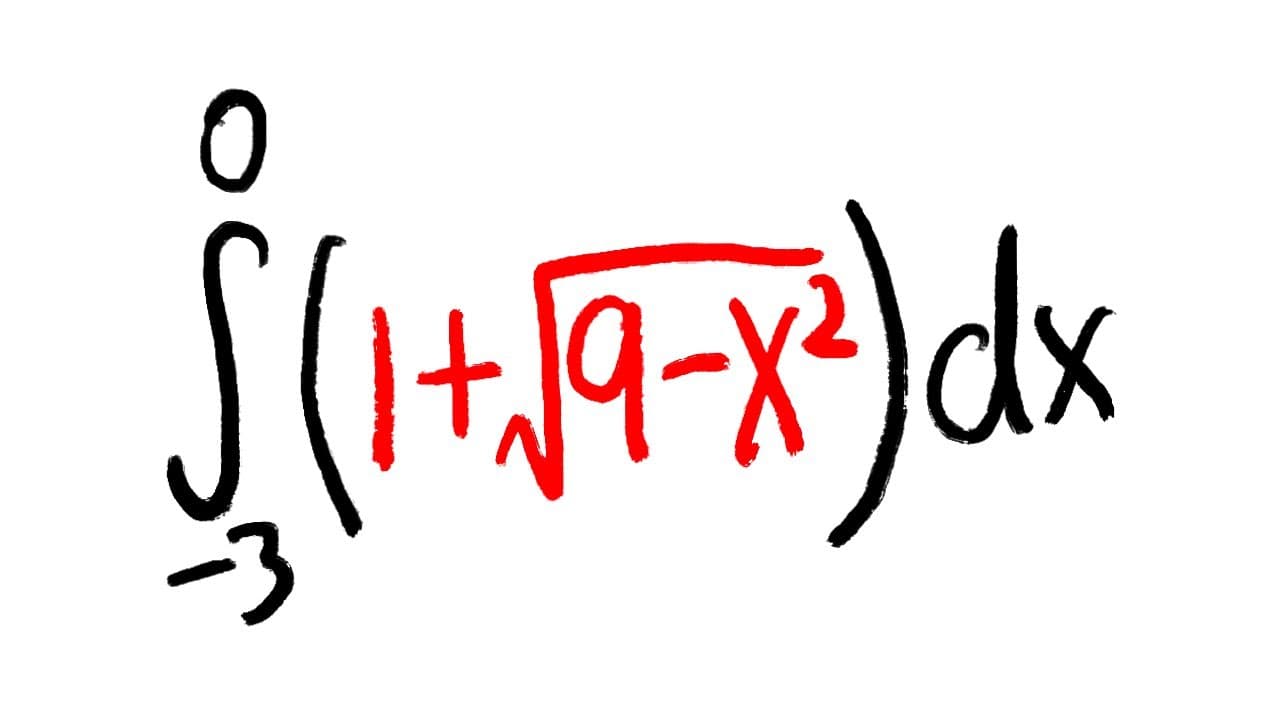
Evaluate integral by interpreting it in terms of areas
TL;DR
This content explains how to calculate integrals by interpreting them as areas and demonstrates the process using two specific examples.
Transcript
okay we are going to calculate this integral but we are not actually going to do the integration step but rather we can actually interpret this as areas so let me show you first of all we notice we have one plus square root of nine minus x squared side and when we have an integral of a sum it's actually the same as the sum of these two integrals th... Read More
Key Insights
- ❓ Integrals can be interpreted as calculating areas under curves.
- 🍉 The integral of a sum can be calculated by evaluating each term separately.
- 👻 The geometric interpretation of integrals allows for easier calculation in certain cases.
- 🫥 Understanding geometric shapes, such as lines and circles, can simplify integral calculations.
- 🫥 The area under a straight line from -3 to 0 is simply the product of the base and height.
- ⌛ The area of a quarter circle with a radius of 3 is calculated as ¼ times π times the square of the radius.
- 🔨 Integrals provide a powerful tool for finding areas and solving various mathematical problems.
Install to Summarize YouTube Videos and Get Transcripts
Explore YouTube Video Summarizer or Get YouTube Transcript Extractor
Questions & Answers
Q: How can integrals be interpreted as areas?
Integrals can be interpreted as finding the area under a curve. By evaluating integrals, we calculate the space enclosed between the curve and the x-axis.
Q: Can the integral of a sum be calculated as the sum of integrals?
Yes, when faced with the integral of a sum, it is possible to split it into separate integrals and evaluate each individually. This simplifies the process and makes it easier to calculate.
Q: What is the geometric interpretation of ∫(1) dx from -3 to 0?
∫(1) dx represents the area under the curve of a horizontal line. In this case, the line is y = 1. The interval from -3 to 0 creates a rectangular shape with a width of 3 and a height of 1, resulting in an area of 3.
Q: How is the integral of √(9 - x^2) dx from -3 to 0 interpreted?
The integral represents the area under the curve of a quarter circle with a radius of 3. Since only the positive square root is considered, only the upper semicircle is taken into account. Evaluating the integral gives an area of 9π/4.
Summary & Key Takeaways
-
The video explains how to calculate integrals by interpreting them as areas under curves.
-
The first example involves finding the area under a straight line from -3 to 0, which is simply 3.
-
The second example involves finding the area of a quarter circle with a radius of 3, resulting in 9π/4.
Read in Other Languages (beta)
Share This Summary 📚
Summarize YouTube Videos and Get Video Transcripts with 1-Click
Try YouTube Summary with ChatGPT & Claude or YouTube Transcript Generator
Explore More Summaries from blackpenredpen 📚

Summarize YouTube Videos and Get Video Transcripts with 1-Click
Try YouTube Summary with ChatGPT & Claude or YouTube Transcript Generator