6.4: Steering Behaviors: Flow FIeld Following - The Nature of Code
TL;DR
Flow field following involves creating a grid of vectors for vehicles to follow, offering versatile applications in simulations and image analysis.
Transcript
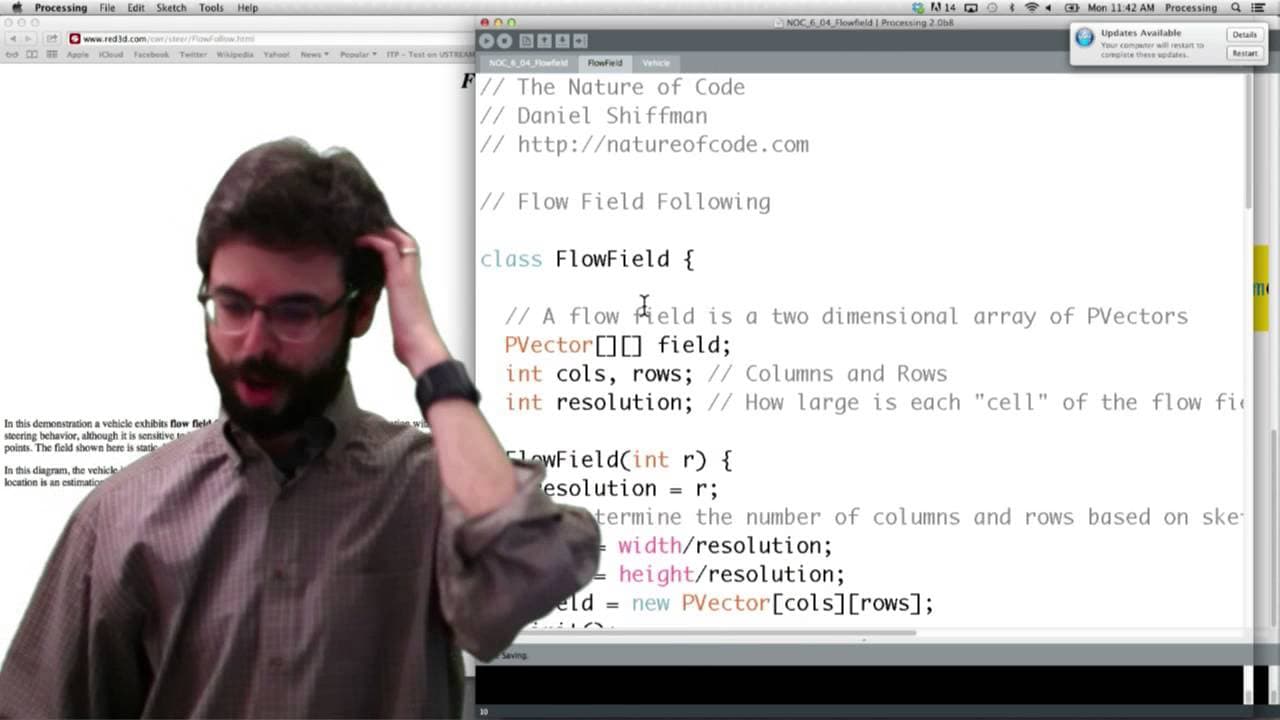
hi welcome today in this video we're going to look at flow field following and processing what is flow field following well it is one of Reynolds steering behaviors if you if you're watching videos before after that's where we are a whole lot of videos about steering behaviour and here we have from Reynolds website this is the example of flow field... Read More
Key Insights
- 💐 Flow field following involves creating a grid of vectors for vehicles to follow based on desired velocity.
- 😒 The implementation uses a two-dimensional array of vectors with resolution to scale down the field.
- 💐 Applications of flow field following include fluid system simulations, image contour analysis, and creative projects involving flow field behavior.
- ⚾ Experimenting with different vector angle calculations, such as random or Perlin noise-based, can produce various dynamic behaviors.
- 💐 Utilizing edge detection algorithms or mapping flow fields to images offers innovative possibilities for flow field applications.
- ⏳ Extending flow field following projects by animating the grid over time or incorporating three-dimensional Perlin noise can enhance the simulation's complexity.
- 💐 Considering unique approaches, like using depth data from Kinect sensors or projecting flow fields onto surfaces, can lead to novel and exciting flow field projects.
Install to Summarize YouTube Videos and Get Transcripts
Explore YouTube Video Summarizer or Get YouTube Transcript Extractor
Questions & Answers
Q: What is flow field following?
Flow field following is a technique where vehicles follow vectors in a grid based on desired velocity, enabling simulations with dynamic behavior.
Q: How is a flow field implemented in processing?
A flow field is represented by a two-dimensional array of vectors, with vehicles calculating steering forces based on desired velocity vectors from the field.
Q: What are some applications of flow field following?
Flow field following can be used to create fluid simulations, meandering paths, analyze image contours, and simulate flocking behavior with simple calculations.
Q: How can one extend flow field following applications?
By animating the flow field over time, implementing three-dimensional Perlin noise, or mapping flow fields to images, one can enhance the versatility and creativity of flow field following projects.
Summary & Key Takeaways
-
Flow field following involves creating a grid of vectors for vehicles to follow based on desired velocity.
-
The process includes calculating vectors for each cell in the grid and looking up the appropriate vector for vehicle steering.
-
Applications range from creating fluid systems to analyzing image contours with flowing vectors.
Read in Other Languages (beta)
Share This Summary 📚
Summarize YouTube Videos and Get Video Transcripts with 1-Click
Try YouTube Summary with ChatGPT & Claude or YouTube Transcript Generator
Explore More Summaries from The Coding Train 📚





Summarize YouTube Videos and Get Video Transcripts with 1-Click
Try YouTube Summary with ChatGPT & Claude or YouTube Transcript Generator