Low pass RC network | Examples | Pulse Digital Circuits | Lec-09
TL;DR
This video explains calculating and plotting output waveforms for varying frequencies in a low pass RC network.
Transcript
hi everyone in this video I am going to explain about one more important problem repeatedly ask the question and this type of questions generally come in the problem section of this low pass RC network in the previous video I have explained about the RC network Lopez RC network how it is acting as an integrator with the two simple problems but gene... Read More
Key Insights
- 🔡 Understanding the relationship between RC and input signal period is crucial for accurate waveform predictions in low pass RC networks.
- 🔠 The upper cutoff frequency defines how quickly the output waveform can respond to input signals, with higher frequencies facilitating quicker rise times.
- 😮 The calculation of the rise time is essential as it helps characterize the responsiveness of the network, which is vital in performance-critical applications.
- 🈂️ Exponential charging behavior indicates that the output waveform will not immediately reach its maximum, highlighting the gradual nature of capacitor charging in circuits.
- 💠 Assessing the output waveform shape involves not just numerical calculations but also qualitative understanding of circuit behavior under varying conditions.
- 🎁 The presented analysis and examples clarify the importance of RC values in determining behavior in practical electronics scenarios.
- ✋ Analyzing RC networks provides foundational knowledge beneficial for higher-level concepts, including more complex circuit designs and signal processing applications.
Install to Summarize YouTube Videos and Get Transcripts
Explore YouTube Video Summarizer or Get YouTube Transcript Extractor
Questions & Answers
Q: What is the primary focus of this video?
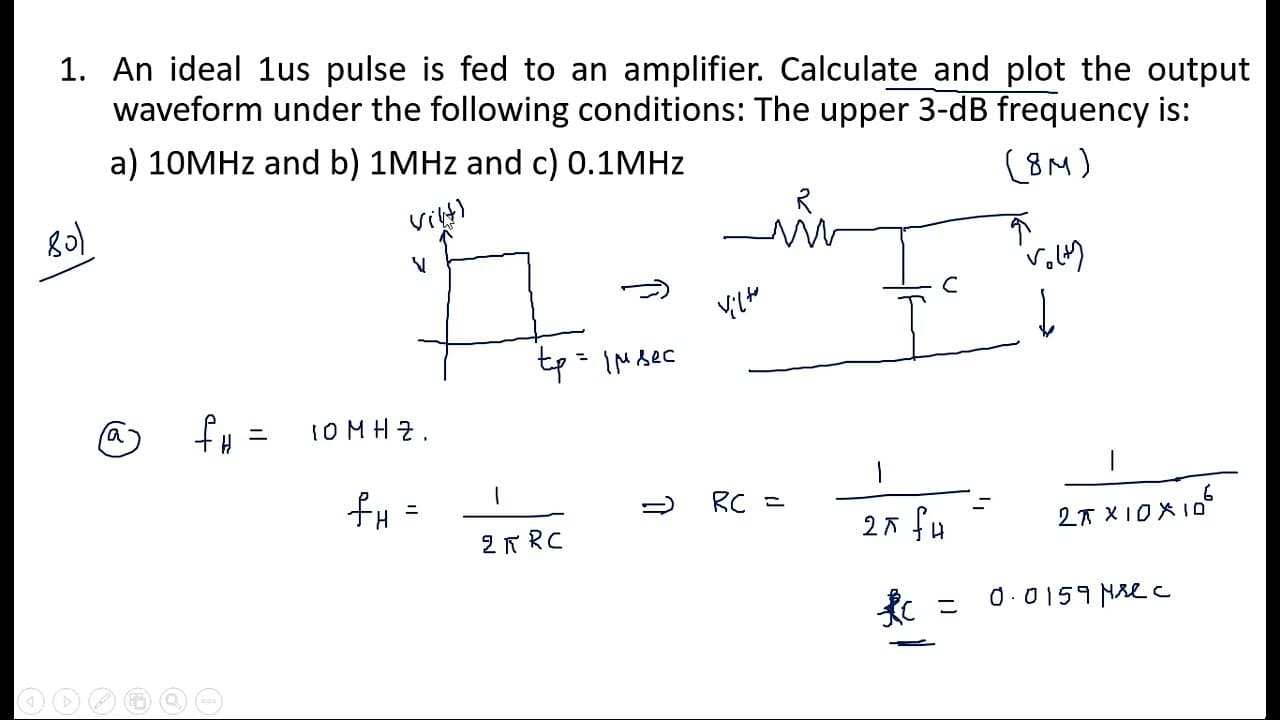
The primary focus of this video is to explain the analysis of low pass RC networks, specifically how to calculate and plot the output waveforms when subjected to different input frequencies and pulse durations.
Q: How does the upper cutoff frequency affect the output waveform?
The upper cutoff frequency significantly impacts the output waveform by determining the rise time and response characteristics of the circuit. A higher cutoff frequency results in a faster rise time, allowing the output to reach closer to the maximum voltage swiftly, while a lower cutoff frequency yields a slower rise time and lower peak output.
Q: Can you explain the role of the RC product in this analysis?
The RC product governs how quickly the capacitor charges and discharges in the circuit. It is crucial for determining the time constant and, therefore, influences the rise time of the output waveform. A smaller RC product indicates faster charging, leading to a waveform that quickly reaches its final value.
Q: How are the output voltages calculated at different time points?
The output voltage is calculated using the formula V_naught(T) = V * (1 - e^(-t/RC)). By substituting the time period (TP) and RC value into this equation, you can determine the output voltage at specific intervals, which reflects how the capacitor responds to the pulse input over time.
Q: What is the significance of rise time in the context of this video?
Rise time signifies the duration it takes for the output voltage to rise to a certain percentage of its maximum value. It is a critical parameter because it influences how quickly the output can respond to input changes, which is essential in high-speed applications where timely signal processing is required.
Q: How does the relationship between RC and TP influence the output waveform shape?
The relationship between the RC product and the period of the input signal (TP) dictates whether the capacitor charges rapidly or slowly. If RC is much smaller than TP, the output waveform rises quickly, while if RC is larger than TP, the output rises more gradually, affecting the shape of the waveform significantly.
Q: What is meant by the term "exponential signal" in this context?
An exponential signal refers to the characteristic charging curve of a capacitor in an RC circuit, where the voltage rises according to an exponential function. This behavior is observed as the capacitor charges toward the maximum voltage, contributing to the distinctive shape of the output waveform.
Q: How would multiple cycles of input affect the output waveform in this analysis?
The presence of multiple cycles in the input signal leads the RC circuit to integrate these cycles, resulting in a smoother output traditionally seen as a triangular waveform. The output continuously adjusts between charging and discharging states, shaping the resultant waveform based on the behavior of the input square waves.
Summary & Key Takeaways
-
The video discusses how to analyze and calculate the output waveform of a low pass RC network when subjected to an input pulse, emphasizing parameters such as cutoff frequency.
-
It provides detailed examples of different upper cutoff frequencies (10 MHz, 1 MHz, and 0.1 MHz) and how the network responds to each in terms of rise time and output voltage.
-
The presenter highlights the importance of understanding the relationship between RC product and input signal periods to predict the behavior of the circuit accurately.
Read in Other Languages (beta)
Share This Summary 📚
Summarize YouTube Videos and Get Video Transcripts with 1-Click
Try YouTube Summary with ChatGPT & Claude or YouTube Transcript Generator