What Is Cosmic Microwave Background Radiation?
TL;DR
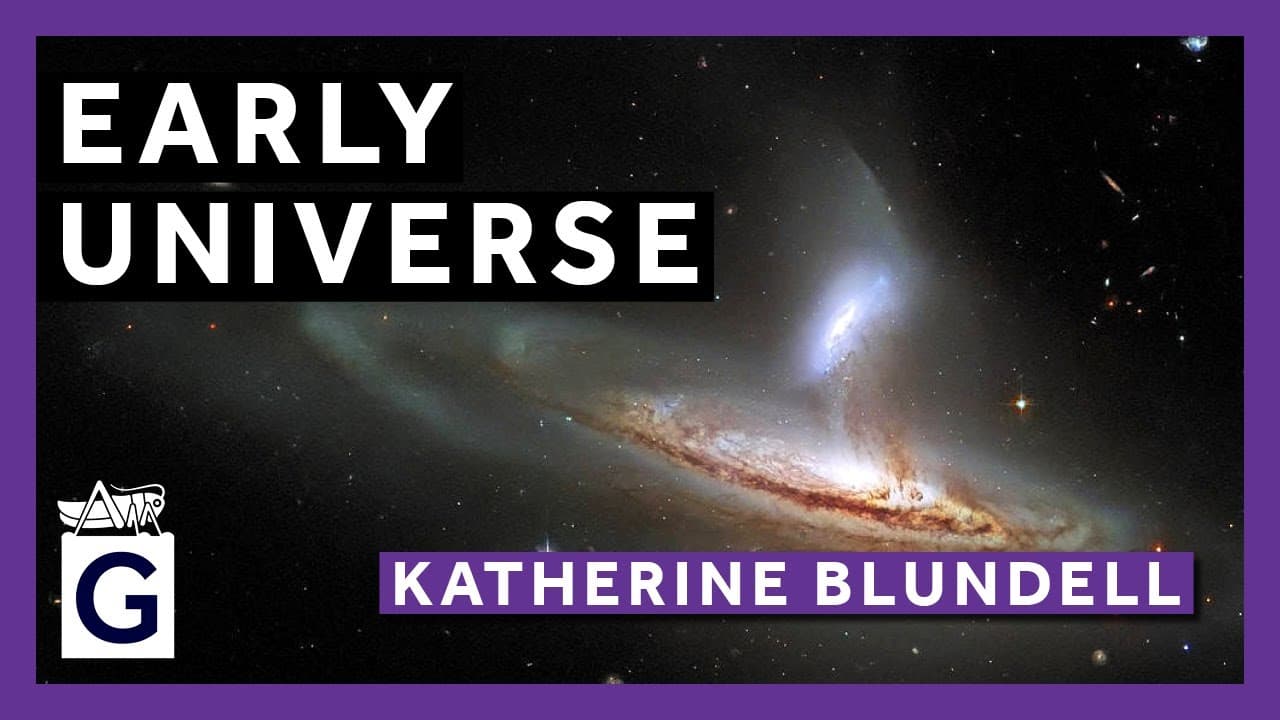
Cosmic microwave background radiation is the oldest observable light, emitted about 300,000 years after the Big Bang. It provides critical insights into the early universe's structure, evolution, and geometry, suggesting the universe is flat and expanding. Understanding this radiation helps to address key cosmological questions, including the horizon and flatness problems, which have sparked the theory of inflation.
Transcript
- Today's lecture is entitled the "Early Universe". I want us to consider what we can see, how you can see it and how we can use those observations and measurements to infer back to the beginning of our cosmos and how it evolved at some of the earliest times. So I want us to begin by considering the question, what are our horizons and how far back ... Read More
Key Insights
- 💁 Observations of background radiation provide valuable information about the early universe, its origins, and its evolution.
- 💡 The universe is expanding, and the receding motion of galaxies supports the idea of an expanding universe.
- 🫓 The size scales of variations in the cosmic microwave background radiation depend on the geometry of the universe, with a flat universe being the most likely.
- 🥺 The horizon problem and flatness problem led to the development of the inflation theory, which suggests a rapid period of expansion in the early universe to explain the observed homogeneity and flatness. Inflation is an active area of research.
Install to Summarize YouTube Videos and Get Transcripts
Explore YouTube Video Summarizer or Get YouTube Transcript Extractor
Questions & Answers
Q: How does studying the oldest things we can see within our horizon in the universe help us understand the earlier times?
By studying the oldest things we can observe, such as background radiation, we can gain information about the geological activity and the origins and evolution of the cosmos at earlier times. This allows us to infer how the universe has changed over billions of years.
Q: What is the cosmic microwave background radiation, and how do we detect it?
The cosmic microwave background radiation is leftover radiation from the hot plasma soup that formed galaxies and stars. It was emitted approximately 300,000 years after the Big Bang. To detect it, we need to use satellites or balloons above Earth's atmosphere, as the radiation can be absorbed by water molecules in the atmosphere.
Q: How does the temperature of the cosmic microwave background radiation provide insights into the early universe?
The temperature of the radiation corresponds to how hot the plasma soup was at the time it emitted the radiation. As the universe expanded and cooled down, the temperature of the radiation dropped. By measuring the temperature, we can understand the conditions and physical processes that occurred in the early universe.
Q: What does the spectrum of the cosmic microwave background radiation tell us about the early universe?
The spectrum, which corresponds to the intensity of the radiation at different wavelengths, has a very precise shape. It matches the thermal spectrum of a perfect black body, indicating that the early universe was in thermodynamic equilibrium. This provides important information about the origins and composition of the cosmos.
Summary & Key Takeaways
-
The lecture starts by discussing how our horizons and what we can see depend on our vantage point and the information we can detect, using a photograph of a sunset as an example.
-
The oldest thing that we can see in the universe is background radiation, which was emitted from the hot plasma that formed galaxies and stars.
-
The lecture explains that the cosmic microwave background radiation, emitted approximately 300,000 years after the Big Bang, is the oldest thing that we can study and provides insights into the early universe.
Read in Other Languages (beta)
Share This Summary 📚
Summarize YouTube Videos and Get Video Transcripts with 1-Click
Try YouTube Summary with ChatGPT & Claude or YouTube Transcript Generator
Explore More Summaries from Gresham College 📚

Summarize YouTube Videos and Get Video Transcripts with 1-Click
Try YouTube Summary with ChatGPT & Claude or YouTube Transcript Generator