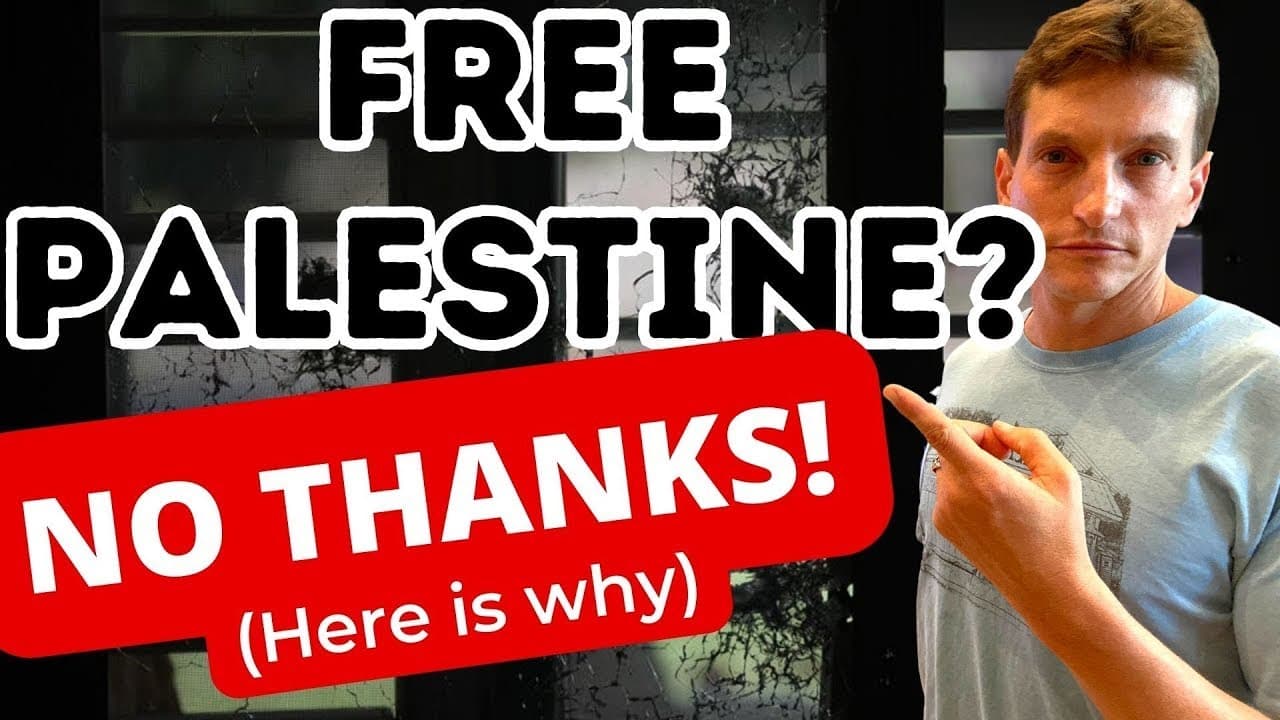
Free Palestine? No thanks! (The Israeli perspective) Français / Español / русский / Deutsch / عربي
TL;DR
This video tackles the Israeli-Palestinian conflict, providing a new perspective and inviting viewers to challenge prevailing narratives with facts and evidence.
Transcript
This video is going to be interesting. Even if you have heard a thousand different reports about the Israeli-Palestinian conflict, I promise you that this will give you a new perspective. I will be talking about the settlements, the occupation, the two-state solution, Islam, Jerusalem, the solution, and a whole lot more. Before I break down the P... Read More
Key Insights
- 🇵🇸 The Palestinian identity emerged in the 20th century, challenging the perception of a longstanding Palestinian presence.
- 🥹 Jerusalem holds religious significance for Jews, Christians, and Muslims, with historical evidence supporting Jewish ties to the city.
- 🧑🏭 The conflict is not solely rooted in land disputes, but also driven by religious and ideological factors.
- ✌️ Palestinians rejected peace offers and continue to prioritize the elimination of Israel over peaceful coexistence.
- 🖤 The Muslim world's lack of democracy and violations of human rights cannot be solely attributed to colonialism.
- 🤗 Successful societies prioritize education, open-mindedness, and non-violence, as exemplified by Israel's achievements.
- ✌️ Sustainable peace requires a transformation of values, including the acceptance of religious and ethnic diversity within the Middle East.
Install to Summarize YouTube Videos and Get Transcripts
Explore YouTube Video Summarizer or Get YouTube Transcript Extractor
Questions & Answers
Q: Is there historical evidence for the existence of a Palestinian people prior to the 20th century?
No, historical records do not mention a distinct Palestinian identity until the 1900s. The term "Palestinian" was used to differentiate Jews from Arabs and was not associated with a specific ethnic group.
Q: Did Jews forcibly take land from Arabs?
No evidence supports the claim that Jews stole land from Arabs. In fact, prior to 1948, Jewish immigrants legally acquired land and developed it, often in areas deemed undesirable by Arab settlers.
Q: Why did Palestinians reject peace offers?
The Palestinians rejected peace offers because their leadership, as exemplified by the PLO, sought to eliminate Israel rather than coexist peacefully. The rejectionist stance persists, hindering the prospects of a lasting solution.
Q: How does religion play a role in the conflict?
Religion is a significant factor, as it influences the motivations and actions of various groups. The video highlights the religious connections of Jews, Christians, and Muslims to the land of Israel and the religiously-driven goals of certain Palestinian factions.
Key Insights:
- The Palestinian identity emerged in the 20th century, challenging the perception of a longstanding Palestinian presence.
- Jerusalem holds religious significance for Jews, Christians, and Muslims, with historical evidence supporting Jewish ties to the city.
- The conflict is not solely rooted in land disputes, but also driven by religious and ideological factors.
- Palestinians rejected peace offers and continue to prioritize the elimination of Israel over peaceful coexistence.
- The Muslim world's lack of democracy and violations of human rights cannot be solely attributed to colonialism.
- Successful societies prioritize education, open-mindedness, and non-violence, as exemplified by Israel's achievements.
- Sustainable peace requires a transformation of values, including the acceptance of religious and ethnic diversity within the Middle East.
Please note that the analysis provided is based on the content summarized and may not fully reflect the complexities of the Israeli-Palestinian conflict.
Summary & Key Takeaways
-
The video challenges the common narrative that the Palestinians have been living in Palestine for centuries, highlighting the absence of a Palestinian people until the 20th century.
-
It discusses the religious and historical connections of Jews, Christians, and Muslims to the land of Israel, emphasizing the Jewish connection dating back thousands of years.
-
The content addresses the challenges in the Israeli-Palestinian conflict, including the rejection of peace offers by the Palestinians and the religious and ideological motivations of certain groups.
Read in Other Languages (beta)
Share This Summary 📚
Summarize YouTube Videos and Get Video Transcripts with 1-Click
Try YouTube Summary with ChatGPT & Claude or YouTube Transcript Generator
Explore More Summaries from travelingisrael.com 📚



Summarize YouTube Videos and Get Video Transcripts with 1-Click
Try YouTube Summary with ChatGPT & Claude or YouTube Transcript Generator