How Do Submarines Surface in the Arctic Ice?
TL;DR
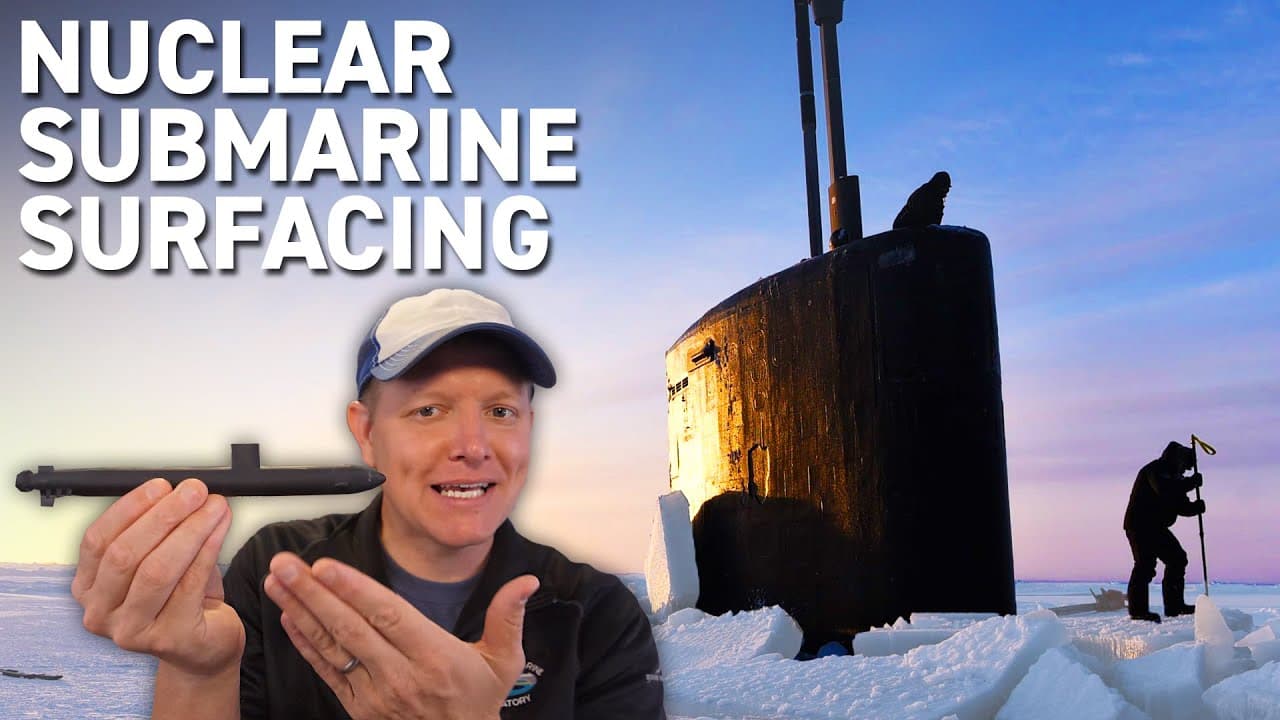
Submarines surface in Arctic ice by using precise control of dive planes and ballast tanks to adjust buoyancy and navigate through ice thickness. They must find specific spots with thinner ice and account for ocean currents, making the surfacing process complex and critical to avoid damage. Accurate calculations and teamwork are essential for a successful surfacing operation.
Transcript
- [Man] Seven zero, six up, point four up, Standby for impact! - Welcome back to Smarter Every Day. I've made a really long journey to an ice floe in the Arctic Ocean to board the USS Toledo, a U.S.. Navy fast attack nuclear submarine, which has punched its way up through the ice. Today we're gonna learn how to actually control a sub underwater, an... Read More
Key Insights
- ✈️ Controlling a submarine underwater involves complex calculations and precise adjustments using dive planes and ballast tanks.
- 🤔 Surfacing a submarine in the Arctic requires finding thinner ice and careful positioning to avoid damage.
- ✋ Submarines can reach deep depths under high pressures by adjusting the balance between their dive planes, ballast tanks, and external forces.
- 💦 Hovering a submarine at a specific depth requires continuous adjustments due to changing water salinity.
- 🥶 Punching through ice requires accurate positioning, considering ice thickness and ocean currents.
- ℹ️ Submarines rely on advanced instruments or external information sources to determine where to surface in the ice.
- 🎮 The coordination and precision involved in controlling a submarine highlight the challenging and dangerous nature of operating in underwater environments.
Install to Summarize YouTube Videos and Get Transcripts
Explore YouTube Video Summarizer or Get YouTube Transcript Extractor
Questions & Answers
Q: How do dive planes and ballast tanks work together to control a submarine's depth?
Dive planes, similar to airplane wings, provide upward and downward force to the submarine when in motion. Ballast tanks are used to adjust buoyancy by adding or releasing water, which affects the submarine's overall weight and ability to control depth.
Q: What are the challenges of surfacing a submarine in the Arctic?
Surfacing in the Arctic requires finding a spot with thinner or younger ice to punch through. The submarine needs to be positioned accurately, considering ocean currents and ice thickness. Additionally, the ship's sails and other parts need to avoid ice damage during surfacing.
Q: How do submarines determine where to punch through the ice?
While specific details were not revealed, submarines likely rely on advanced instruments or communication with external sources to identify areas with thinner ice for surfacing. Escape routes and contingencies are also considered.
Q: How do submarines control their depth when not in motion?
To remain stationary at a specific depth, submarines adjust the buoyancy of the boat using the ballast tanks. By adding or releasing air or water, they can achieve neutral buoyancy and maintain depth without relying on motion.
Summary & Key Takeaways
-
Smarter Every Day embarks on a journey to explore a nuclear submarine, starting from dropping down through the ice and beginning the underwater journey.
-
The process of controlling a submarine underwater is complex, involving the use of dive planes and ballast tanks to adjust buoyancy and maintain depth.
-
Surfacing the submarine in the Arctic requires precise calculations and careful control to avoid damaging the sub in thick ice.
Read in Other Languages (beta)
Share This Summary 📚
Summarize YouTube Videos and Get Video Transcripts with 1-Click
Try YouTube Summary with ChatGPT & Claude or YouTube Transcript Generator
Explore More Summaries from SmarterEveryDay 📚





Summarize YouTube Videos and Get Video Transcripts with 1-Click
Try YouTube Summary with ChatGPT & Claude or YouTube Transcript Generator