Talks S2E3 (Merve Noyan): BYOB - Build Your Own Bot
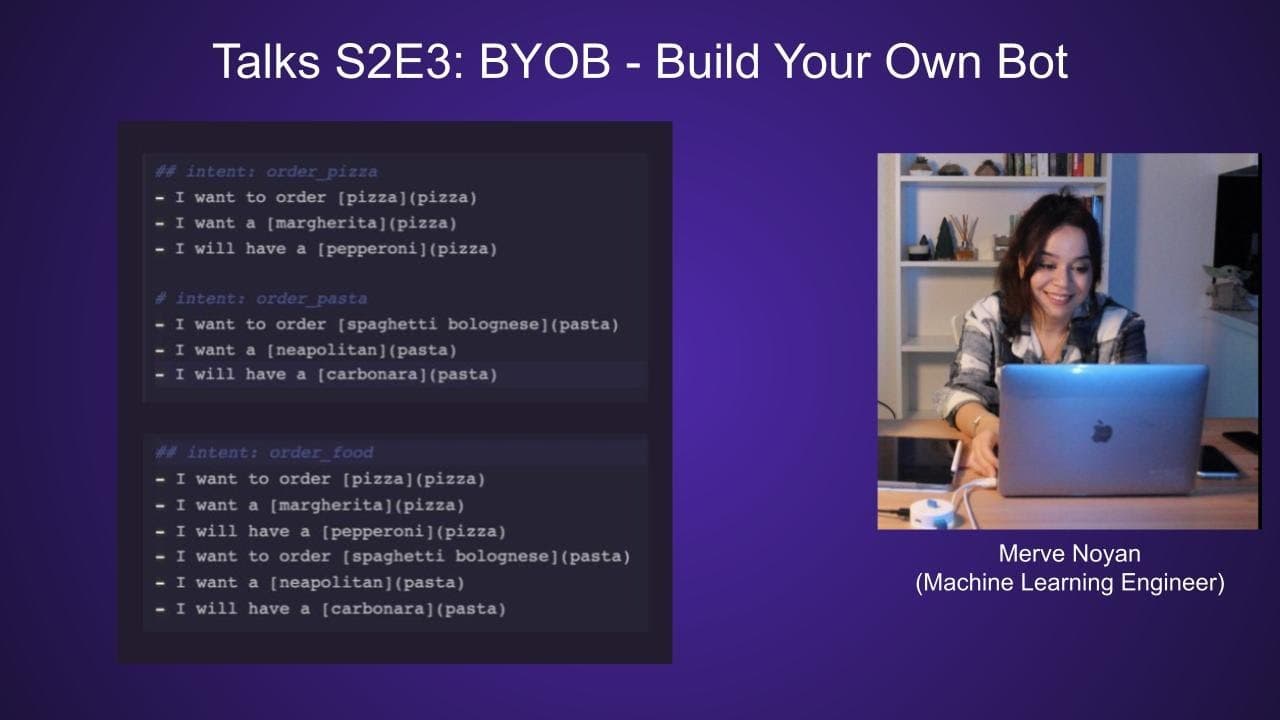
TL;DR
Learn about conversational AI and chatbots, their different levels of complexity, and best practices for building them.
Transcript
hello everyone and welcome to talks number three today we have with the smurf he's from turkey and works for i am why i am which was very difficult for me to pronounce but and she working in conversational ai for a long time now and today she's going to talk about conversational ai chatbots and by the end of the talk we will be able to build our ow... Read More
Key Insights
- 😯 Conversational AI encompasses a wide range of technologies, including chatbots, speech assistants, and more.
- 🎚️ Chatbots can be narrow domain or general, with different levels of interaction and personalization.
- 💁 Intent recognition and entity recognition are essential tasks in chatbot development, involving understanding user intentions and extracting valuable information.
- 👤 Fallback mechanisms and handling negations are crucial for improving chatbot performance and user experience.
- 🗯️ Choosing the right framework, such as Rasa or Dialogflow, depends on factors like project requirements, target audience, and available resources.
- ❓ Training data, including datasets for intent and entity recognition, should be carefully curated and augmented to improve model performance.
- 🖐️ Considerations like pronouns, stop words, and negations play a significant role in developing accurate and context-aware chatbots.
- 🧑💻 Balancing user privacy concerns, logging data, and providing transparency are essential for ethical chatbot development.
Install to Summarize YouTube Videos and Get Transcripts
Explore YouTube Video Summarizer or Get YouTube Transcript Extractor
Questions & Answers
Q: What is the difference between conversational AI and chatbots?
Conversational AI is a broad domain of technologies that enable human-like interactions between computers and humans, including speech-enabled applications. Chatbots are a subdomain of conversational AI that focus on automated messaging and text-based interactions.
Q: How do intent recognition and entity recognition work in chatbots?
Intent recognition involves understanding the intention or purpose behind a user's message, while entity recognition involves identifying specific pieces of information, such as names, dates, or locations, within that message. Both are crucial for providing accurate and personalized responses.
Q: Can you explain the concept of fallback in chatbots?
Fallback refers to a scenario where the chatbot cannot understand or respond to a user's message with enough confidence. In such cases, the chatbot can ask the user to rephrase the question, seek clarification, or even redirect the user to a human agent for assistance.
Q: Is it necessary to use generative models in chatbots?
While generative models can be powerful, they also pose risks in terms of biased or inappropriate responses. It is recommended to use a combination of intent classification models and predefined responses to ensure better control and accuracy in chatbot interactions.
Summary & Key Takeaways
-
The speaker, a chatbot expert, introduces the topic of conversational AI and chatbots, and shares their experience working in this field.
-
They explain the difference between narrow domain chatbots, like those used for automated tasks, and more general chatbots that aim to mimic human conversation.
-
Key concepts discussed include intent recognition, entity recognition, slot filling, and named entity recognition.
-
The speaker emphasizes the importance of defining intents and entities, handling fallbacks, and using machine learning models to improve the chatbot's performance.
Read in Other Languages (beta)
Share This Summary 📚
Summarize YouTube Videos and Get Video Transcripts with 1-Click
Try YouTube Summary with ChatGPT & Claude or YouTube Transcript Generator
Explore More Summaries from Abhishek Thakur 📚
Summarize YouTube Videos and Get Video Transcripts with 1-Click
Try YouTube Summary with ChatGPT & Claude or YouTube Transcript Generator