Products
Features
YouTube Video Summarizer
Summarize YouTube videos
Web & PDF Highlighter
Highlight web pages & PDFs
Chat with PDF
Ask any PDF questions with AI
Ask AI Clone
Chat with your highlights & memories
Audio Transcriber
Transcribe audio files to text
Glasp Reader
Read and highlight articles
Kindle Highlight Export
Export your Kindle highlights
Idea Hatch
Hatch ideas from your highlights
Integrations
Obsidian Plugin
Notion Integration
Pocket Integration
Instapaper Integration
Medium Integration
Readwise Integration
Snipd Integration
Hypothesis Integration
Apps & Extensions
Chrome Extension
Safari Extension
Edge Add-ons
Firefox Add-ons
iOS App
Android App
Discover
Discover
Ideas
Discover new ideas and insights
Articles
Curated articles and insights
Books
Book recommendations by great minds
Posts
Essays and notes from readers
Quotes
Inspiring quotes collection
Videos
Curated videos and summaries
Explore Glasp
Glasp Newsletter
Weekly insights and updates
Glasp Talk
Interview series with great minds
Glasp Blog
Latest news and articles
Glasp Use Cases
Learn how others use Glasp
Build & Support
Glasp API
Access Glasp's API for developers
MCP Connector
Connect Glasp to Claude & ChatGPT
Community
Glasp Reddit Community
Students
Student discount and benefits
FAQs
Frequently Asked Questions
AboutPricing
DashboardLog inSign up

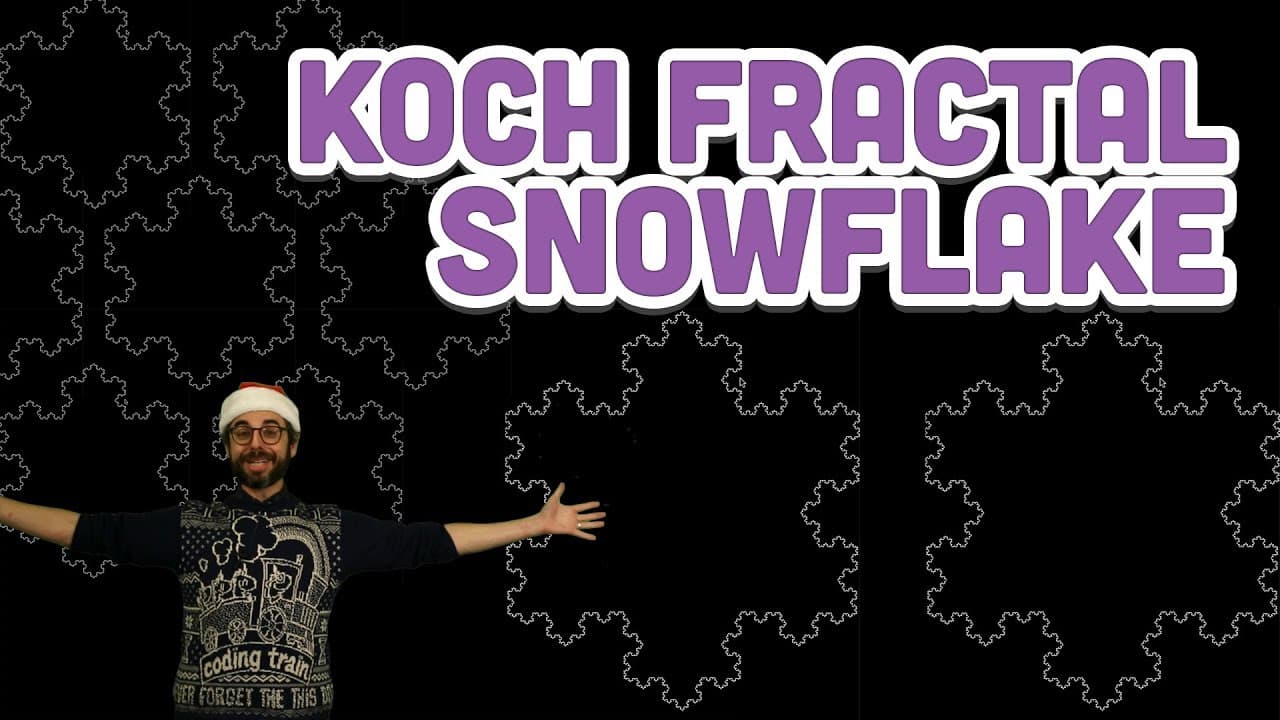
Coding Challenge #129: Koch Fractal Snowflake
55.0K views
•
December 30, 2018
by
The Coding Train
YouTube video player
Coding Challenge #129: Koch Fractal Snowflake

TL;DR

Learn to create a Koch snowflake using recursion in processing.

Transcript

(bell rings) - Yes! It's another snowflake coding challenge. This is my third holiday snowflake challenge, and in this one I'm going to, once again, make an algorithmic snowflake and I'm going to render in processing of the Koch snowflake, otherwise known as the Koch curve, Koch star, Koch island. It's a mathematical curve and one of the earliest f... Read More

Key Insights

  • 🫥 The Koch snowflake is a mathematical curve created by recursively dividing line segments and forming equilateral triangles.
  • 🤳 The curve's self-similarity and infinite complexity pose intriguing mathematical challenges and paradoxes.
  • 🤑 The algorithmic creation of the Koch snowflake involves implementing recursive functions to generate new segments from existing ones.

Install to Summarize YouTube Videos and Get Transcripts

Explore YouTube Video Summarizer or Get YouTube Transcript Extractor

Questions & Answers

Q: What is the Koch snowflake and how is it created?

The Koch snowflake is a fractal curve created by recursively dividing line segments into thirds, erasing the middle section, and rendering equilateral triangles along the segments.

Q: What is the significance of the mathematical properties of the Koch snowflake?

The Koch snowflake exhibits infinite length within a finite space, showcasing mathematical paradoxes related to its self-similarity and fractal nature.

Q: How can the Koch snowflake generation be automated in the programming environment?

By implementing recursive functions to generate new segments from existing ones, the Koch snowflake can be created algorithmically in processing.

Q: What are some variations and possibilities for exploring the Koch snowflake further?

Variations like color, animation, and multiple snowflakes can be explored, and submissions can be made to codingarray.com for sharing and showcasing different interpretations of the snowflake.

Summary & Key Takeaways

  • The video demonstrates creating a Koch snowflake by recursively dividing line segments and forming equilateral triangles.

  • The mathematical curve known as the Koch snowflake is made by applying a recursive pattern.

  • The process involves dividing lines into thirds, erasing the middle section, and rendering equilateral triangles to create the snowflake shape.


Read in Other Languages (beta)

English

Share This Summary 📚

Summarize YouTube Videos and Get Video Transcripts with 1-Click

Download browser extensions on:

Try YouTube Summary with ChatGPT & Claude or YouTube Transcript Generator

Explore More Summaries from The Coding Train 📚
8.1: Fractals - The Nature of Code thumbnail
8.1: Fractals - The Nature of Code
The Coding Train
9.4: Genetic Algorithm: Looking at Code - The Nature of Code thumbnail
9.4: Genetic Algorithm: Looking at Code - The Nature of Code
The Coding Train
Classifying Poses with ml5.js Part 2 thumbnail
Classifying Poses with ml5.js Part 2
The Coding Train
Computer Mouse Conference Demos! (node.js + tensorflow.js) thumbnail
Computer Mouse Conference Demos! (node.js + tensorflow.js)
The Coding Train
Text Generation using Spell with Nabil Hassein thumbnail
Text Generation using Spell with Nabil Hassein
The Coding Train
Coding Challenge #126: Toothpicks thumbnail
Coding Challenge #126: Toothpicks
The Coding Train

Summarize YouTube Videos and Get Video Transcripts with 1-Click

Download browser extensions on:

Try YouTube Summary with ChatGPT & Claude or YouTube Transcript Generator

Apps & Extensions

  • Chrome Extension
  • Safari Extension
  • Edge Add-ons
  • Firefox Add-ons
  • iOS App
  • Android App

Key Features

  • YouTube Video Summarizer
  • Web & PDF Summarizer
  • Web & PDF Highlighter
  • Chat with PDF
  • Ask AI Clone
  • Audio Transcriber
  • Glasp Reader
  • Kindle Highlight Export
  • Idea Hatch

Integrations

  • Obsidian Plugin
  • Notion Integration
  • Pocket Integration
  • Instapaper Integration
  • Medium Integration
  • Readwise Integration
  • Snipd Integration
  • Hypothesis Integration

More Features

  • APIs
  • MCP Connector
  • Blog & Post
  • Embed Links
  • Image Highlight
  • Personality Test
  • Quote Shots

Company

  • About us
  • Blog
  • Community
  • FAQs
  • Job Board
  • Newsletter
  • Pricing
Terms

•

Privacy

•

Guidelines

© 2026 Glasp Inc. All rights reserved.