Test for Goodness of Fit - Problem 4 - Chi- Square Test - Engineering Mathematics - 4
TL;DR
This video demonstrates how to fit a binomial distribution and check the goodness of fit using a chi-square test.
Transcript
hello friends in this video we'll be discussing one more example on chi-square a test test for goodness of it and this is a fourth example friends in the first two examples we found out expected frequency by taking average in the third example we found out expected frequency in the ratio nine is to 3 is to 3 is to 1 now we will see this particular ... Read More
Key Insights
- ⌛ The problem involves fitting a binomial distribution to data obtained from tossing seven coins 128 times.
- 🪙 The null hypothesis assumes that the data follows a binomial distribution, given an unbiased coin.
- 🤏 The chi-square test is used to assess the goodness of fit between observed and expected frequencies.
- ❎ The chi-square statistic is calculated by comparing the squared differences between observed and expected frequencies, divided by expected frequencies.
- 🤏 If the calculated chi-square value exceeds the critical value at a certain level of significance, the null hypothesis is rejected.
- 🪙 In this particular problem, the data did not follow a binomial distribution, indicating that the coin may be biased.
- 🤏 The steps to perform the chi-square test and calculate expected frequencies are outlined in detail.
Install to Summarize YouTube Videos and Get Transcripts
Explore YouTube Video Summarizer or Get YouTube Transcript Extractor
Questions & Answers
Q: What is the purpose of fitting a binomial distribution to the data?
By fitting a binomial distribution, we can determine if the observed data follows the expected distribution for a unbiased coin.
Q: How is the null hypothesis defined in this problem?
The null hypothesis states that the data follows a binomial distribution, assuming the coin is unbiased.
Q: How do we calculate the expected frequency for each number of heads?
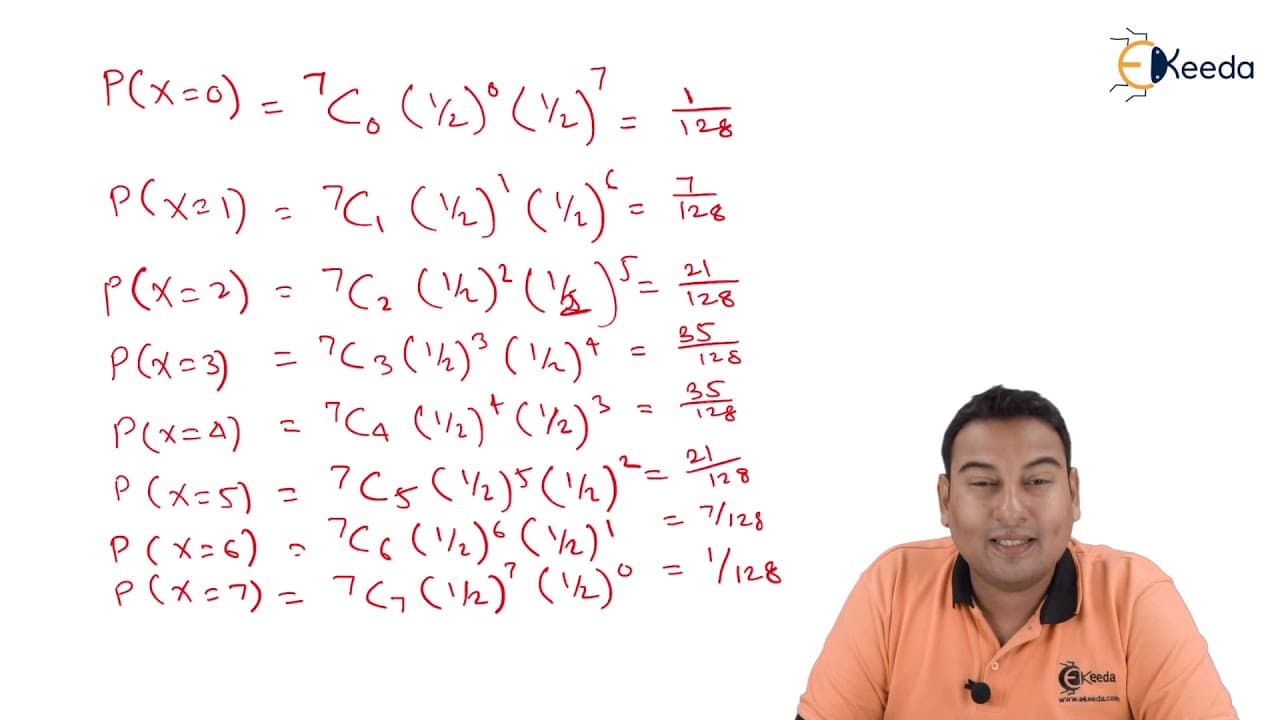
The expected frequency is determined by multiplying the total number of trials (128) by the probability of getting a specific number of heads, obtained from the binomial distribution.
Q: What is the significance of the chi-square test in this problem?
The chi-square test allows us to compare the observed frequencies with the expected frequencies from the binomial distribution. If the calculated chi-square value exceeds the critical value, we reject the null hypothesis.
Summary & Key Takeaways
-
The problem involves tossing seven coins and noting the number of heads obtained, repeated 128 times.
-
The objective is to fit a binomial distribution to the data and assess whether the coin is unbiased.
-
The video explains the steps to calculate expected frequencies using binomial distribution and perform a chi-square test for goodness of fit.
Read in Other Languages (beta)
Share This Summary 📚
Summarize YouTube Videos and Get Video Transcripts with 1-Click
Try YouTube Summary with ChatGPT & Claude or YouTube Transcript Generator
Explore More Summaries from Ekeeda 📚






Summarize YouTube Videos and Get Video Transcripts with 1-Click
Try YouTube Summary with ChatGPT & Claude or YouTube Transcript Generator