Teaching Robots to Walk with Proximal Policy Optimization (PPO) | Reinforcement Learning for Robots
TL;DR
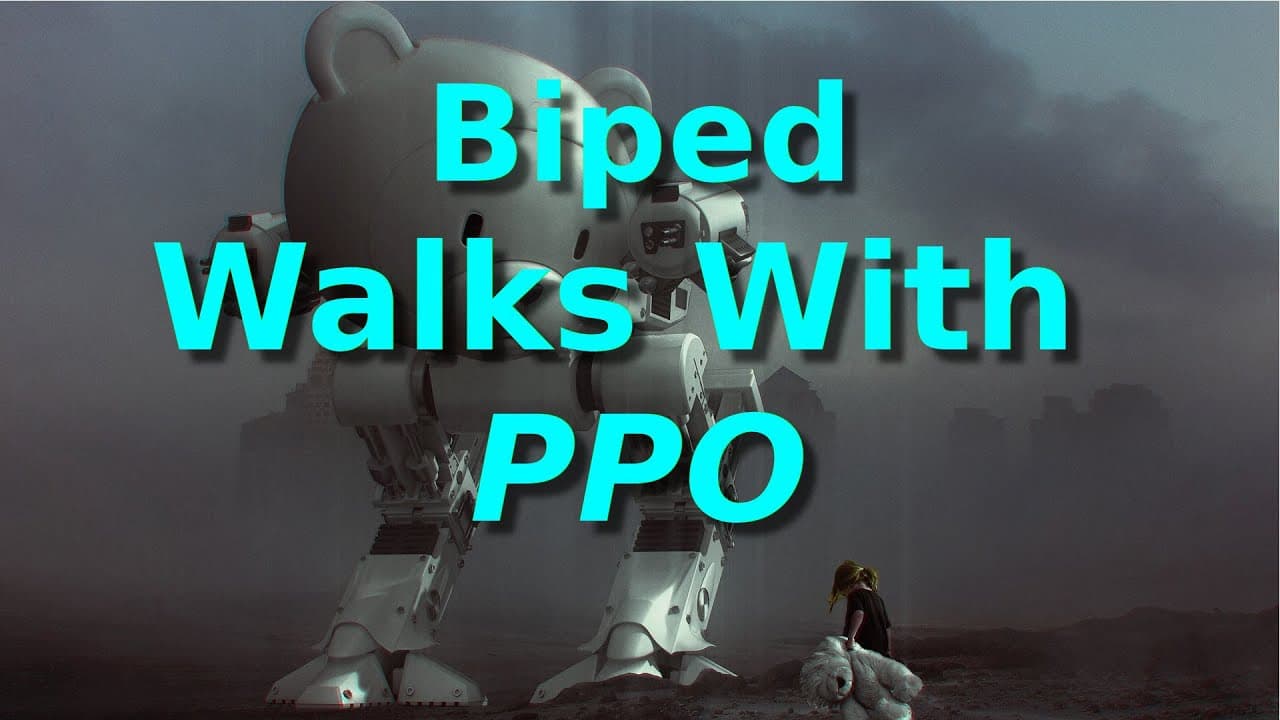
Researchers have developed a novel approach using reinforcement learning to teach a bipedal robot how to walk, allowing it to recover from perturbations, handle different terrains, and exhibit a wide range of motions.
Transcript
you know we take walking for granted but the reality is that it's a difficult act of controlled falling your heel strikes the floor you actuate your foot to the flat position and then roll the toes all the while your brain is processing information about how much traction your feet have how much pressure you're applying and what angle your foot is ... Read More
Key Insights
- 🚶 Teaching robots to walk is a difficult task due to the complexity of factors involved in walking.
- 😒 Bipedal robots that have been commercially successful do not use artificial intelligence.
- 🤖 Reinforcement learning, specifically proximal policy optimization, can be used to teach a robot to walk.
- 👻 The new approach allows the robot to recover from perturbations and handle different terrains.
- 🧡 The learned policies can generate a wide range of motions beyond the reference library.
- 🌍 Domain randomization is used to simulate uncertainty and improve robustness in real-world scenarios.
- 🖐️ The reward system design plays a critical role in reinforcement learning.
Install to Summarize YouTube Videos and Get Transcripts
Explore YouTube Video Summarizer or Get YouTube Transcript Extractor
Questions & Answers
Q: Why is teaching robots how to walk such a difficult task?
Walking involves controlled falling, with various factors such as traction, pressure, and foot angle needing to be considered. A slight mistake can lead to a fall.
Q: What approach did the researchers at Berkeley use to teach the robot to walk?
They used reinforcement learning, specifically proximal policy optimization, to imitate gates from a reference library, and trained the robot in simulated environments with randomized parameters.
Q: How does the robot handle perturbations and different terrains?
The robot's learned policies allow it to recover from perturbations like poking or failing motors. It can also handle transitions between different terrains with varying coefficients of friction.
Q: What are the advantages of the new approach compared to previous methods?
The new approach allows the robot to exhibit diverse motions beyond the reference library and provides robustness against perturbations and motor failures.
Summary & Key Takeaways
-
Teaching robots to walk is a challenging task that researchers have been working on for years.
-
Most commercially successful bipedal robots do not use artificial intelligence or machine learning.
-
A team at Berkeley applied reinforcement learning to teach a robot, using a reference gate library and domain randomization, resulting in an impressive and robust walking behavior.
Read in Other Languages (beta)
Share This Summary 📚
Summarize YouTube Videos and Get Video Transcripts with 1-Click
Try YouTube Summary with ChatGPT & Claude or YouTube Transcript Generator
Explore More Summaries from Machine Learning with Phil 📚



Summarize YouTube Videos and Get Video Transcripts with 1-Click
Try YouTube Summary with ChatGPT & Claude or YouTube Transcript Generator