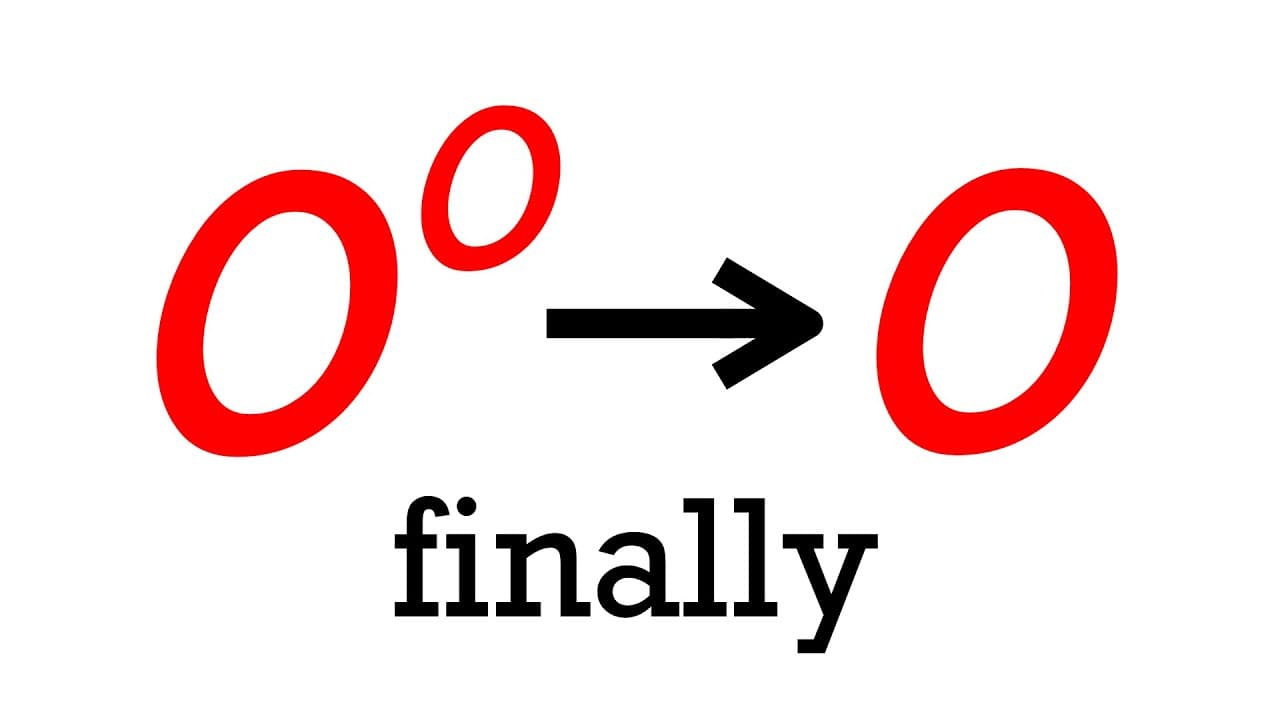
finally 0^0 approaches 0 after 6 years!
TL;DR
This analysis provides a comprehensive example of a limit with the indeterminate form zero to the power of zero, showing that it approaches zero.
Transcript
some of you guys may not like this example because we use the zero for the base already so it's kind of like cheating this is the video that I really really wanted to make since 2017 today I will give you guys a legitimate example of a limit with the indeterminate form Z to the Zero's power and the answer is zero I finally came with an exa... Read More
Key Insights
- ✊ The limit of zero raised to the power of zero is an indeterminate form that requires careful analysis.
- 0️⃣ Manipulating the expression and applying L'Hopital's rule can be used to evaluate limits involving zero to the power of zero.
- ⚾ The choice of the base and exponent in the example ensures that the limit approaches zero.
- 🥡 By taking the natural logarithm and applying L'Hopital's rule, the limit is determined to be zero.
- 0️⃣ ln(ln(x)) serves as a larger zero in the exponent, leading to a limit of zero.
- ⛔ The example demonstrates the versatility of limits and the importance of thorough analysis.
- 👻 L'Hopital's rule simplifies complex functions and allows for the evaluation of indeterminate forms.
Install to Summarize YouTube Videos and Get Transcripts
Explore YouTube Video Summarizer or Get YouTube Transcript Extractor
Questions & Answers
Q: What is the indeterminate form zero to the power of zero?
The zero to the power of zero is an indeterminate form that does not have a unique value. It requires further analysis to determine its limit.
Q: How is L'Hopital's rule applied in this example?
L'Hopital's rule allows us to find the limit of a function by taking the derivative of the numerator and denominator separately, which helps simplify the expression and evaluate the limit.
Q: What is the significance of using ln(ln(x)) as the exponent?
The choice of ln(ln(x)) as the exponent ensures that the limit approaches zero. ln(ln(x)) is an increasing function that grows slower than ln(x) or x^p, which leads to a larger zero in the exponent.
Q: Why is it important to verify the result using L'Hopital's rule?
Verifying the result using L'Hopital's rule ensures that the obtained limit is accurate. It provides a rigorous mathematical approach to confirm the solution obtained through manipulation.
Summary & Key Takeaways
-
The content explains how to find the limit of the function (square root of x + 1 - square root of x) / (ln(ln(x))) as x approaches infinity.
-
By manipulating the function and applying L'Hopital's rule, it is determined that the limit is equal to zero.
-
The example demonstrates that the limit of zero raised to the power of zero is equal to zero.
Read in Other Languages (beta)
Share This Summary 📚
Summarize YouTube Videos and Get Video Transcripts with 1-Click
Try YouTube Summary with ChatGPT & Claude or YouTube Transcript Generator
Explore More Summaries from blackpenredpen 📚
Summarize YouTube Videos and Get Video Transcripts with 1-Click
Try YouTube Summary with ChatGPT & Claude or YouTube Transcript Generator