L0.4 Introduction to Nuclear and Particle Physics: Literature
TL;DR
The professor discusses a sequence of textbooks and reading materials used in the class, covering topics such as high energy physics, nuclear physics, and elementary particles.
Transcript
PROFESSOR: Hello, welcome again to 8701. In this short video, I'll talk about the books we are using and the literature we are using in this class. So let's dive right into. There's a sequence of textbooks I go back to when I prepare the material for the class. You know, the one which I use in order to derive the outline or the schedule for the cla... Read More
Key Insights
- 🏛️ Introduction to High Energy Physics by Perkins is the main textbook used in the class.
- 📔 Nuclear physics is covered using Samuel Wong's book on Introductory Nuclear Physics and Kenneth Krane's book.
- 🏛️ Griffiths' Introduction to Elementary Particles is a liked book that provides examples for the class.
- 👷 Techniques for Nuclear and Particle Physics by Leo delves into important technical details of detector construction.
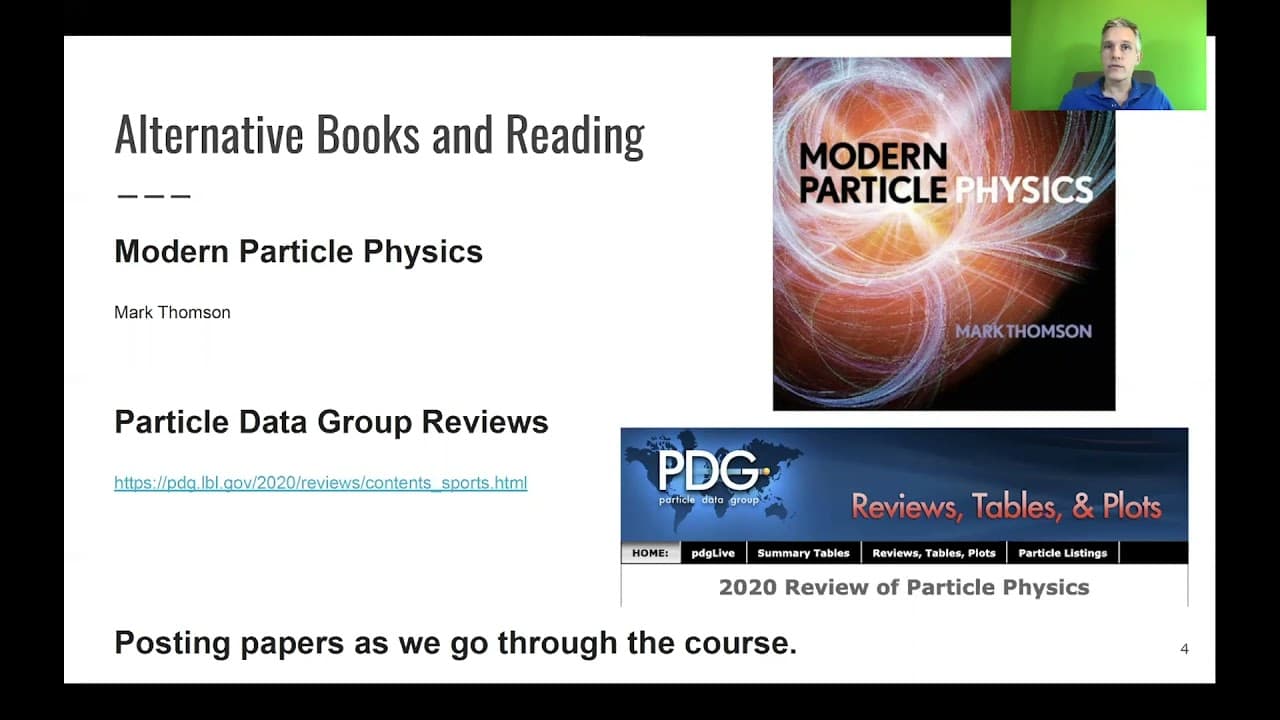
- 📔 A more recent book, Modern Particle Physics by Mark Thomson, offers a comprehensive overview of particle physics at the energy frontier.
- 👨🏫 The professor recommends using review articles by the particle data group to review specific topics in the class.
- 🏮 Students will be asked to summarize important papers in the recitation section, including papers on parity violation and the Higgs discovery.
Install to Summarize YouTube Videos and Get Transcripts
Explore YouTube Video Summarizer or Get YouTube Transcript Extractor
Questions & Answers
Q: What is the main textbook used in the class?
The main textbook used in the class is Introduction to High Energy Physics by Perkins. It serves as the basis for deriving the class outline and schedule.
Q: Are there any additional readings on nuclear physics?
Yes, alongside Perkins, the professor recommends Samuel Wong's book on Introductory Nuclear Physics and Kenneth Krane's book, which was put together by MIT faculty and research scientists.
Q: Which book provides examples used by the professor?
The professor utilizes examples from Introduction to Elementary Particles by Griffiths. This book covers introductory material in the sequence.
Q: Is there a recommended book for understanding detector construction?
Techniques for Nuclear and Particle Physics by Leo is recommended for understanding the technical details and material involved in building detectors.
Summary & Key Takeaways
-
The professor uses Introduction to High Energy Physics by Perkins as the main textbook for the class.
-
Additional readings include books on nuclear physics by Samuel Wong and Kenneth Krane, as well as Introduction to Elementary Particles by Griffiths.
-
Techniques for Nuclear and Particle Physics by Leo provides technical details on building detectors, while Modern Particle Physics by Mark Thomson focuses on particle physics at the energy frontier.
Read in Other Languages (beta)
Share This Summary 📚
Summarize YouTube Videos and Get Video Transcripts with 1-Click
Try YouTube Summary with ChatGPT & Claude or YouTube Transcript Generator
Explore More Summaries from MIT OpenCourseWare 📚



Summarize YouTube Videos and Get Video Transcripts with 1-Click
Try YouTube Summary with ChatGPT & Claude or YouTube Transcript Generator