LoRA (Low-rank Adaption of AI Large Language Models) for fine-tuning LLM models
TL;DR
LoRA offers efficient fine-tuning for large language models using low-rank adaptation.
Transcript
a custom model for our application we start with a pre-trained language model and fine-tune it on our own data set this used to be fine until we reached the large language model regime and started working with models such as GPT llama vuna Etc now these llms are quite bulky and so F tuning a model for different applications such as summarization or... Read More
Key Insights
- LoRA provides a solution for fine-tuning large language models without the need to deploy the entire bulky model for each application, thus reducing computational demands.
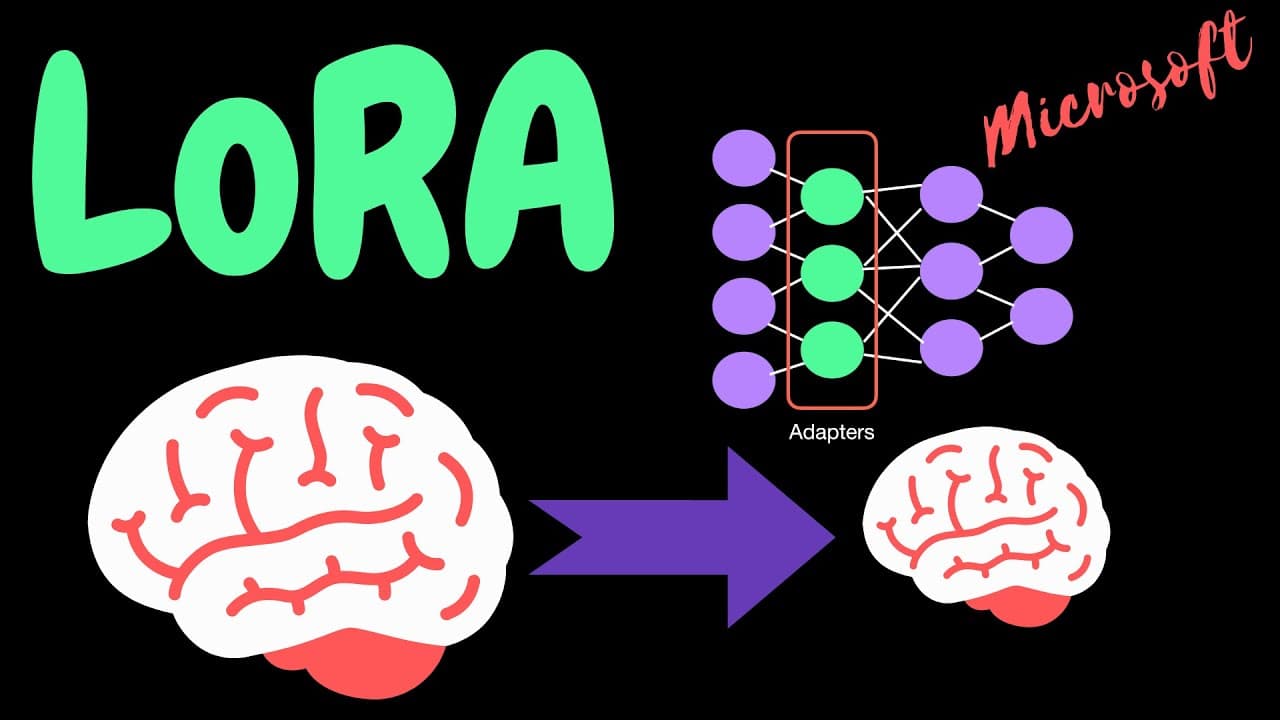
- Adapters are additional modules that can be plugged into neural networks, allowing specific parameters to be fine-tuned while leaving the pre-trained model's core parameters frozen.
- LoRA leverages the concept of rank decomposition, which reduces the number of parameters needed by representing the weight matrix in a lower-dimensional space.
- The rank of a matrix is crucial in LoRA, as it determines the number of linearly independent rows or columns, and a lower rank indicates a more compact representation.
- LoRA achieves low latency during inference by merging the decomposed weights with the pre-trained weights, thus overcoming potential bottlenecks.
- LoRA is particularly effective for transformers, focusing on adapting the self-attention module while leaving other components like MLPs untouched.
- Choosing the optimal rank for LoRA is essential, with a rank as low as one being sufficient for certain tasks, while others may require higher ranks.
- LoRA is implemented in libraries like Microsoft’s LoRA and Hugging Face’s PEFT, making it accessible for practical use in various AI applications.
Install to Summarize YouTube Videos and Get Transcripts
Explore YouTube Video Summarizer or Get YouTube Transcript Extractor
Questions & Answers
Q: What problem does LoRA solve in the context of large language models?
LoRA addresses the challenge of fine-tuning large language models, which are often bulky and computationally expensive to deploy for various applications. By using low-rank adaptation, LoRA reduces the number of parameters that need to be updated during fine-tuning, thus enabling efficient deployment and operation without compromising performance.
Q: How does rank decomposition contribute to LoRA's efficiency?
Rank decomposition plays a crucial role in LoRA's efficiency by breaking down a large weight matrix into two smaller matrices, significantly reducing the number of parameters that need to be stored and computed. This decomposition allows LoRA to leverage the low intrinsic dimension of pre-trained models, leading to a more compact and computationally efficient representation.
Q: Why is choosing the right rank important in LoRA?
Choosing the right rank in LoRA is important because it determines the level of parameter reduction and the effectiveness of fine-tuning. A lower rank can lead to a more compact model, but it must be sufficient to capture the necessary information for the specific task. The optimal rank varies depending on the task and model architecture, impacting the balance between efficiency and performance.
Q: How does LoRA handle latency during inference?
LoRA handles latency during inference by merging the low-rank decomposed weights with the pre-trained weights, effectively creating a single set of weights for deployment. This approach eliminates the need for additional computational steps that would otherwise increase latency, allowing for faster inference times without sacrificing model accuracy.
Q: In what way is LoRA applied specifically to transformers?
LoRA is applied specifically to transformers by focusing on the self-attention modules, which are key components of transformer architectures. It adapts the query and value matrices within these modules, leaving other parts like the multi-layer perceptrons (MLPs) unchanged. This targeted adaptation ensures that the model remains efficient while being fine-tuned for specific downstream tasks.
Q: What are some practical implementations of LoRA available for use?
Practical implementations of LoRA are available through libraries such as Microsoft's LoRA library and Hugging Face's PEFT (Parameter-Efficient Fine-Tuning). These implementations provide accessible tools for researchers and developers to apply LoRA to various AI applications, offering options for different licensing and integration with existing machine learning frameworks.
Q: What is the significance of LoRA's low intrinsic dimension in pre-trained models?
The low intrinsic dimension in pre-trained models is significant because it indicates that these models can be effectively fine-tuned using a smaller set of parameters without losing performance. LoRA leverages this property by using low-rank matrices to represent the model's weights, enabling efficient adaptation to new tasks while maintaining the model's accuracy and reducing computational overhead.
Q: How does LoRA differ from traditional fine-tuning methods?
LoRA differs from traditional fine-tuning methods by focusing on parameter efficiency and reducing the computational burden associated with large language models. Instead of updating all model parameters, LoRA uses low-rank matrices to adapt only the necessary components, resulting in a more efficient fine-tuning process that requires less computational power and storage while maintaining performance.
Summary & Key Takeaways
-
LoRA, or Low-Rank Adaptation, is a method designed to efficiently fine-tune large language models by reducing the computational burden associated with their large parameter sizes. By using rank decomposition, LoRA significantly decreases the number of parameters, enabling faster and more efficient model deployment.
-
The concept of LoRA revolves around the idea that pre-trained models have a low intrinsic dimension, allowing for effective fine-tuning through low-rank matrices. This approach maintains the performance of the full parameter space while reducing the computational complexity.
-
LoRA is particularly applicable to transformer models, focusing on the self-attention modules. It provides a parameter-efficient method for adapting these models to specific tasks without the need to retrain the entire model, thus saving resources and time.
Read in Other Languages (beta)
Share This Summary 📚
Summarize YouTube Videos and Get Video Transcripts with 1-Click
Try YouTube Summary with ChatGPT & Claude or YouTube Transcript Generator