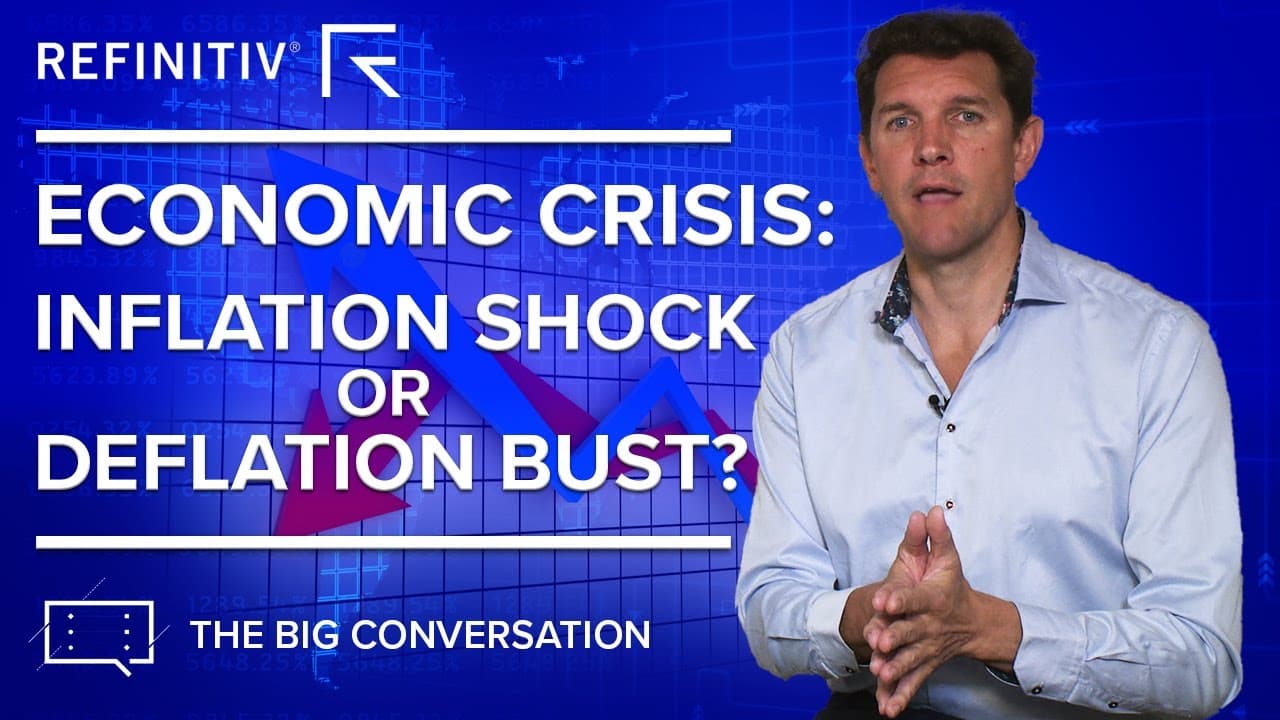
Economic Crisis: Inflation Shock or Deflation Bust? | The Big Conversation | Refinitiv
TL;DR
The content explores the possibility of a surge in inflation due to unprecedented monetary and fiscal responses to combat the economic fallout of the current crisis, but also highlights the potential for deflation. It discusses various forms of inflation, factors impacting inflation, and the challenges of stimulating demand in the current environment.
Transcript
The current crisis has led to demand destruction of historic proportions, and in order to combat that economic fallout, policymakers from the US to Japan are combining a monetary and fiscal response of unprecedented size and speed. Will this lead to a sudden surge in inflation? Or is deflation already baked in the cake? That's The Big Conversation.... Read More
Key Insights
- 🎚️ The historical analysis of CPI shows high inflation levels in the 1970s, followed by lower levels in subsequent decades.
- 🤑 Factors such as money printing, bottlenecks, changes in population growth, and OPEC agreements have contributed to past inflationary periods.
- 🤑 The decline in the velocity of money has offset the impact of money printing on inflation in recent years.
- 🥺 The current crisis has led to significant demand destruction, which is expected to be disinflationary or deflationary in nature.
- 🥺 The reopening of economies without a recovery in demand could lead to deflationary pressures.
- 🤑 The possibility of future inflation is dependent on factors such as money supply, GDP, and changes in the velocity of money.
- 🍉 The current stimulus measures are primarily addressing liquidity issues, while solvency issues may emerge in the long term.
- ☠️ High savings rates and impaired balance sheets may result in changed consumer behavior and a shift towards debt repayment rather than consumption.
- 🌐 Emerging market currencies may be better indicators of weaker global growth and economies compared to financial assets of developed countries.
Install to Summarize YouTube Videos and Get Transcripts
Explore YouTube Video Summarizer or Get YouTube Transcript Extractor
Questions & Answers
Q: What are the different forms of inflation mentioned in the content?
The content mentions inflation, deflation, disinflation, stagflation, and hyperinflation as different forms of inflation that can occur in an economy. These terms refer to various scenarios related to economic growth, wage inflation, goods inflation, asset price inflation, and extreme cases of rapid inflation, respectively.
Q: How has the balance between inflation and deflation shifted in the past decade?
Economists have been more concerned with deflation rather than inflation in the past decade. However, the content highlights that the inflation experienced during this period has been primarily asset price inflation, while economic growth has been relatively absent. The decline in the velocity of money has also offset the impact of money printing on inflation.
Q: How has the current crisis affected consumer spending and its potential impact on inflation?
The current crisis has led to significant demand destruction, which is expected to result in disinflationary or deflationary pressures. Personal consumption has seen a dramatic drop globally, with significant impacts on leisure facilities, transportation, and eating out. The reopening of economies without a corresponding recovery in demand could create deflationary forces.
Q: How does the content explore the possibility of future inflation?
The content suggests that the gargantuan expansion of the US Federal Reserve's balance sheet, coupled with fiscal support for the economy, has raised concerns about future inflation. However, factors such as the decline in the velocity of money and the global printing of currencies may prevent excessive inflation in the short term.
Summary & Key Takeaways
-
The content discusses the ongoing debate between inflation and deflation and highlights the concerns over a possible surge in inflation in the future.
-
It examines historical data on CPI, showing high inflation in the 1970s followed by lower levels in subsequent decades.
-
The content explores factors that contributed to inflation in the past, such as money printing, bottlenecks, and changes in population growth.
-
It also discusses the impact of money printing and declining velocity of money on inflation, as well as the potential for inflationary and deflationary forces in the current crisis.
Read in Other Languages (beta)
Share This Summary 📚
Summarize YouTube Videos and Get Video Transcripts with 1-Click
Try YouTube Summary with ChatGPT & Claude or YouTube Transcript Generator
Explore More Summaries from Real Vision 📚


Summarize YouTube Videos and Get Video Transcripts with 1-Click
Try YouTube Summary with ChatGPT & Claude or YouTube Transcript Generator