What is a Parallelogram? | Special Cases of Parallelogram | Don't Memorise
TL;DR
This content explains the properties of different types of quadrilaterals, including parallelograms, rhombuses, rectangles, and squares.
Transcript
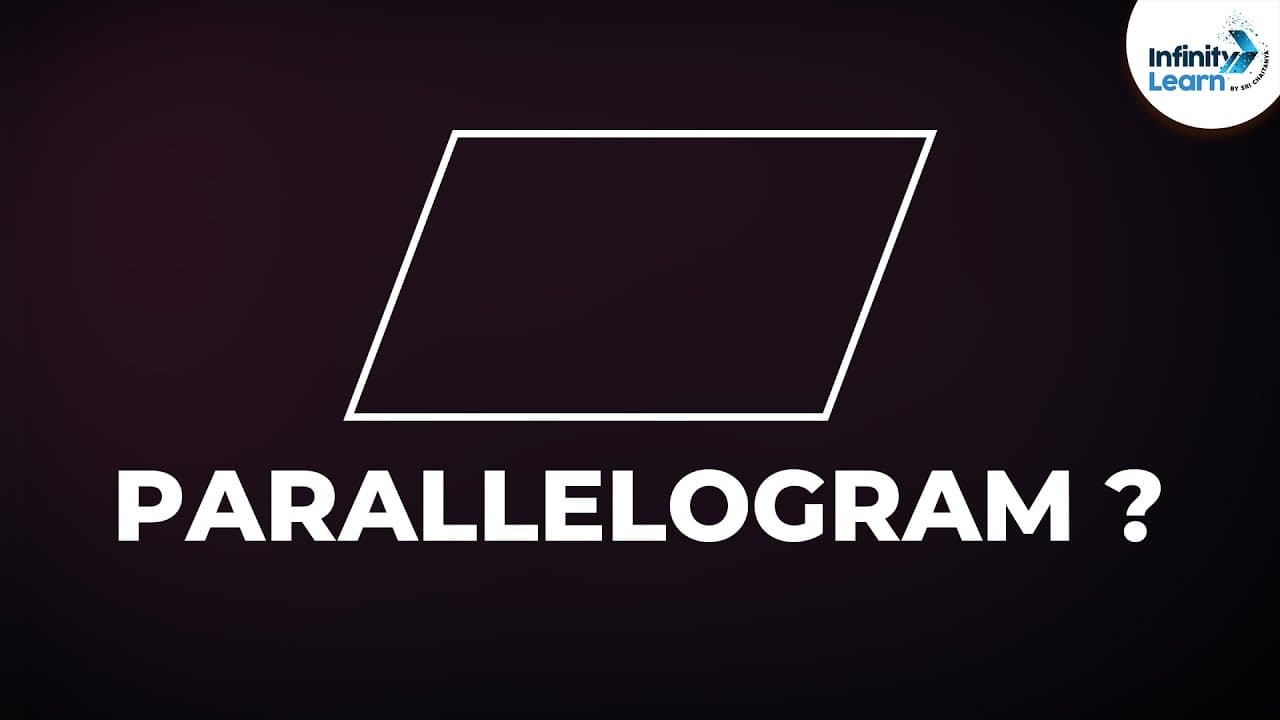
Here's another type of quadrilateral. Let's name it ABCD. In this quadrilateral, both pairs of opposite sides are parallel. The first pair of opposite sides is AB and DC. We can see that AB is parallel to DC. We use two arrows in the same direction to show that the sides are parallel. The second pair of opposite sides is AD and BC. We can also see ... Read More
Key Insights
- 🙃 Parallelograms have parallel opposite sides and equal opposite angles and sides.
- 🟰 Rhombuses are parallelograms with all sides equal and opposite angles equal.
- 🟰 Rectangles are parallelograms with all angles equal to 90 degrees.
- 🙃 Squares are both rectangles and rhombuses, with all sides and angles equal to each other.
- 🙃 Opposite angles, sides, and diagonals play crucial roles in determining the properties of each quadrilateral.
- 🙃 The properties of a quadrilateral can change based on the combination of parallel sides, equal angles, and equal sides.
- ⚾ Each type of quadrilateral can be categorized based on its unique combination of properties.
Install to Summarize YouTube Videos and Get Transcripts
Explore YouTube Video Summarizer or Get YouTube Transcript Extractor
Questions & Answers
Q: How are parallelograms different from other quadrilaterals?
Parallelograms have both pairs of opposite sides parallel, opposite sides equal, and opposite angles equal. Other quadrilaterals may have some of these properties but not all.
Q: What is the defining property of a rhombus?
A rhombus is a quadrilateral with all sides equal and opposite sides parallel. It also has opposite angles equal. Additionally, a rhombus can also be referred to as a parallelogram.
Q: How does a rectangle differ from a parallelogram?
A rectangle is a special type of parallelogram where all angles are equal to 90 degrees. In addition to having parallel opposite sides and equal opposite angles, a rectangle also has opposite sides equal.
Q: What makes a square unique among quadrilaterals?
A square is a special type of rectangle where all sides are equal. It also has the properties of a rhombus, with opposite sides parallel. Furthermore, a square has all angles equal to 90 degrees.
Summary & Key Takeaways
-
A quadrilateral with parallel opposite sides is known as a parallelogram, where opposite sides, angles, and diagonals are all equal.
-
A rhombus is a parallelogram with all sides equal, while a rectangle is a parallelogram with all angles equal to 90 degrees.
-
A square is a special case of both a rectangle and a rhombus, with all sides equal and all angles equal to 90 degrees.
Read in Other Languages (beta)
Share This Summary 📚
Summarize YouTube Videos and Get Video Transcripts with 1-Click
Try YouTube Summary with ChatGPT & Claude or YouTube Transcript Generator
Explore More Summaries from Infinity Learn NEET 📚

Summarize YouTube Videos and Get Video Transcripts with 1-Click
Try YouTube Summary with ChatGPT & Claude or YouTube Transcript Generator