Page Size Concern
TL;DR
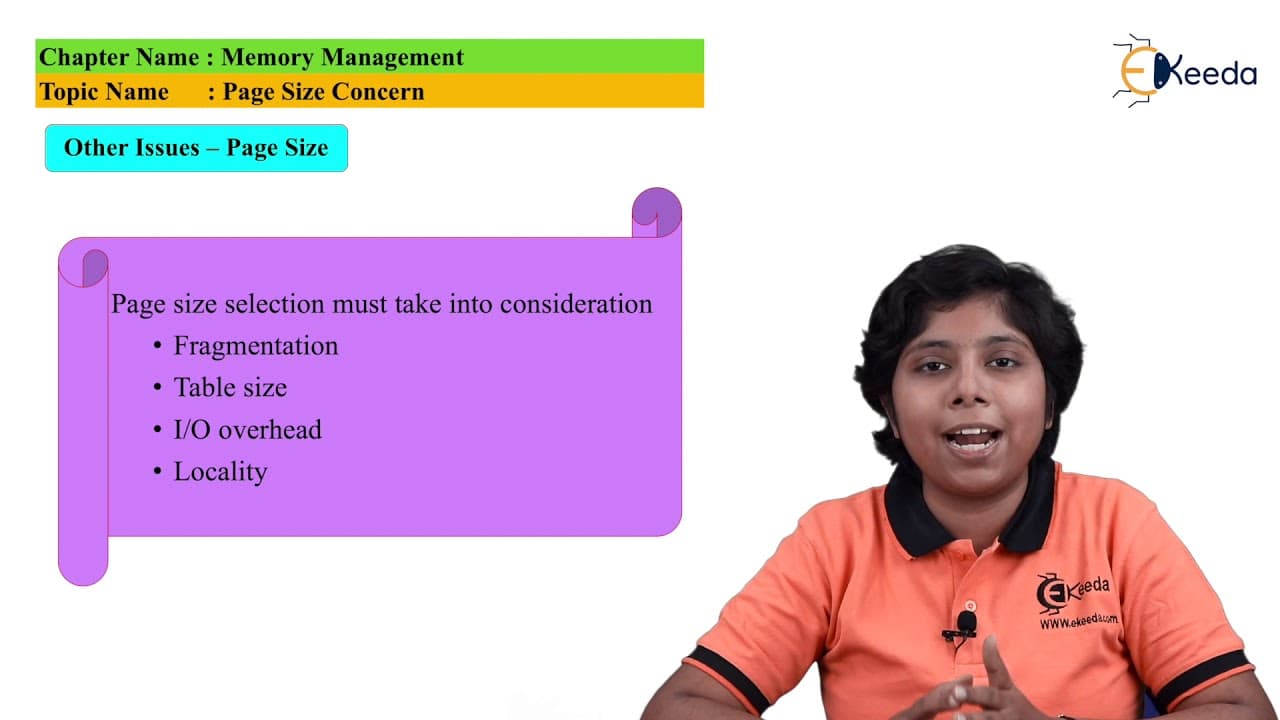
Page size in operating systems depends on various factors, including page table size, internal fragmentation, IO time, and locality of reference.
Transcript
click the bell icon to get latest videos from akira hello friends today we will discuss about the paid shiz issues that is related with the paging now when you are talking about and paid size issue it should cover all the factors depending on which the large page sizes and slope it sizes will be chosen the designers of an existing operating system ... Read More
Key Insights
- 📟 Page size choice depends on factors like page table size and fragmentation, with smaller sizes reducing internal fragmentation and memory wastage.
- 🛩️ Larger page sizes can increase IO time, while smaller sizes can decrease it by requiring less memory transfer.
- 🛩️ Smaller page sizes enhance the accuracy of the locality of reference by matching the execution with the currently residing locality.
- 📟 The number of pages affects the page fault rate, with larger page sizes generally resulting in lower rates.
Install to Summarize YouTube Videos and Get Transcripts
Explore YouTube Video Summarizer or Get YouTube Transcript Extractor
Questions & Answers
Q: What factors influence the choice of page sizes in operating systems?
Page sizes in operating systems are influenced by factors such as page table size, internal fragmentation, IO time, and locality of reference. Each of these factors plays a role in determining the optimal page size for a given system.
Q: How does page table size affect the choice of page size?
Increasing the number of pages in a system decreases the page size, which in turn reduces the size of the page table. This can improve memory access time as there are fewer entries to search through. Conversely, decreasing the number of pages increases the page size and the size of the page table.
Q: What is internal fragmentation, and how does it relate to page size?
Internal fragmentation occurs when a page frame is allocated to a process but not fully utilized. Using smaller page sizes can help reduce internal fragmentation, as there is less wasted space within each frame. This is because smaller page sizes result in a smaller chance of having unused portions within a frame.
Q: How does IO time influence the choice of page size?
IO time consists of seek time, rotational latency, and transfer time, with the latter being directly proportional to the memory being transferred. Larger page sizes require more time for IO operations, as more memory needs to be transferred. However, a smaller page size can decrease the total IO time by reducing the amount of memory transferred.
Summary & Key Takeaways
-
Page sizes in operating systems are chosen based on factors such as page table size and fragmentation.
-
Increasing the number of pages decreases page size and vice versa, affecting the page table size and memory access time.
-
Smaller page sizes help reduce internal fragmentation, but larger page sizes can decrease IO time.
Read in Other Languages (beta)
Share This Summary 📚
Summarize YouTube Videos and Get Video Transcripts with 1-Click
Try YouTube Summary with ChatGPT & Claude or YouTube Transcript Generator
Explore More Summaries from Ekeeda 📚






Summarize YouTube Videos and Get Video Transcripts with 1-Click
Try YouTube Summary with ChatGPT & Claude or YouTube Transcript Generator