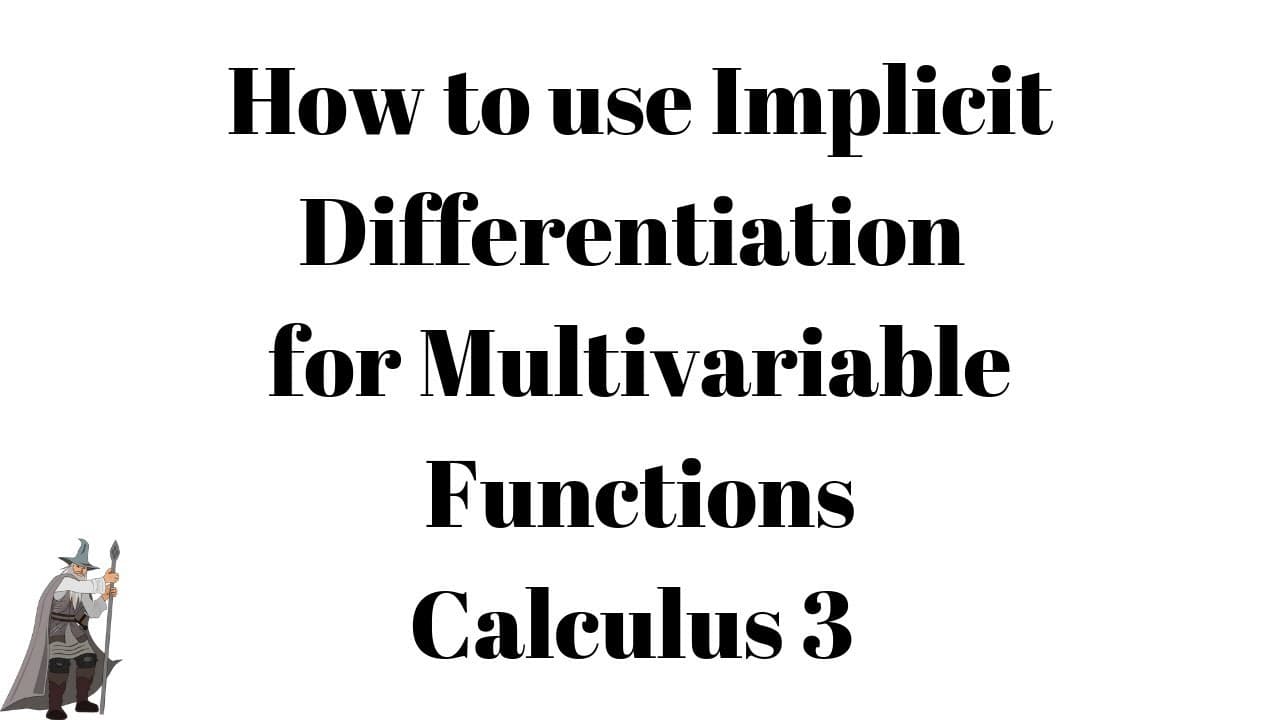
How to use Implicit Differentiation for Multivariable Functions - Calculus 3
TL;DR
Learn how to find partial derivatives of Z with respect to X and Y using easy-to-memorize formulas.
Transcript
in this video we're going to look at some implicit differentiation formulas from calculus 3 so here is the set up so if you have a function f of x y and z and it's equal to zero so if this defines z implicitly as a function of x and y so implicitly as a function of x and y then we get these really beautiful formulas for the partial derivative of Z ... Read More
Key Insights
- 🫡 Implicit differentiation involves finding partial derivatives of Z with respect to X and Y in functions defined implicitly.
- ❓ The crisscross method simplifies the arrangement of variables in the partial differentiation formulas.
- 😫 Setting everything equal to zero is crucial in defining the function for implicit differentiation problems.
- 🍉 Neglecting terms not related to the variables being differentiated ensures accurate partial derivative calculations.
Install to Summarize YouTube Videos and Get Transcripts
Explore YouTube Video Summarizer or Get YouTube Transcript Extractor
Questions & Answers
Q: What are implicit differentiation formulas in calculus 3?
Implicit differentiation formulas involve finding partial derivatives of Z with respect to X and Y in functions defined implicitly as a function of X and Y. These formulas have negative signs and require a crisscross method for variable arrangement.
Q: How do you memorize the implicit differentiation formulas?
To memorize the formulas, remember that the variable next to the partial derivative symbol goes to the opposite end. For example, for del Z del X, the partial of F with respect to X goes up top, and the Z goes at the bottom.
Q: Why is setting everything equal to zero important in implicit differentiation problems?
Setting everything equal to zero helps define the function F(X, Y, Z) needed to calculate partial derivatives. It ensures that the terms unrelated to X or Y are isolated, simplifying the differentiation process.
Q: Can you provide an example of applying implicit differentiation formulas?
In the example of 11x^2 + 5y^2 + 3z^2 = 4, finding del Z del X and del Z del Y involves using the crisscross method to differentiate each term with respect to X and Y, respectively.
Summary & Key Takeaways
-
Implicit differentiation formulas from calculus 3 involve finding partial derivatives of Z with respect to X and Y.
-
The formulas follow a simple crisscross method to determine the arrangement of variables.
-
A step-by-step example is provided to demonstrate how to apply the formulas in practice.
Read in Other Languages (beta)
Share This Summary 📚
Summarize YouTube Videos and Get Video Transcripts with 1-Click
Try YouTube Summary with ChatGPT & Claude or YouTube Transcript Generator
Explore More Summaries from The Math Sorcerer 📚


Summarize YouTube Videos and Get Video Transcripts with 1-Click
Try YouTube Summary with ChatGPT & Claude or YouTube Transcript Generator