L13.6 The Conditional Variance
TL;DR
The conditional variance is the variance of a random variable given another random variable, and it is defined as a random variable itself.
Transcript
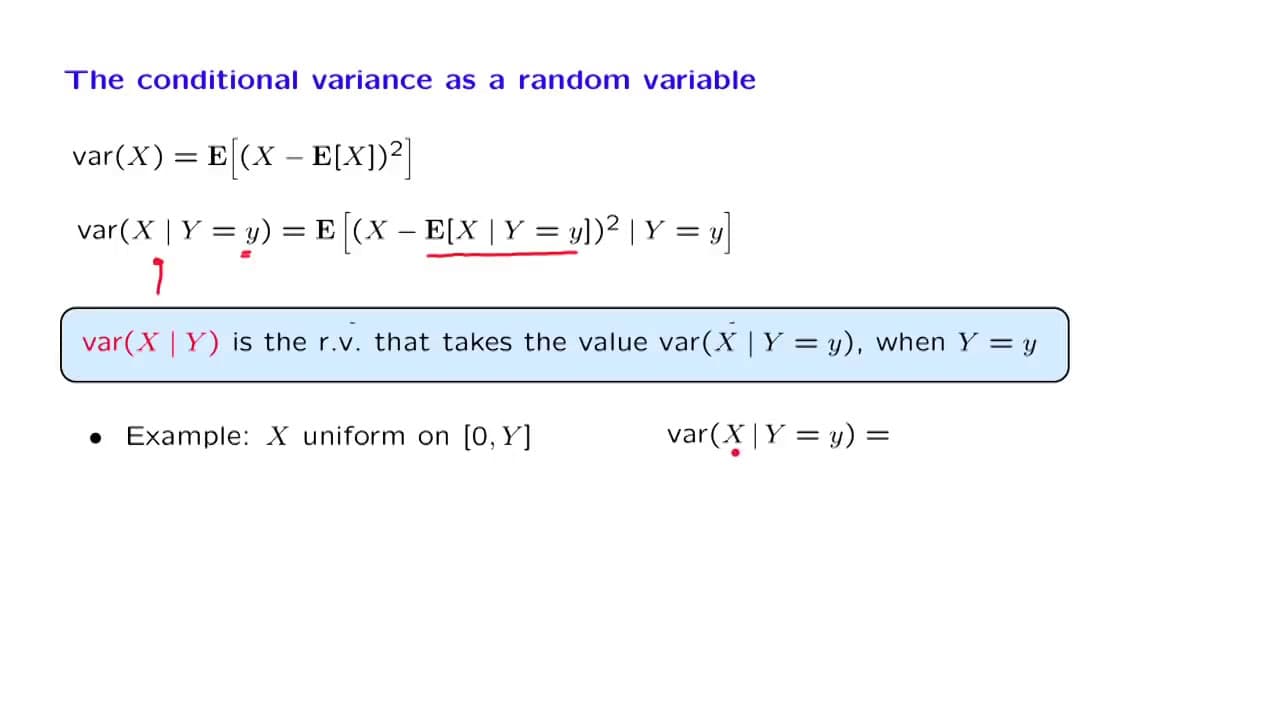
We have defined the conditional expectation of a random variable given another as an abstract object, which is itself a random variable. Let us now do something analogous with the notion of [the] conditional variance. Let us start with the definition of the variance, which is the following. We look at the deviation of the random variable from its m... Read More
Key Insights
- ❓ Conditional variance is an abstract concept in probability theory that measures the variability of a random variable when another random variable is known.
- ❎ The conditional variance is defined as a random variable itself, calculated by finding the squared deviation of the random variable from its expected value in a conditional universe.
- ➕ The unconditional variance is equal to the expected value of the conditional variance plus the variance of the conditional expectation.
Install to Summarize YouTube Videos and Get Transcripts
Explore YouTube Video Summarizer or Get YouTube Transcript Extractor
Questions & Answers
Q: What is conditional variance?
Conditional variance is the variability of a random variable when another random variable is known. It is defined by calculating the squared deviation of the random variable from its expected value in a conditional universe, and then finding the expected value of that squared deviation.
Q: How is conditional variance different from unconditional variance?
Conditional variance takes into account the variability of a random variable when another random variable is known, while unconditional variance represents the overall variability of the random variable. The unconditional variance is equal to the expected value of the conditional variance plus the variance of the conditional expectation.
Q: How is conditional variance defined mathematically?
Mathematically, conditional variance is calculated by finding the squared deviation of a random variable from its expected value in a conditional universe, and then taking the expected value of that squared deviation. It is denoted as the variance of the conditional distribution of the random variable.
Q: How does conditional variance relate to conditional expectation?
Conditional variance and conditional expectation are both concepts that involve considering a random variable when another random variable is known. While conditional expectation represents the average value of a random variable given the knowledge of another random variable, conditional variance represents the variability of a random variable under the same conditions.
Summary & Key Takeaways
-
Conditional variance is similar to conditional expectation, where it represents the variability of a random variable when another random variable is known.
-
The conditional variance is defined by taking the squared deviation of a random variable from its expected value in a conditional universe, and then finding the expected value of that squared deviation.
-
The unconditional variance is equal to the expected value of the conditional variance plus the variance of the conditional expectation.
Read in Other Languages (beta)
Share This Summary 📚
Summarize YouTube Videos and Get Video Transcripts with 1-Click
Try YouTube Summary with ChatGPT & Claude or YouTube Transcript Generator
Explore More Summaries from MIT OpenCourseWare 📚



Summarize YouTube Videos and Get Video Transcripts with 1-Click
Try YouTube Summary with ChatGPT & Claude or YouTube Transcript Generator