L11.9 The PDF of a Function of Multiple Random Variables
TL;DR
Learn how to calculate the distribution of a random variable that is defined as a function of multiple random variables.
Transcript
In all of the examples that we have seen so far, we have calculated the distribution of a random variable, Y, which is defined as a function of another random variable, X. What about the case where we define a random variable, Z, as a function of multiple random variables? For example, here is the function of two random variables. How can we find a... Read More
Key Insights
- ❓ The distribution of a random variable that is a function of multiple random variables can be calculated by finding its CDF and differentiating it to obtain the PDF.
- ❓ The joint distribution of independent random variables is the product of their individual probability density functions.
- 🤪 The CDF of a random variable Z can be calculated by determining the area under the curve in the joint distribution.
- 💤 The CDF and PDF of Z depend on the values and relationship between the random variables X and Y.
Install to Summarize YouTube Videos and Get Transcripts
Explore YouTube Video Summarizer or Get YouTube Transcript Extractor
Questions & Answers
Q: How can we calculate the distribution of a random variable that is a function of multiple random variables?
To calculate the distribution of a random variable Z, which depends on multiple random variables, we can use the same methodology of finding its CDF and differentiating it to obtain the PDF.
Q: What is the joint distribution of independent random variables X and Y?
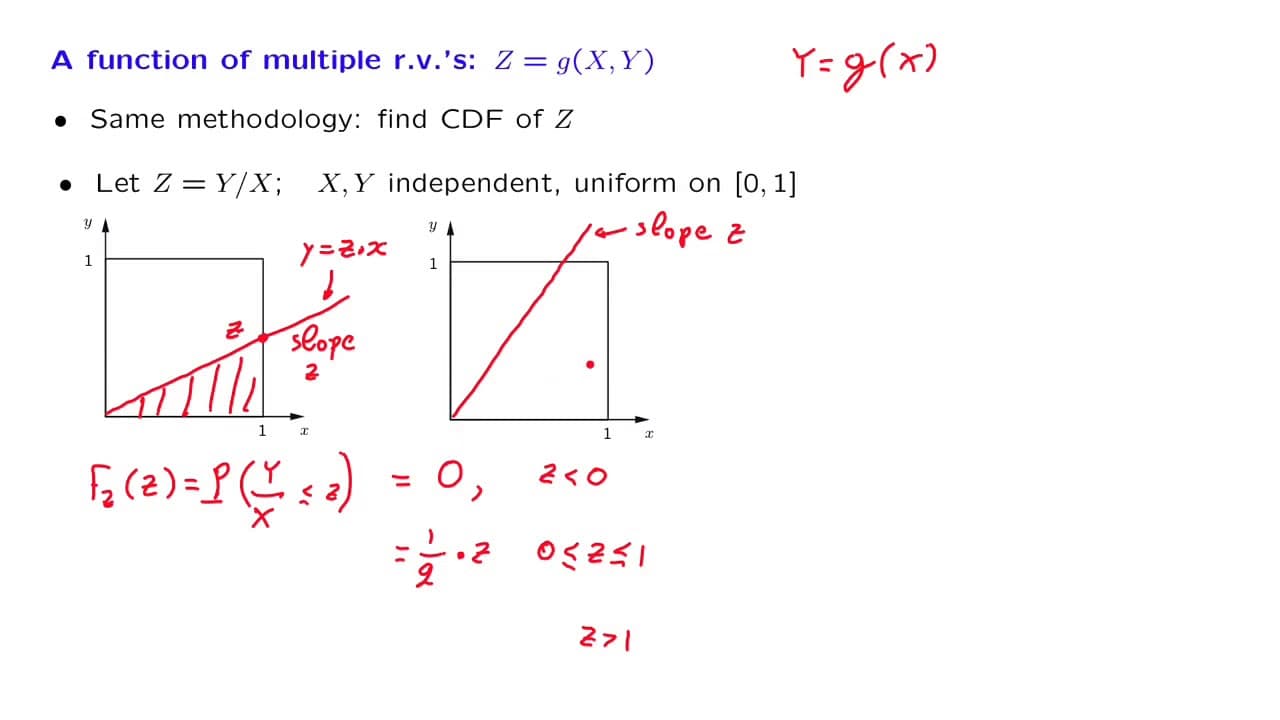
In the given example, as X and Y are independent random variables uniformly distributed on the unit interval, their joint distribution is a uniform probability density function throughout the unit square.
Q: How is the CDF of Z derived for negative values of z?
If Z is a negative number, the probability of Z being less than or equal to z is 0, as X and Y are non-negative. Therefore, the CDF of Z is 0 for negative values of z.
Q: What is the shape of the PDF of Z for large positive values of z?
As z approaches infinity, the PDF of Z approaches 0, indicating a decreasing probability as z gets larger. The shape of the PDF is a decreasing curve.
Summary & Key Takeaways
-
The distribution of a random variable Z can be calculated by finding its cumulative distribution function (CDF) and then differentiating it to obtain the probability density function (PDF).
-
In the given example, the random variables X and Y are independent and uniformly distributed on the unit interval.
-
The random variable Z is defined as the ratio of Y divided by X. Through geometric analysis, the CDF and PDF of Z are derived.
Read in Other Languages (beta)
Share This Summary 📚
Summarize YouTube Videos and Get Video Transcripts with 1-Click
Try YouTube Summary with ChatGPT & Claude or YouTube Transcript Generator
Explore More Summaries from MIT OpenCourseWare 📚



Summarize YouTube Videos and Get Video Transcripts with 1-Click
Try YouTube Summary with ChatGPT & Claude or YouTube Transcript Generator