21. Generalized Linear Models
TL;DR
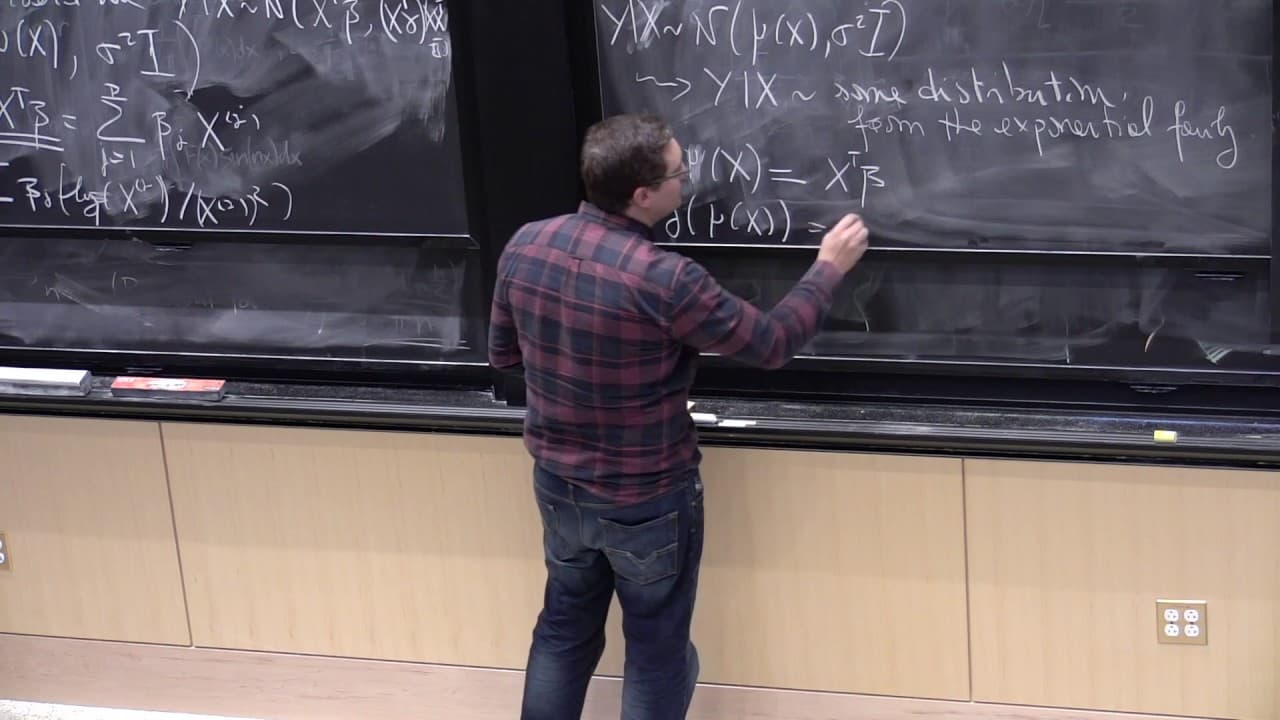
Generalized Linear Models (GLMs) extend linear models to incorporate different distributions and allow for flexible modeling of the mean response variable given predictor variables.
Transcript
The following content is provided under a Creative Commons license. Your support will help MIT OpenCourseWare continue to offer high quality educational resources for free. To make a donation or to view additional materials from hundreds of MIT courses, visit MIT OpenCourseWare and ocw.mit.edu. PHILIPPE RIGOLLET: The chapter is a natural capstone c... Read More
Key Insights
- 💁 Exponential family distributions form the basis of generalized linear models.
- 👻 GLMs allow for flexible modeling of the response variable's mean using different distributions from the exponential family.
- ❓ GLMs include distributions such as Gaussian, Poisson, Bernoulli, and gamma, among others.
- 🍻 The random component in GLMs refers to the distribution of the response variable, while the link function models the relationship between the mean response and the predictor variables.
Install to Summarize YouTube Videos and Get Transcripts
Explore YouTube Video Summarizer or Get YouTube Transcript Extractor
Questions & Answers
Q: What is the main difference between linear models and generalized linear models?
The main difference is that generalized linear models allow for modeling the mean response variable using different distributions, while linear models assume a Gaussian distribution for the response variable.
Q: What is the random component in generalized linear models?
The random component refers to the distribution of the response variable given the predictor variables. It can be any distribution from the exponential family, such as Gaussian, Bernoulli, Poisson, or gamma distributions.
Q: How are generalized linear models different from linear regression models?
Generalized linear models extend linear regression models by allowing for different distributions for the response variable and incorporating a link function to model the mean response.
Q: What is the purpose of the link function in generalized linear models?
The link function is used to model the relationship between the mean response variable and the predictor variables. It transforms the mean response, which can take any value, into a function that maps the entire real line to a specific range, such as 0 to 1. The choice of link function ensures compatibility between the mean response and the distribution of the response variable.
Summary & Key Takeaways
-
GLMs are a natural extension of linear models, allowing for modeling of the mean response variable using different distributions.
-
GLMs have two main components: the random component (distribution of the response variable) and the link function (relationship between the mean response and predictor variables).
-
The exponential family is a broad class of distributions that can be used in GLMs, including the Gaussian, Bernoulli, Poisson, and gamma distributions.
Read in Other Languages (beta)
Share This Summary 📚
Summarize YouTube Videos and Get Video Transcripts with 1-Click
Try YouTube Summary with ChatGPT & Claude or YouTube Transcript Generator
Explore More Summaries from MIT OpenCourseWare 📚



Summarize YouTube Videos and Get Video Transcripts with 1-Click
Try YouTube Summary with ChatGPT & Claude or YouTube Transcript Generator