How Waymo Is Using GenAI to Build a Better Driver
TL;DR
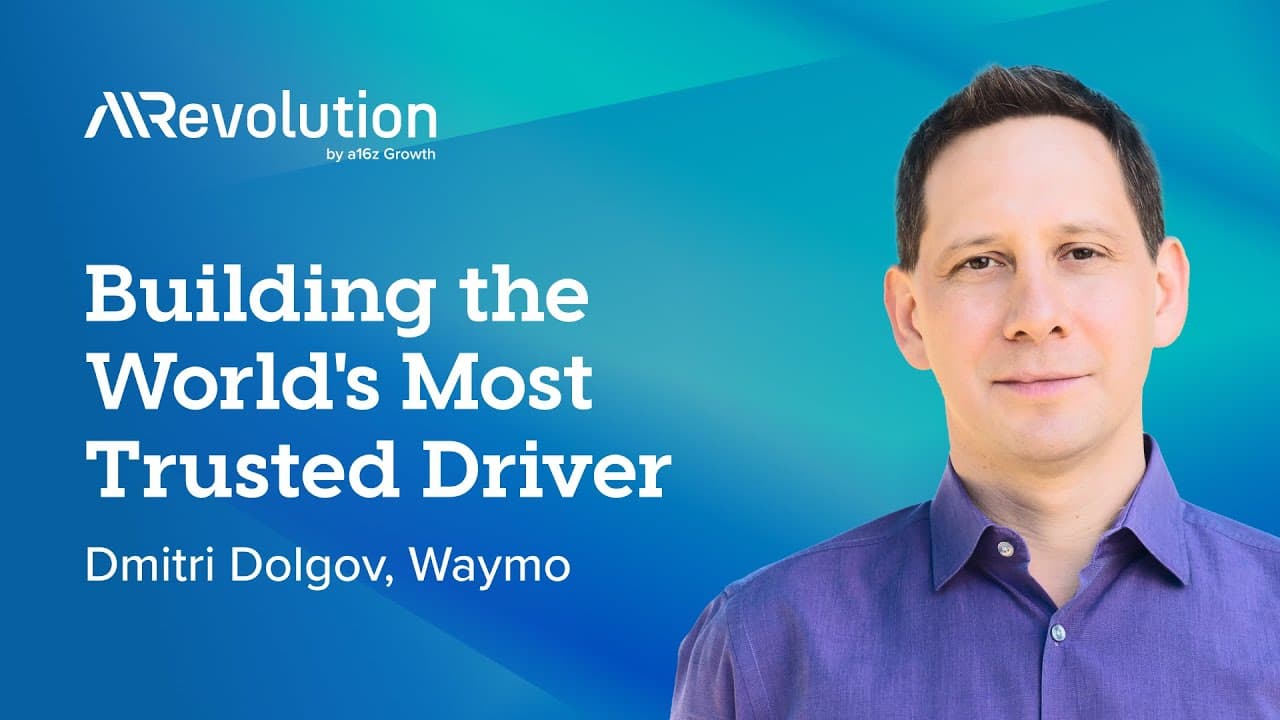
Dimitri Dolgov, co-CEO of Waymo, discusses the progress and challenges of bringing autonomous driving technology to the real world.
Transcript
hey guys I'm Sarah Wang General partner on the a16z growth team welcome back to our AI Revolution series in this series we talk to the Gen Builders who are Transforming Our World to understand one where we are two where we're going and three the big open questions in the field Our Guest this episode is Dimitri dolgov the co-ceo of weo Dimitri has l... Read More
Key Insights
- 🖐️ AI has played a significant role in autonomous driving, from early decision-making algorithms to breakthroughs in perception models using convolutional neural networks and transformers.
- ⚖️ Simulation and synthetic data have been crucial in scaling autonomous driving technology and enabling extensive testing and training.
- 🦺 Safety remains a top priority, with Waymo demonstrating a significant reduction in accidents compared to human drivers through its autonomous driving technology.
- 🌍 Achieving full autonomy requires addressing various challenges, including the complexity of the physical world, ensuring safety, and making real-time decisions.
- 🙃 Waymo aims to bring autonomous driving technology to various commercial applications, such as ride-hailing, deliveries, and personally-owned vehicles, by exploring different partnership structures.
- 🚙 The hardware stack in autonomous vehicles consists of various sensors, including cameras, lidars, and radars, each serving different purposes and providing redundancy.
Install to Summarize YouTube Videos and Get Transcripts
Explore YouTube Video Summarizer or Get YouTube Transcript Extractor
Questions & Answers
Q: How has AI in autonomous driving evolved over the years?
AI in autonomous driving has gone through various developments, from classical decision-making algorithms and computer vision to breakthroughs in convolutional neural networks and transformers for perceiving and predicting behaviors in the environment.
Q: What is the role of simulation and synthetic data in autonomous driving?
Simulation allows for realistic closed-loop testing and the generation of large datasets to train AI models. It is essential for evaluating the performance of autonomous driving systems in different scenarios and environments.
Q: How does Waymo ensure safety in autonomous driving?
Waymo employs a rigorous safety framework, including comparing the behavior of its autonomous vehicles to that of a hypothetical attentive human driver. They also continuously iterate and improve their systems based on real-world feedback and experiences.
Q: What are the main challenges in achieving full autonomy in driving?
The physical world presents unique challenges, such as uncertainty and noise, which make autonomous driving more difficult than digital AI applications. Safety requirements, real-time decision-making, and the high cost of errors further elevate the difficulty in achieving full autonomy.
Summary & Key Takeaways
-
Dimitri Dolgov's introduction to autonomous vehicles began during his post-doc at Stanford when he participated in the DARPA Grand Challenge in 2007.
-
Waymo has driven over 15 million miles autonomously and has shown a 3.5 times reduction in accidents compared to human drivers.
-
The use of simulation and synthetic data has been instrumental in scaling autonomous driving technology and improving its capabilities.
Read in Other Languages (beta)
Share This Summary 📚
Summarize YouTube Videos and Get Video Transcripts with 1-Click
Try YouTube Summary with ChatGPT & Claude or YouTube Transcript Generator
Explore More Summaries from a16z 📚





Summarize YouTube Videos and Get Video Transcripts with 1-Click
Try YouTube Summary with ChatGPT & Claude or YouTube Transcript Generator