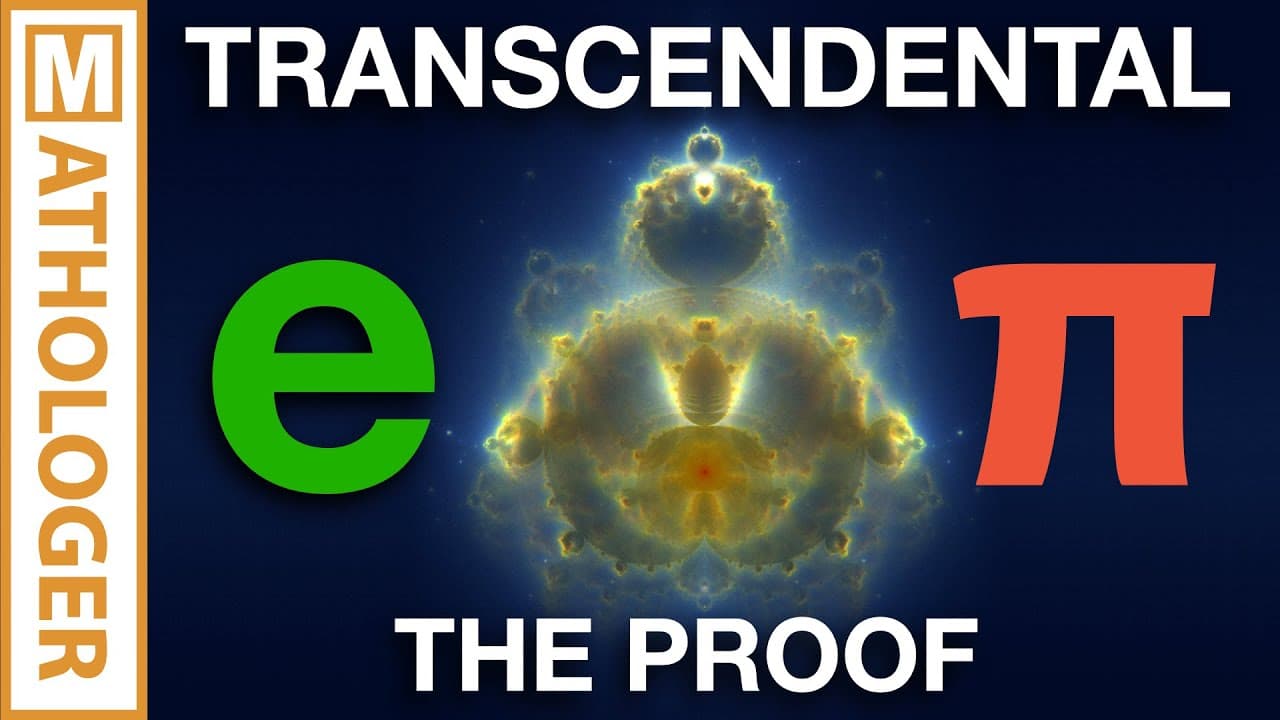
The PROOF: e and pi are transcendental
TL;DR
Mathologer delves into the complex and intricate world of transcendental numbers, providing visually engaging and accessible proofs for the transcendence of e and pi.
Transcript
Welcome to another Mathologer video. Mathematical seatbelts on? Airbags working? Crash helmets comfy? Okay, let's go. In recent videos we proved that e and pi are irrational, that they cannot be written as ratios of integers. We now want to go much much further. We'll prove that e and pi are transcendental numbers. Now I've already done a couple o... Read More
Key Insights
- 😑 The proof for the transcendence of e involves utilizing the infinite series representation of e and showing that it cannot be expressed as a fraction.
- 🤨 The proofs for the transcendence of e and pi are often unconventional and require ingenuity to comprehend and prove.
- 🤨 The transcendence of e and pi signifies that they do not have a simple algebraic relationship and are unique mathematical entities.
- 💦 The proofs discussed in the video are based on the works of renowned mathematicians such as Georg Cantor, Charles Hermite, and Ferdinand von Lindemann.
- 🎮 The video emphasizes the importance of understanding transcendental numbers and their impact on mathematical theory.
- 🤨 The proof for the transcendence of pi piggybacks on the proof for e, showcasing the interconnections between different transcendence proofs.
Install to Summarize YouTube Videos and Get Transcripts
Explore YouTube Video Summarizer or Get YouTube Transcript Extractor
Questions & Answers
Q: How does the proof for e being irrational utilize factorials?
In the proof, the infinite series representation of e is used, where factorials play a crucial role. By considering the denominator of the series, which consists of factorials, it is shown that e cannot be expressed as a fraction, therefore proving its irrationality.
Q: What is the significance of proving e and pi to be transcendental numbers?
Proving e and pi to be transcendental confirms that these numbers cannot be the solutions to any non-trivial polynomial equation with integer coefficients. This deepens our understanding of these important mathematical constants and highlights their unique properties.
Q: What trick did Ferdinand von Lindemann utilize to prove the transcendence of pi?
Lindemann utilized a clever trick by combining Euler's identity and the q equation for pi. This resulted in a new equation involving powers of e, which Lindemann then utilized Hermite's proof for e to show that the new equation was impossible. This contradiction proved that pi is transcendental.
Q: Are there any other transcendence proofs discussed in the video?
The video primarily focuses on proving the transcendence of e and pi, showcasing the complexity and uniqueness of these proofs. Other transcendence proofs, such as quadratic reciprocity and the Riemann hypothesis, are mentioned but not explored in detail.
Summary & Key Takeaways
-
Mathologer aims to present accessible and visually engaging proofs for the transcendence of e and pi, two fundamental mathematical constants.
-
The proof for e being irrational is explained in detail, showcasing the use of factorials and infinite series.
-
The video then introduces the concept of transcendental numbers and the challenge of proving individual numbers like e and pi to be transcendental.
-
The proof for the transcendence of pi is summarized, with an emphasis on the clever trick used to combine Euler's identity and the q equation for pi.
Read in Other Languages (beta)
Share This Summary 📚
Summarize YouTube Videos and Get Video Transcripts with 1-Click
Try YouTube Summary with ChatGPT & Claude or YouTube Transcript Generator
Explore More Summaries from Mathologer 📚

Summarize YouTube Videos and Get Video Transcripts with 1-Click
Try YouTube Summary with ChatGPT & Claude or YouTube Transcript Generator