Quadrilaterals - Trapezoids, Parallelograms, Rectangles, Squares, and Rhombuses!
TL;DR
This video explains different types of quadrilaterals, their properties, and how to solve angle problems involving quadrilaterals.
Transcript
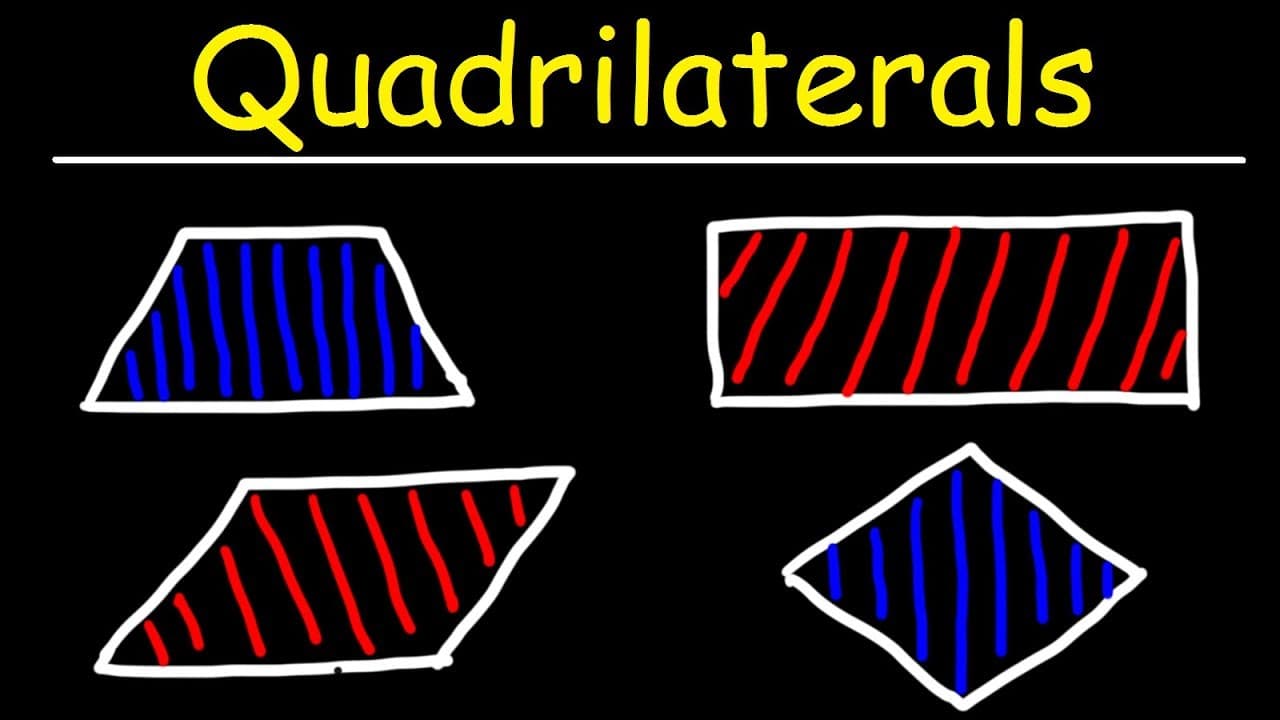
in this video we're going to talk about quadrilaterals a quadrilateral is simply a four-sided figure and it turns out that the interior angles of a four-sided figure adds up to 360. so in this example angle a plus angle b plus angle c plus angle d adds up to 360 degrees now there are certain types of quadrilaterals that have specific names this par... Read More
Key Insights
- 🍹 Quadrilaterals are four-sided figures, and the sum of their interior angles is always 360 degrees.
- 🙃 Trapezoids have two parallel sides, while isosceles trapezoids have congruent non-parallel sides.
- 🙃 Parallelograms have two pairs of parallel sides and congruent opposite sides.
- 🙃 Rectangles have four right angles, congruent opposite sides, and parallel top and bottom sides.
- 🙃 Rhombuses have all sides congruent and diagonals that bisect each other at right angles.
- 🔺 Squares have all angles as right angles and all sides congruent, like rectangles and rhombuses.
- 🔺 To solve angle problems involving quadrilaterals, determine the sum of known angles and subtract from 360 degrees to find missing angles.
Install to Summarize YouTube Videos and Get Transcripts
Explore YouTube Video Summarizer or Get YouTube Transcript Extractor
Questions & Answers
Q: What is the sum of the interior angles in a quadrilateral?
The sum of the interior angles in any quadrilateral is always 360 degrees.
Q: How can we identify a parallelogram?
A parallelogram has two pairs of parallel sides and opposite sides that are congruent in length.
Q: How is a rectangle different from other quadrilaterals?
A rectangle has four right angles (90 degrees) and opposite sides that are congruent and parallel to each other.
Q: Can you explain the properties of a rhombus?
A rhombus has all four sides congruent and the diagonals that bisect each other at right angles.
Q: How can we find the value of a missing angle in a quadrilateral?
Adding the measurements of all known angles and subtracting from 360 degrees will give the value of the missing angle.
Summary & Key Takeaways
-
Quadrilaterals are four-sided figures, and the sum of their interior angles is always 360 degrees.
-
Different types of quadrilaterals include trapezoids, parallelograms, rectangles, rhombuses, and squares, each with unique properties.
-
To solve angle problems involving quadrilaterals, use the fact that the sum of all interior angles is 360 degrees.
Read in Other Languages (beta)
Share This Summary 📚
Summarize YouTube Videos and Get Video Transcripts with 1-Click
Try YouTube Summary with ChatGPT & Claude or YouTube Transcript Generator
Explore More Summaries from The Organic Chemistry Tutor 📚





Summarize YouTube Videos and Get Video Transcripts with 1-Click
Try YouTube Summary with ChatGPT & Claude or YouTube Transcript Generator