Propagation of Sound | Don't Memorise
TL;DR
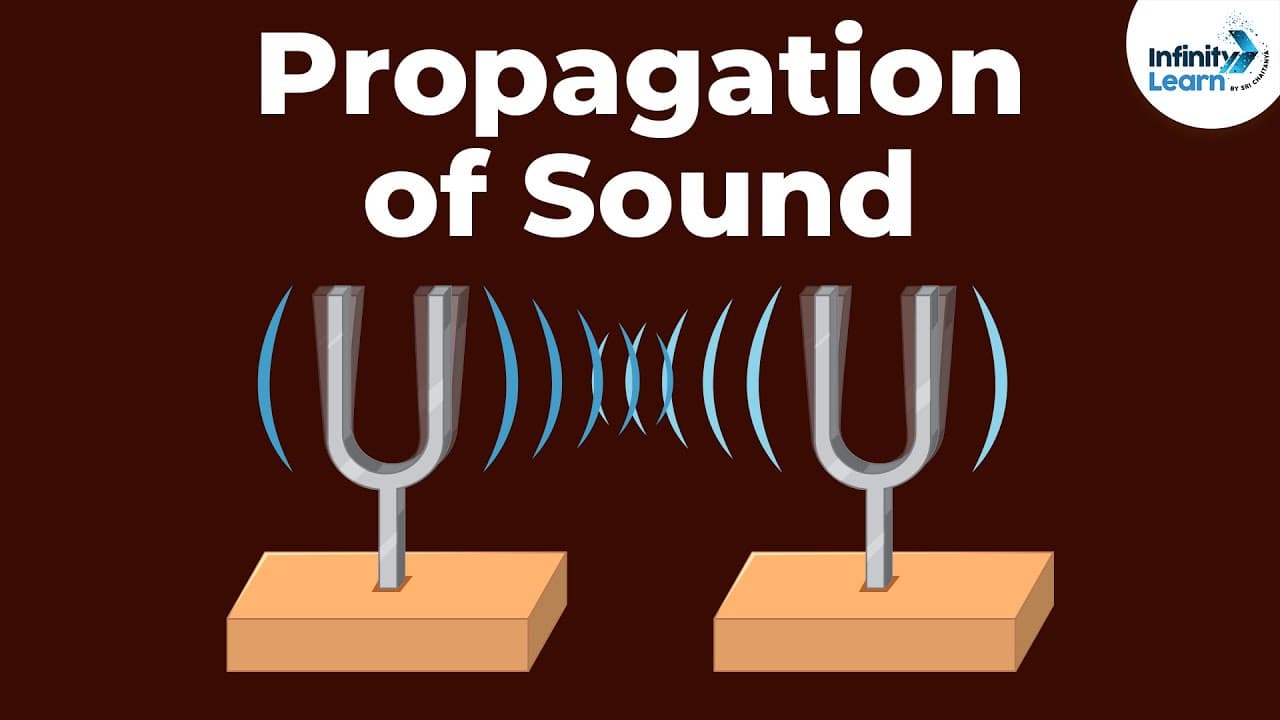
Sound waves travel through a medium by creating compressions and rarefactions, which are disturbances in the particles of the medium.
Transcript
in our previous video we studied that sound needs a medium for propagation that is it requires some medium to travel from one place to another but how does it really travel through the medium what happens to the particles of the medium let us find out we now know that sound is produced by vibration when the object is vibrating it sets the particles... Read More
Key Insights
- 📳 Sound is produced by vibration, which sets the particles of the medium into vibration.
- 🧘 The nearest particles to the source of vibration get displaced from their mean positions and start colliding with adjacent particles, creating a disturbance in the medium.
- 🔉 Sound waves travel through a medium as disturbances in the form of compressions (high pressure regions) and rarefactions (low pressure regions).
- 🗺️ The particles of the medium do not travel from the source to the human ear; it is the disturbance created by the vibrating object that travels.
- 👋 Sound waves are considered mechanical waves because they require a material medium to travel.
- 🔉 A vacuum, which lacks any medium, does not support the propagation of sound waves.
- 👋 Compressions and rarefactions created by vibrating objects generate a continuous sequence of sound waves.
Install to Summarize YouTube Videos and Get Transcripts
Explore YouTube Video Summarizer or Get YouTube Transcript Extractor
Questions & Answers
Q: How does sound travel through a medium?
Sound travels through a medium by creating disturbances in the particles of the medium, known as sound waves. These sound waves travel as compressions and rarefactions.
Q: What is a mechanical wave?
A mechanical wave is a wave that requires a material medium to travel. Since sound waves require a medium to travel, they are considered mechanical waves.
Q: Can sound travel through a vacuum?
No, sound cannot travel through a vacuum. A vacuum is an absence of any medium, so there are no particles for the sound waves to propagate through.
Summary & Key Takeaways
-
Sound is produced by vibration, which sets the particles of the medium into vibration.
-
The vibrating object creates disturbances in the medium, known as sound waves, which travel from the source to the human ear.
-
Sound waves travel in the form of compressions (high pressure regions) and rarefactions (low pressure regions) through the medium.
Read in Other Languages (beta)
Share This Summary 📚
Summarize YouTube Videos and Get Video Transcripts with 1-Click
Try YouTube Summary with ChatGPT & Claude or YouTube Transcript Generator
Explore More Summaries from Infinity Learn NEET 📚


Summarize YouTube Videos and Get Video Transcripts with 1-Click
Try YouTube Summary with ChatGPT & Claude or YouTube Transcript Generator