Lecture 27
TL;DR
Explores portfolio construction, risk, and optimization techniques.
Transcript
thank you in this lesson we'll revisit the problem of portfolio construction computation of expected returns risk correlation and covariance will also summarize our learnings of portfolio optimization with two security case and multi-security case we'll construct portfolio possibility curve and examine the feasibility region where a... Read More
Key Insights
- Portfolio construction involves balancing expected returns against risk, using metrics such as correlation and covariance to optimize asset combinations.
- Expected returns are calculated as the weighted average of individual security returns, which helps match risk profiles in portfolio applications.
- Risk in a portfolio is not just the sum of individual risks; covariance between securities plays a crucial role in determining overall risk.
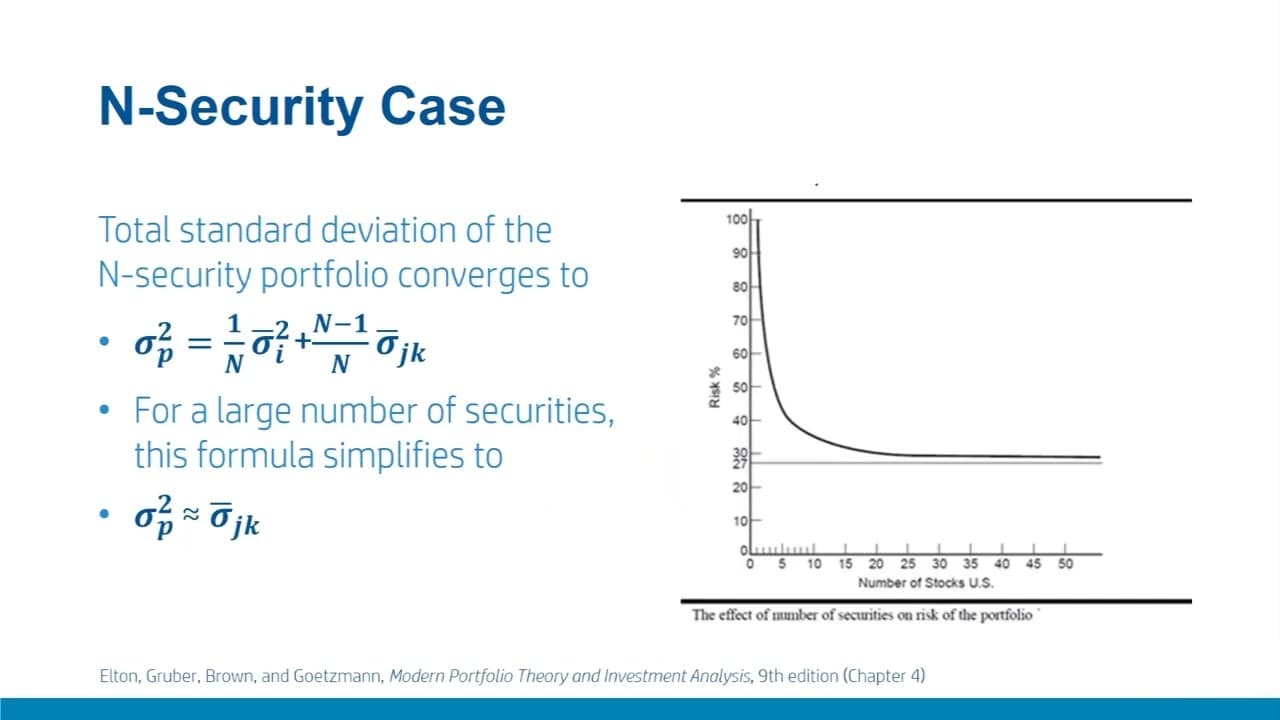
- Diversification reduces specific risk, leaving only market risk, which is non-diversifiable and arises from correlations among securities.
- The efficient frontier represents the set of optimal portfolios offering the highest expected return for a given level of risk.
- In a two-security case, the risk-return profile varies with correlation, with perfect positive correlation offering no diversification benefits.
- Adding more securities to a portfolio expands the feasible region of risk-return possibilities, enhancing diversification benefits.
- Short selling allows for extending the efficient frontier, providing opportunities for higher returns but also increasing potential risk.
Install to Summarize YouTube Videos and Get Transcripts
Explore YouTube Video Summarizer or Get YouTube Transcript Extractor
Questions & Answers
Q: What is the significance of expected returns in portfolio construction?
Expected returns are crucial in portfolio construction as they provide a measure to align with the investor's risk profile. They are calculated as the weighted average of the returns of individual securities within the portfolio. This helps in assessing the potential performance of the portfolio and making informed investment decisions, balancing the anticipated returns against the associated risks.
Q: How does covariance affect portfolio risk?
Covariance impacts portfolio risk by indicating how securities move in relation to each other. A positive covariance means that securities tend to move together, increasing risk, while a negative covariance suggests they move inversely, reducing risk. The overall portfolio risk is not just the sum of individual risks but is significantly influenced by the covariance between securities, highlighting the importance of diversification.
Q: What is the efficient frontier in portfolio optimization?
The efficient frontier is a concept in portfolio optimization that represents the set of portfolios offering the highest expected return for a given level of risk. It is a graphical representation of optimal portfolios, where each point on the frontier provides the best possible risk-return combination. Investors aim to construct portfolios that lie on this frontier to maximize returns while minimizing risk.
Q: How does diversification benefit a portfolio?
Diversification benefits a portfolio by reducing specific or idiosyncratic risk, which is the risk associated with individual securities. By including a variety of securities with different risk profiles and correlations, diversification minimizes the impact of any single security's performance on the overall portfolio. This leaves only market risk, which is non-diversifiable, thus stabilizing returns and reducing volatility.
Q: What role does correlation play in portfolio construction?
Correlation plays a critical role in portfolio construction as it measures the degree to which securities move in relation to each other. Low or negative correlation between securities enhances diversification benefits, reducing overall portfolio risk. Conversely, high positive correlation indicates that securities move together, offering limited diversification and potentially increasing portfolio risk.
Q: What is the impact of short selling on the efficient frontier?
Short selling impacts the efficient frontier by allowing investors to sell securities they do not own, usually those with lower expected returns, and reinvest the proceeds into higher-return securities. This strategy extends the efficient frontier beyond the point of maximum return, theoretically offering infinite returns. However, it also increases potential risk, as short selling involves borrowing securities and can lead to significant losses if the market moves unfavorably.
Q: Why is a concave efficient frontier considered feasible?
A concave efficient frontier is considered feasible because it represents portfolios that offer higher returns for a given level of risk, aligning with the principle of diversification. A concave shape indicates that as risk increases, returns increase at a decreasing rate, reflecting optimal risk-return trade-offs. Convex frontiers, on the other hand, suggest higher risk for lower returns, which is not desirable or feasible in real-world portfolio management.
Q: How does the addition of securities affect the feasible region?
The addition of securities to a portfolio expands the feasible region, which represents all possible combinations of risk and return. More securities increase diversification opportunities, reducing specific risk and enhancing the potential for achieving optimal risk-return combinations. This expansion allows investors to construct portfolios that better align with their risk preferences and investment goals, moving closer to the efficient frontier.
Summary & Key Takeaways
-
This content covers the fundamentals of portfolio construction, focusing on the balance between expected returns and risk. It explains the calculation of expected returns and the role of covariance in risk assessment, emphasizing the importance of diversification in reducing specific risks.
-
The efficient frontier is a key concept, representing the optimal portfolios with the best risk-return trade-offs. The discussion includes both theoretical and practical aspects of portfolio optimization, considering different correlation scenarios and the impact of adding more securities.
-
Short selling is introduced as a strategy to enhance the efficient frontier by selling lower-return securities and investing in higher-return ones. This approach can theoretically lead to infinite returns but also increases risk, highlighting the trade-offs in portfolio management.
Read in Other Languages (beta)
Share This Summary 📚
Summarize YouTube Videos and Get Video Transcripts with 1-Click
Try YouTube Summary with ChatGPT & Claude or YouTube Transcript Generator
Explore More Summaries from IIT KANPUR-NPTEL 📚



Summarize YouTube Videos and Get Video Transcripts with 1-Click
Try YouTube Summary with ChatGPT & Claude or YouTube Transcript Generator