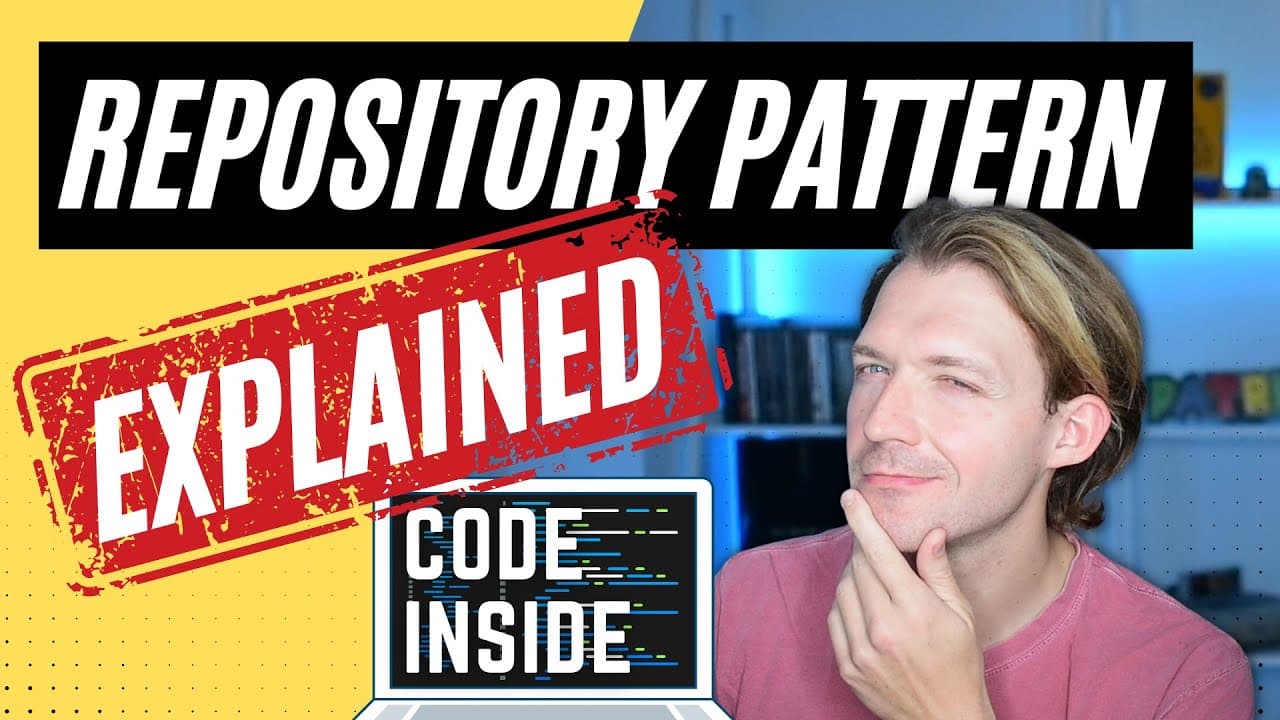
The Repository Pattern explained for EVERYONE (with Code Examples) 🚀
TL;DR
The repository pattern is a way to encapsulate data access logic in a class, providing better maintainability and decoupling. Object-relational mapping (ORM) is often used in combination with the repository pattern.
Transcript
now first let's have a look at one or two definitions of the repository pattern we'll break this down a little and then I guess even more important is how would you actually write the code of such a repository pattern so how would you develop this stuff I will show you that and make sure to stick around until the end because then we will also talk ... Read More
Key Insights
- ♿ The repository pattern centralizes data access logic, improving maintainability and decoupling.
- 👨💻 By using the repository pattern, code duplication can be reduced, leading to more reusable and scalable code.
- 💨 Object-relational mapping tools like Entity Framework simplify data access by abstracting away the intricacies of database operations.
- 🕸️ The repository pattern can be applied in various contexts, including web APIs.
- 🈸 A well-implemented repository pattern can significantly enhance the overall architecture and flexibility of an application.
- 💄 The repository pattern promotes separation of concerns and makes unit testing easier.
- 🐕🦺 Dependency injection is often used in conjunction with the repository pattern to inject repository instances into controllers or services.
Install to Summarize YouTube Videos and Get Transcripts
Explore YouTube Video Summarizer or Get YouTube Transcript Extractor
Questions & Answers
Q: What is the purpose of the repository pattern?
The repository pattern aims to encapsulate data access logic, centralizing it in a class and providing better maintainability and decoupling from the domain model layer.
Q: How does the repository pattern improve code reusability?
By implementing the repository pattern, you can reuse the same data access logic across multiple controllers or services, reducing code duplication.
Q: What is the role of object-relational mapping (ORM) in the repository pattern?
ORM tools like Entity Framework work in conjunction with the repository pattern to abstract the database operations, simplifying data access and eliminating the need for manual SQL queries.
Q: Can the repository pattern be used in web APIs?
Yes, the repository pattern can be used in web APIs to separate the data access logic from the controller, making the code more modular and maintainable.
Key Insights:
- The repository pattern centralizes data access logic, improving maintainability and decoupling.
- By using the repository pattern, code duplication can be reduced, leading to more reusable and scalable code.
- Object-relational mapping tools like Entity Framework simplify data access by abstracting away the intricacies of database operations.
- The repository pattern can be applied in various contexts, including web APIs.
- A well-implemented repository pattern can significantly enhance the overall architecture and flexibility of an application.
- The repository pattern promotes separation of concerns and makes unit testing easier.
- Dependency injection is often used in conjunction with the repository pattern to inject repository instances into controllers or services.
- It is crucial to properly configure the dependency injection container to ensure the correct implementation of the repository is used throughout the application.
Summary & Key Takeaways
-
The repository pattern is a class or component that centralizes data access functionality, improving maintainability and decoupling from the domain model layer.
-
Martin Fowler defines a repository as an intermediary between the domain model layer and data mapping, supporting declaratively built queries.
-
The video demonstrates how to implement the repository pattern using C# and the example of a weather forecast service.
-
Object-relational mapping, such as Entity Framework, can be used with the repository pattern to simplify data access and eliminate the need for manual database operations.
Read in Other Languages (beta)
Share This Summary 📚
Summarize YouTube Videos and Get Video Transcripts with 1-Click
Try YouTube Summary with ChatGPT & Claude or YouTube Transcript Generator
Explore More Summaries from Patrick God 📚




Summarize YouTube Videos and Get Video Transcripts with 1-Click
Try YouTube Summary with ChatGPT & Claude or YouTube Transcript Generator