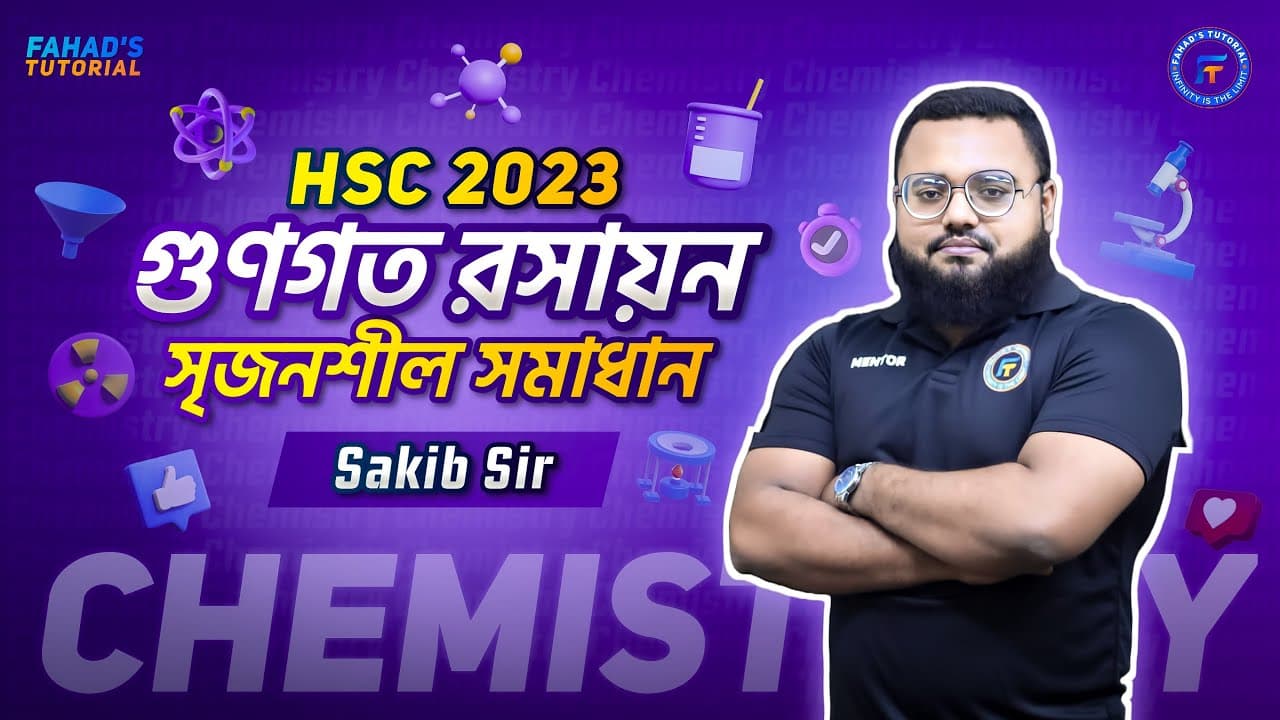
গুনগত রসায়নের সবকিছু একসাতে । সৃজনশীল ও বহুনির্বাচনী সমাধান । সাকিব স্যার । Fahad's Tutorial HSC'23
TL;DR
A detailed chemistry lesson covering qualitative analysis and problem-solving.
Transcript
foreign foreign foreign clear done okay alhamdulillah um foreign thank you okay sir clear okay foreign foreign okay take us days first class foreign okay foreign foreign foreign foreign foreign foreign foreign foreign okay so foreign foreign foreign foreign foreign foreign minus one zero plus one is zero plus minus one plus minus two minus one zero... Read More
Key Insights
- The session focuses on qualitative chemistry, emphasizing both creative and multiple-choice problem-solving techniques to enhance understanding.
- Key concepts include the calculation of energy levels, orbitals, and the application of the Rydberg formula in spectral analysis.
- Detailed explanations of chemical reactions, including equilibrium constants and solubility products, are provided to illustrate complex chemical processes.
- The instructor uses various examples to demonstrate the application of theoretical concepts to practical problems in chemistry.
- The lesson includes step-by-step calculations and problem-solving strategies to help students grasp difficult topics more effectively.
- The importance of understanding the periodic table and electron configurations is highlighted as foundational knowledge for advanced chemistry topics.
- The session also covers the significance of chemical bonding and molecular structure in determining the properties of substances.
- Interactive elements, such as student questions and real-time problem-solving, are integrated to facilitate active learning.
Install to Summarize YouTube Videos and Get Transcripts
Explore YouTube Video Summarizer or Get YouTube Transcript Extractor
Questions & Answers
Q: What is the main focus of the chemistry lesson?
The main focus of the lesson is on qualitative chemistry, specifically on creative and multiple-choice problem-solving techniques. The instructor covers various topics, including energy levels, orbitals, and the application of the Rydberg formula, providing a comprehensive overview of these key concepts.
Q: How does the instructor explain complex chemical processes?
The instructor uses detailed explanations and step-by-step calculations to illustrate complex chemical processes. By providing examples of chemical reactions, equilibrium constants, and solubility products, the instructor helps students understand the practical application of theoretical concepts in chemistry.
Q: What foundational knowledge is emphasized in the lesson?
The lesson emphasizes the importance of understanding the periodic table and electron configurations as foundational knowledge for advanced chemistry topics. This understanding is crucial for grasping more complex concepts, such as chemical bonding, molecular structure, and the properties of substances.
Q: How are interactive elements used in the session?
Interactive elements, such as student questions and real-time problem-solving, are integrated into the session to facilitate active learning. These elements allow students to engage with the material, ask questions, and receive immediate feedback, enhancing their overall understanding of the topics covered.
Q: What is the significance of chemical bonding and molecular structure?
Chemical bonding and molecular structure are significant because they determine the properties of substances. Understanding these concepts is essential for predicting how substances will behave in different chemical reactions and for explaining the physical and chemical properties of compounds.
Q: How are problem-solving strategies incorporated into the lesson?
Problem-solving strategies are incorporated through step-by-step explanations and practical examples. The instructor demonstrates how to approach and solve various types of chemistry problems, providing students with the tools and techniques needed to tackle challenging questions effectively.
Q: What topics are covered in relation to the Rydberg formula?
The lesson covers the application of the Rydberg formula in spectral analysis, explaining how it is used to calculate energy levels and transitions between orbitals. The instructor provides examples and calculations to demonstrate the formula's practical application in understanding atomic spectra.
Q: How does the lesson address the properties of substances?
The lesson addresses the properties of substances by explaining the role of chemical bonding and molecular structure. By understanding these concepts, students can predict how substances will behave in chemical reactions and understand their physical and chemical properties, which are crucial for qualitative analysis.
Summary & Key Takeaways
-
This chemistry lesson provides a comprehensive overview of qualitative chemistry, focusing on problem-solving techniques for both creative and multiple-choice questions. Key topics include energy levels, orbitals, and the application of the Rydberg formula. The instructor uses examples and calculations to explain complex concepts effectively.
-
The session emphasizes the understanding of chemical reactions, equilibrium constants, and solubility products. The instructor provides step-by-step explanations and problem-solving strategies to help students tackle difficult chemistry topics. The lesson also highlights the importance of the periodic table and electron configurations.
-
Interactive elements, such as student questions and real-time problem-solving, are incorporated to enhance learning. The lesson covers the significance of chemical bonding and molecular structure in determining substance properties, providing a well-rounded understanding of qualitative chemistry.
Read in Other Languages (beta)
Share This Summary 📚
Summarize YouTube Videos and Get Video Transcripts with 1-Click
Try YouTube Summary with ChatGPT & Claude or YouTube Transcript Generator
Explore More Summaries from Fahad's Tutorial 📚



Summarize YouTube Videos and Get Video Transcripts with 1-Click
Try YouTube Summary with ChatGPT & Claude or YouTube Transcript Generator