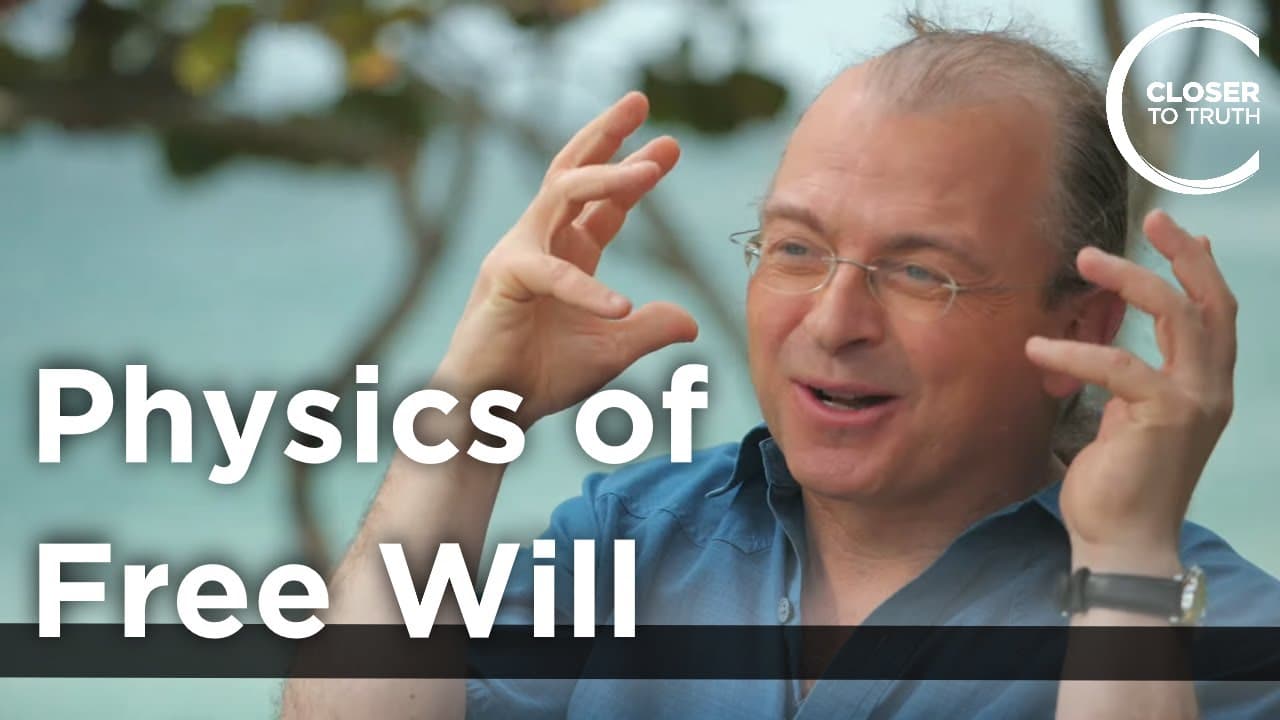
Seth Lloyd - Physics of Free Will
TL;DR
In physics, the concept of free will is not dependent on consciousness or intelligence, but rather on the capacity for self-reference and the ability to ask the question of what one is going to do.
Transcript
Seth I've been somewhat obsessed with the concept of Free Will and I've made the mistake of talking largely to philosophers so I want you to tell me from a physics point of view what can we learn about Free Will assuming that the universe is predictable in some real sense underlying quantum mechanics in some way you still believe there's a robust k... Read More
Key Insights
- 🥶 Belief in free will is not dependent on the deterministic nature of the universe.
- 🥶 The capacity for self-reference is crucial for the experience of free will.
- 🥶 Computers are incapable of having free will due to their lack of self-reference.
Install to Summarize YouTube Videos and Get Transcripts
Explore YouTube Video Summarizer or Get YouTube Transcript Extractor
Questions & Answers
Q: Why do people believe in free will despite the deterministic nature of the universe?
People believe in free will because they have the experience of making decisions and acting according to their own choices. This belief is not necessarily dependent on the actual nature of the universe.
Q: Can computers have free will?
No, computers cannot have free will because their actions are determined by their programming. They lack the capacity for self-reference and the ability to question what they will do in the future.
Q: Is there a difference between the free will of a sentient being and a physical object like a computer?
From a physics perspective, there is no difference. Both sentient beings and physical objects can have the experience of making decisions, as long as they possess the ability to ask the question of what they will do.
Q: Can we predict our own future actions?
According to the Gödel theorem in logic, there are always questions that a system, including our own brains, cannot answer. It is impossible for us to predict our own future actions with certainty.
Key Insights:
- Belief in free will is not dependent on the deterministic nature of the universe.
- The capacity for self-reference is crucial for the experience of free will.
- Computers are incapable of having free will due to their lack of self-reference.
- The ability to predict our own future actions is limited due to inherent limitations in self-reference and computation.
Summary & Key Takeaways
-
The belief in free will is prevalent among humans, despite the deterministic nature of the universe.
-
Philosophers and scientists in the past have attributed this belief to the slight swerves of atoms, but this view is challenged.
-
The experience of free will is not tied to consciousness or intelligence, but rather to the ability to ask the question of what one is going to do.
Read in Other Languages (beta)
Share This Summary 📚
Summarize YouTube Videos and Get Video Transcripts with 1-Click
Try YouTube Summary with ChatGPT & Claude or YouTube Transcript Generator
Explore More Summaries from Closer To Truth 📚



Summarize YouTube Videos and Get Video Transcripts with 1-Click
Try YouTube Summary with ChatGPT & Claude or YouTube Transcript Generator