Transition times of diode | Storage | Pulse Digital Circuits ( PDC ) | Lec-37
TL;DR
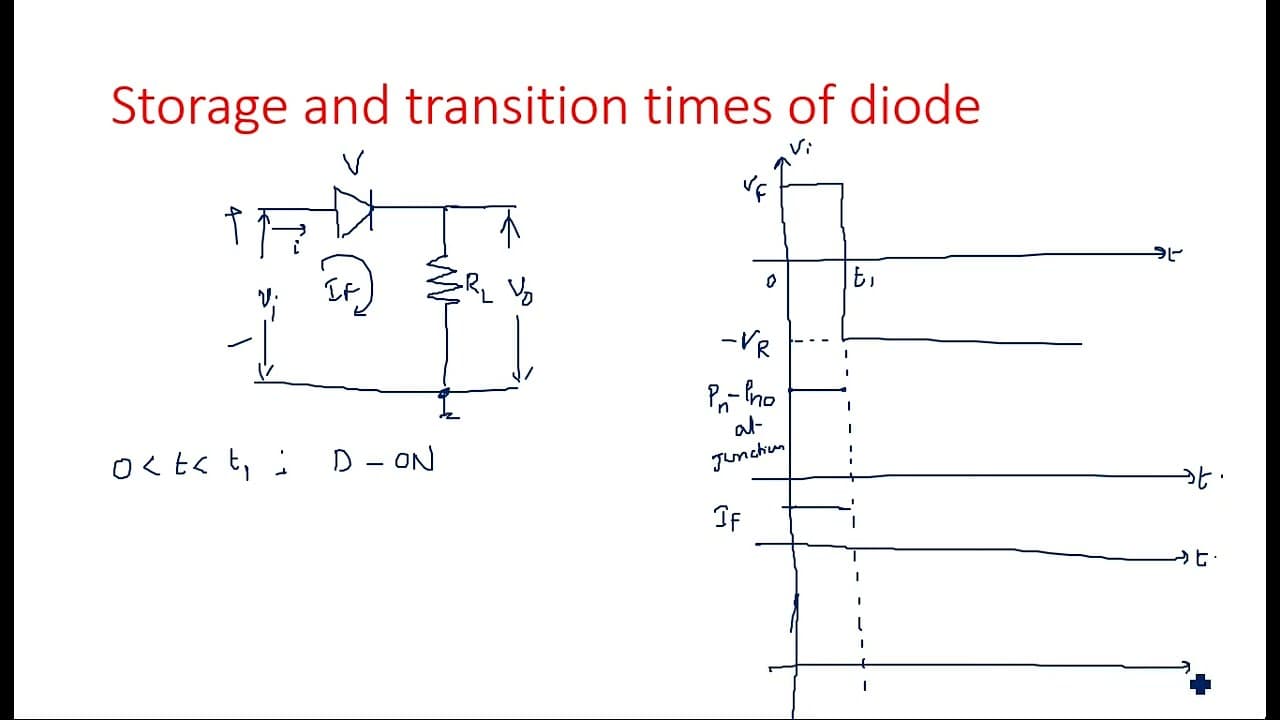
This video explains diode storage and transition times when reversing bias conditions.
Transcript
hi everyone so in this video I am going to explain about storage and transition times of the diode in the previous video we have seen forward reverse a forward recovery time and reverse recovery time and how the diode is acting as a switch what are the materials involved and how the electrons and holes are moving across the junction that all we hav... Read More
Key Insights
- ⚡ Storage time is measured after a diode's voltage polarity is reversed, indicating how long it retains previous voltage.
- ⌛ Transition time signifies the required duration for a diode to completely switch from forward bias to reverse bias condition.
- 🕳️ The behavior of electrons and holes plays a pivotal role during the periods of storage and transition times in diodes.
- ⚡ High initial forward voltage leads to maximum current flow until reverse bias is applied, at which point current begins to decrease.
- 💱 Diode voltage changes significantly during the transition, affecting the current behavior due to the change in charge carrier distribution.
- ☠️ The rate at which minority charge carriers release impacts the overall performance and functionality of diodes in circuits.
- ⌛ The effects of storage and transition times are often negligible in idealized diode models but become significant in practical applications.
Install to Summarize YouTube Videos and Get Transcripts
Explore YouTube Video Summarizer or Get YouTube Transcript Extractor
Questions & Answers
Q: What is storage time in a diode?
Storage time in a diode is the duration it holds onto the previous voltage after the polarity of the input voltage is suddenly reversed. During this time, the diode retains minority charge carriers before they completely dissipate. This is crucial for understanding how the diode behaves during rapid changes in voltage.
Q: How does a diode transition from forward to reverse bias?
A diode transitions from forward to reverse bias when the input voltage changes polarity. Initially, the diode conducts current in the forward direction, but as the voltage becomes negative, the diode stops conducting and begins to clear stored minority charge carriers before entering a stable reverse bias state.
Q: What happens to charge carriers during transition time in a diode?
During transition time, minority charge carriers within the diode are gradually released before the device fully stabilizes in reverse bias. The time taken for the majority carriers to deplete and for the current to stabilize in the opposite direction is called transition time, reflecting the diode's dynamic response to voltage changes.
Q: Why are storage and transition times important in diode operation?
Storage and transition times are critical for understanding the response time of diodes in circuits, especially in high-speed applications. They influence how quickly a diode can switch states, affecting the overall performance in electronic devices. Understanding these times helps in designing circuits that utilize diodes effectively.
Summary & Key Takeaways
-
The video explores the concept of storage time, which refers to the duration a diode retains previous voltage when the bias polarity is reversed.
-
Transition time is defined as the time it takes for a diode to switch from forward bias to reverse bias condition after a voltage change.
-
Detailed analysis of diode characteristics during forward and reverse bias is provided, including the behavior of charge carriers during these changes.
Read in Other Languages (beta)
Share This Summary 📚
Summarize YouTube Videos and Get Video Transcripts with 1-Click
Try YouTube Summary with ChatGPT & Claude or YouTube Transcript Generator