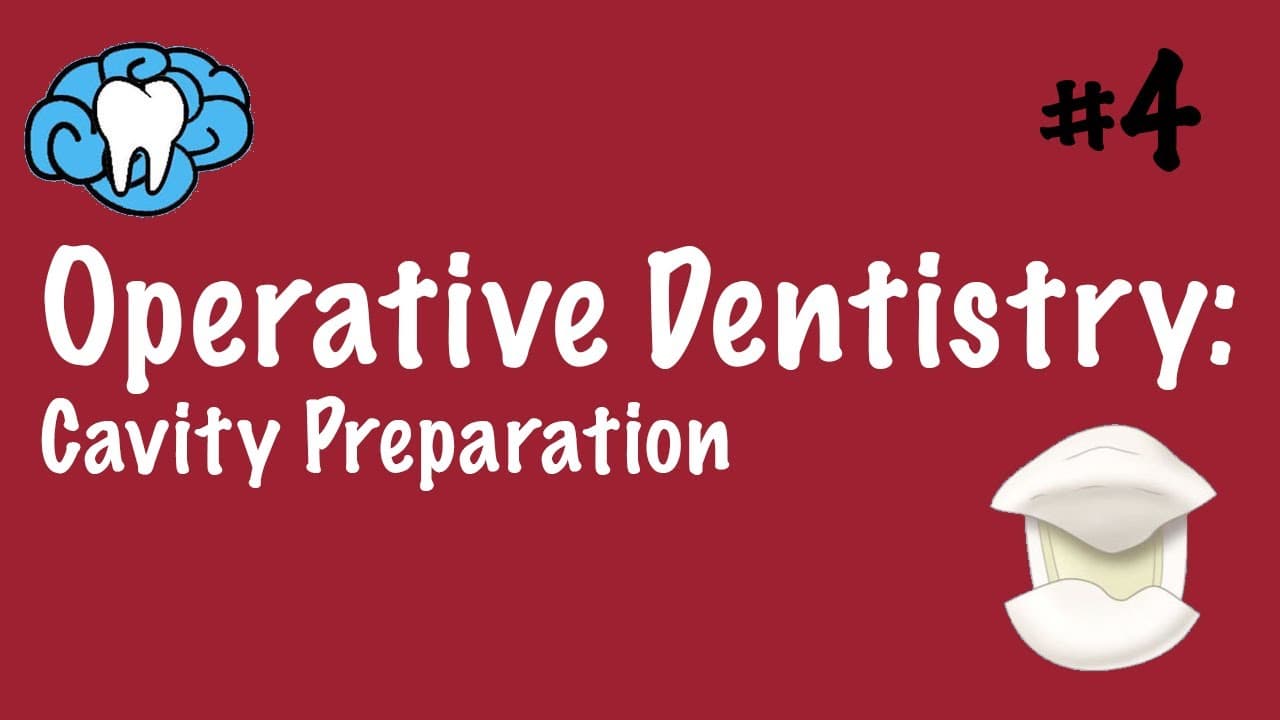
Operative Dentistry | Cavity Preparation | INBDE, ADAT
TL;DR
This video discusses the cavity preparation process, including classifications, steps, and techniques for different types of decay.
Transcript
hey everybody ryan here and welcome back to our operative dentistry series this video we will talk all about the cavity preparation how to classify them how to name the different components of them and finally we'll go through from start to finish how to do a cavity preparation so green vardaman black better known as gv black is one of the founders... Read More
Key Insights
- ❓ GV Black's classification system is widely used for cavity preparations.
- 🍉 Cavity preparations require careful attention to detail in terms of margin definition, wall naming, and angle identification.
- ❓ The eight steps of cavity preparation ensure proper removal of caries, protection of the pulp, and incorporation of resistance and retention features.
Install to Summarize YouTube Videos and Get Transcripts
Explore YouTube Video Summarizer or Get YouTube Transcript Extractor
Questions & Answers
Q: What is the classification system for cavity preparations?
The classification system for cavity preparations includes Class 1, Class 2, Class 3, Class 4, Class 5, and Class 6 decay, each involving different surfaces of the teeth and locations within the mouth.
Q: How is the cavo surface margin defined in a cavity preparation?
The cavo surface margin is the area where the cavity preparation meets the original tooth surface. It is important to define this margin accurately for the rest of the preparation process.
Q: What are the steps of cavity preparation?
The eight steps of cavity preparation are outline form, primary resistance form, primary retention form, convenience form, removal of remaining defects, pulp protection, secondary resistance and retention features, and finishing external walls.
Q: What are some additional features used for resistance and retention in cavity preparations?
Additional features for resistance and retention in cavity preparations include retentive grooves, beveled enamel margins, slots, and pins. These features help prevent displacement of the restorative material.
Key Insights:
- GV Black's classification system is widely used for cavity preparations.
- Cavity preparations require careful attention to detail in terms of margin definition, wall naming, and angle identification.
- The eight steps of cavity preparation ensure proper removal of caries, protection of the pulp, and incorporation of resistance and retention features.
- Different restorative materials, such as amalgam, composite, and gold, require specific preparation techniques to ensure the longevity of the restoration.
Summary & Key Takeaways
-
The video introduces the classification system for cavity preparations, including Class 1 decay (occlusal surfaces), Class 2 decay (proximal surfaces), Class 3 decay (proximal surfaces of incisors and canines), Class 4 decay (proximal surfaces involving the incisal angle), Class 5 decay (cervical third of facial or lingual surfaces), and Class 6 decay (incisal edge or cusp tips).
-
The cavity preparation process involves defining the cavo surface margin, identifying external and internal walls, and understanding the concepts of line angles and point angles.
-
The video explains the eight steps of cavity preparation, including outline form, primary resistance form, primary retention form, convenience form, removal of remaining defects, pulp protection, secondary resistance and retention features, and finishing external walls.
Read in Other Languages (beta)
Share This Summary 📚
Summarize YouTube Videos and Get Video Transcripts with 1-Click
Try YouTube Summary with ChatGPT & Claude or YouTube Transcript Generator
Explore More Summaries from Mental Dental 📚

Summarize YouTube Videos and Get Video Transcripts with 1-Click
Try YouTube Summary with ChatGPT & Claude or YouTube Transcript Generator