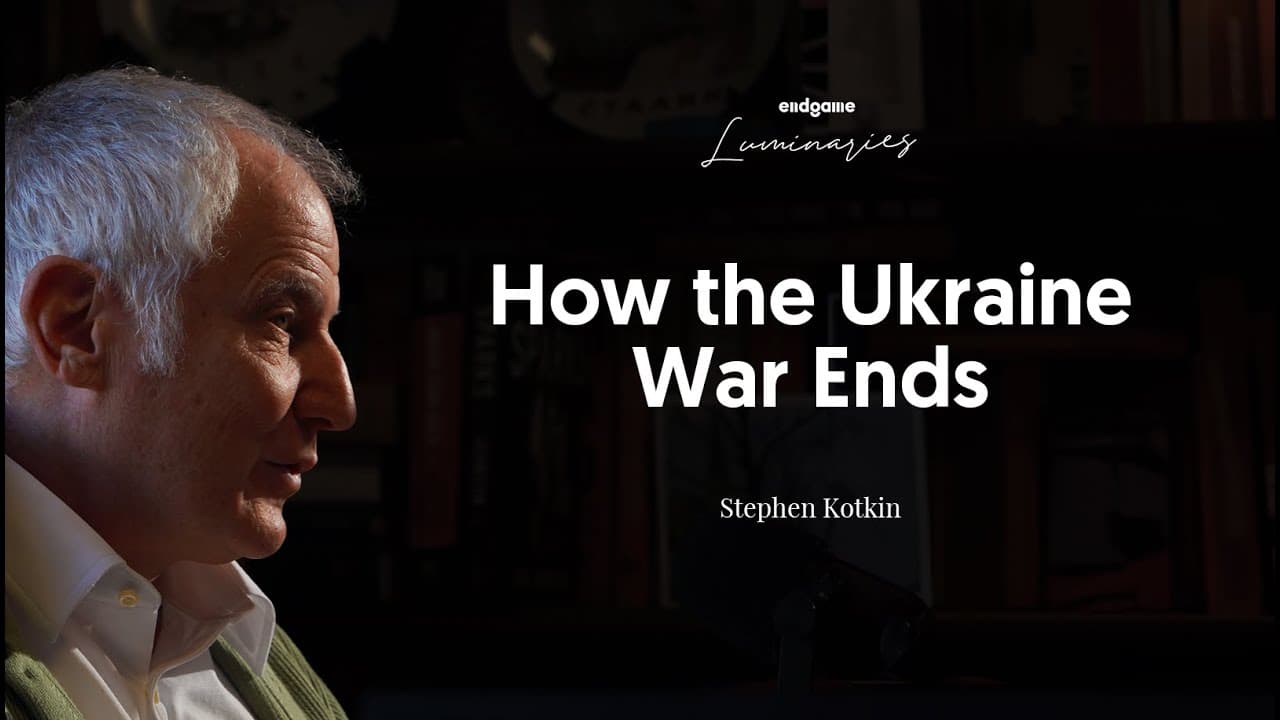
How Not to Win the War, but the Peace - Stephen Kotkin | Endgame #174 (Luminaries)
TL;DR
Stephen Kotkin discusses geopolitical challenges, emphasizing peace over war victory.
Transcript
Stephen Kotkin: A bilateral US-China won't work to our advantage. The President of the United States, President Biden. President Biden is sitting down for a high-stakes meeting with Chinese President, Xi Jinping. Chinese Leader, Xi Jinping. This will be their first in person talks in more than a year. What are we expecting from a summit? — I agree ... Read More
Key Insights
- Stephen Kotkin emphasizes the importance of understanding history to navigate future geopolitical challenges, suggesting that while history doesn't predict the future, it shows that the present won't last.
- Kotkin argues that winning the peace is more crucial than winning the war, citing examples like Vietnam, where the U.S. lost the war but won the peace through improved relations.
- The conversation highlights the necessity of empathy in international relations, urging Americans to understand foreign cultures and perspectives to enhance global diplomacy.
- Kotkin discusses the complexity of the Ukraine conflict, suggesting that an armistice and integration into the European Union could be more beneficial for Ukraine than reclaiming all lost territories.
- He advocates for a balanced approach in U.S.-China relations, emphasizing the need for self-confidence and collaboration with allies rather than unilateral actions.
- Kotkin stresses the importance of education and travel in broadening perspectives, encouraging young people to experience different cultures to better understand global dynamics.
- The discussion underscores the significance of alliances, suggesting that a strong transatlantic partnership is crucial for effective China policy.
- Kotkin warns against viewing global issues solely through the lens of U.S.-China relations, advocating for a broader understanding of regional aspirations and challenges.
Install to Summarize YouTube Videos and Get Transcripts
Explore YouTube Video Summarizer or Get YouTube Transcript Extractor
Questions & Answers
Q: What is Stephen Kotkin's perspective on winning the peace in Ukraine?
Stephen Kotkin believes that winning the peace in Ukraine involves focusing on achievable goals like European Union integration and security guarantees rather than reclaiming all lost territories. He argues that an armistice could allow Ukraine to rebuild and transform its institutions, ultimately achieving long-term stability and prosperity.
Q: How does Kotkin view the role of history in understanding current geopolitical challenges?
Kotkin sees history as a crucial tool for understanding current geopolitical challenges, as it reveals that the present conditions are not permanent. While history cannot predict the future, it can provide insights into how systems change and the factors that drive such transformations, helping policymakers anticipate and shape future developments.
Q: What does Kotkin suggest about U.S.-China relations?
Kotkin suggests that the U.S. should approach China with confidence in its strengths and leverage its alliances. He advocates for a multilateral approach, involving allies in negotiations to ensure that the terms of sharing the planet with China protect democratic values and institutions, rather than allowing authoritarian influence to grow unchecked.
Q: Why does Kotkin emphasize empathy in international relations?
Kotkin emphasizes empathy in international relations because understanding other cultures and perspectives is essential for effective diplomacy. He argues that Americans need to engage with the world, learn foreign languages, and experience different societies to better understand global dynamics and foster more meaningful international partnerships.
Q: What does Kotkin mean by 'winning the peace'?
Winning the peace, according to Kotkin, means creating conditions for long-term stability and prosperity after a conflict, rather than merely achieving military victory. This involves establishing political and economic systems that prevent future conflicts, promote development, and ensure that the outcomes of war lead to lasting positive change.
Q: How does Kotkin view the role of alliances in global politics?
Kotkin views alliances as vital in global politics, arguing that strong partnerships enhance a country's ability to influence global affairs. He believes that the U.S. should work closely with its allies to address challenges like China's rise, as collective action is more effective than unilateral efforts in maintaining a rules-based international order.
Q: What is Kotkin's stance on the importance of education and travel?
Kotkin advocates for education and travel as essential for broadening perspectives and understanding global dynamics. He encourages young people to experience different cultures, which can lead to a deeper understanding of their own society and improve their ability to engage in international relations with empathy and insight.
Q: What does Kotkin say about the pivot to Asia?
Kotkin criticizes the notion of a 'pivot to Asia' as misleading, arguing that the U.S. has long been an Asian power with deep ties in the region. He suggests that strengthening transatlantic relations can enhance U.S. policy towards China, as a unified Western approach is more effective in addressing the challenges posed by China's rise.
Summary & Key Takeaways
-
Stephen Kotkin discusses the importance of winning the peace rather than just the war, using historical examples to illustrate how peace can be achieved even after losing a war. He emphasizes the need for empathy and understanding in international relations, urging Americans to learn from and engage with other cultures.
-
Kotkin highlights the complexities of the Ukraine conflict, suggesting that an armistice and integration into the European Union could be more beneficial for Ukraine than reclaiming all lost territories. He also discusses the importance of a balanced approach in U.S.-China relations, emphasizing collaboration with allies.
-
The conversation underscores the significance of alliances and the need for a strong transatlantic partnership in addressing global challenges, particularly in relation to China. Kotkin warns against viewing global issues solely through the U.S.-China lens, advocating for a broader understanding of regional aspirations.
Read in Other Languages (beta)
Share This Summary 📚
Summarize YouTube Videos and Get Video Transcripts with 1-Click
Try YouTube Summary with ChatGPT & Claude or YouTube Transcript Generator
Explore More Summaries from Gita Wirjawan 📚



Summarize YouTube Videos and Get Video Transcripts with 1-Click
Try YouTube Summary with ChatGPT & Claude or YouTube Transcript Generator