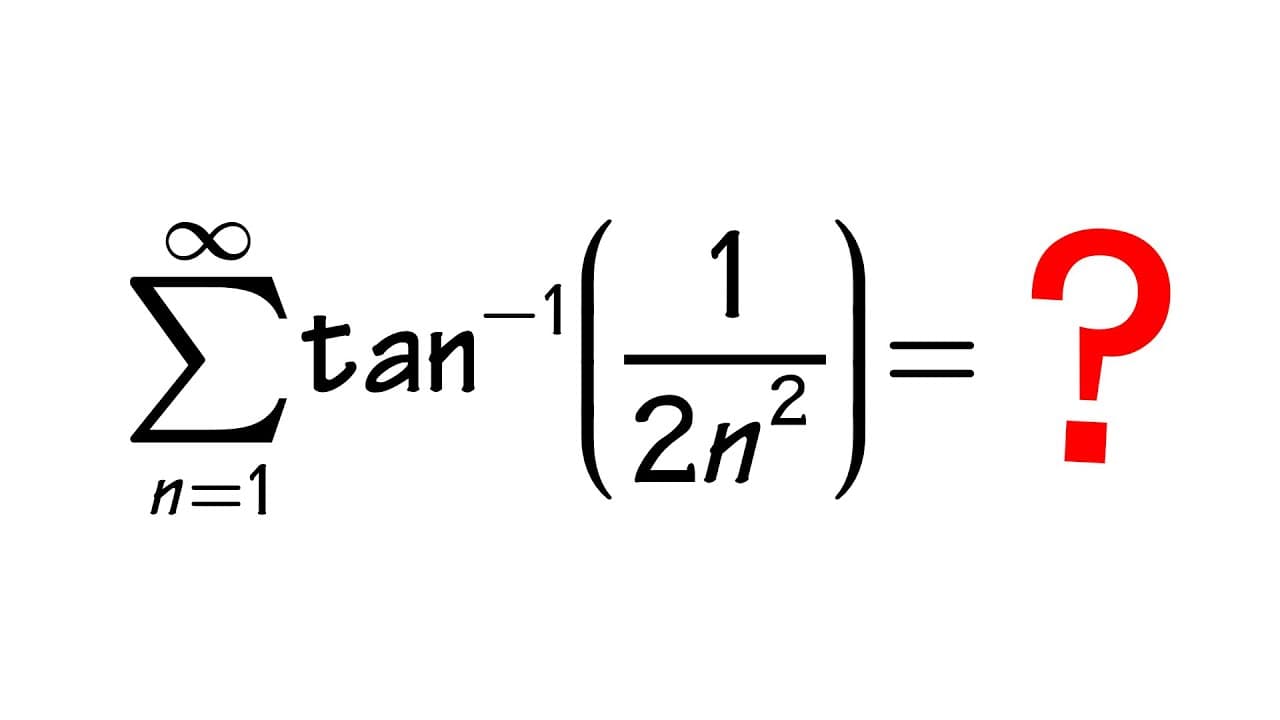
What Is the Sum of arctan(1/(2n^2))?
TL;DR
The sum of arctan(1/(2n^2)) from 1 to infinity equals π/4. This result is derived by breaking the series into a telescoping series using the tangent subtraction formula, which allows for the cancellation of terms.
Transcript
okay let's do some more fun here we're gonna compute the sum as n goes from 1 to infinity of interest engine of 1 over 2 and square and as always please pause the video and try this first okay however you get so have a chance to try this right here and let me tell you guess the answer to this right here is very nice T equal to PI over 4 unfortunate... Read More
Key Insights
- 🍹 The sum of the inverse tangent series can be computed using telescoping series.
- 🍹 The sum involves manipulating the equation using the angle subtraction formula for tangent.
- 🏆 The convergence of the series can be demonstrated using the comparison test.
- 🥳 Breaking down the inverse tangent into two parts is essential for creating a telescoping series.
- 🍉 The telescoping series cancels out terms, simplifying the computation of the sum.
- ❓ The final answer is PI over 4, which is positive.
- 🔭 This method can be applied to similar problems involving telescoping series.
Install to Summarize YouTube Videos and Get Transcripts
Explore YouTube Video Summarizer or Get YouTube Transcript Extractor
Questions & Answers
Q: How is the sum of the inverse tangent from 1 to infinity of 1 over 2 squared computed?
The sum is computed using telescoping series, which involves manipulating the equation and canceling out terms.
Q: Can the convergence of the series be proved using the comparison test?
Yes, the comparison test can be used to show that the series converges by comparing it to the series of 1 over N squared.
Q: What is the significance of breaking down the inverse tangent into two parts?
Breaking down the inverse tangent allows for the creation of a telescoping series, which simplifies the computation of the sum.
Q: Is the final answer of PI over 4 negative or positive?
The final answer is positive PI over 4, as the negative sign in the equation cancels out with other terms.
Summary & Key Takeaways
-
The sum of the inverse tangent from 1 to infinity of 1 over 2 squared can be computed using telescoping series.
-
By using the angle subtraction formula for tangent and manipulating the equation, the sum can be simplified.
-
The resulting telescoping series cancels out terms, leading to the final answer of PI over 4.
Read in Other Languages (beta)
Share This Summary 📚
Summarize YouTube Videos and Get Video Transcripts with 1-Click
Try YouTube Summary with ChatGPT & Claude or YouTube Transcript Generator
Explore More Summaries from blackpenredpen 📚


Summarize YouTube Videos and Get Video Transcripts with 1-Click
Try YouTube Summary with ChatGPT & Claude or YouTube Transcript Generator