How Does Ether Affect Stellar Aberration?
TL;DR
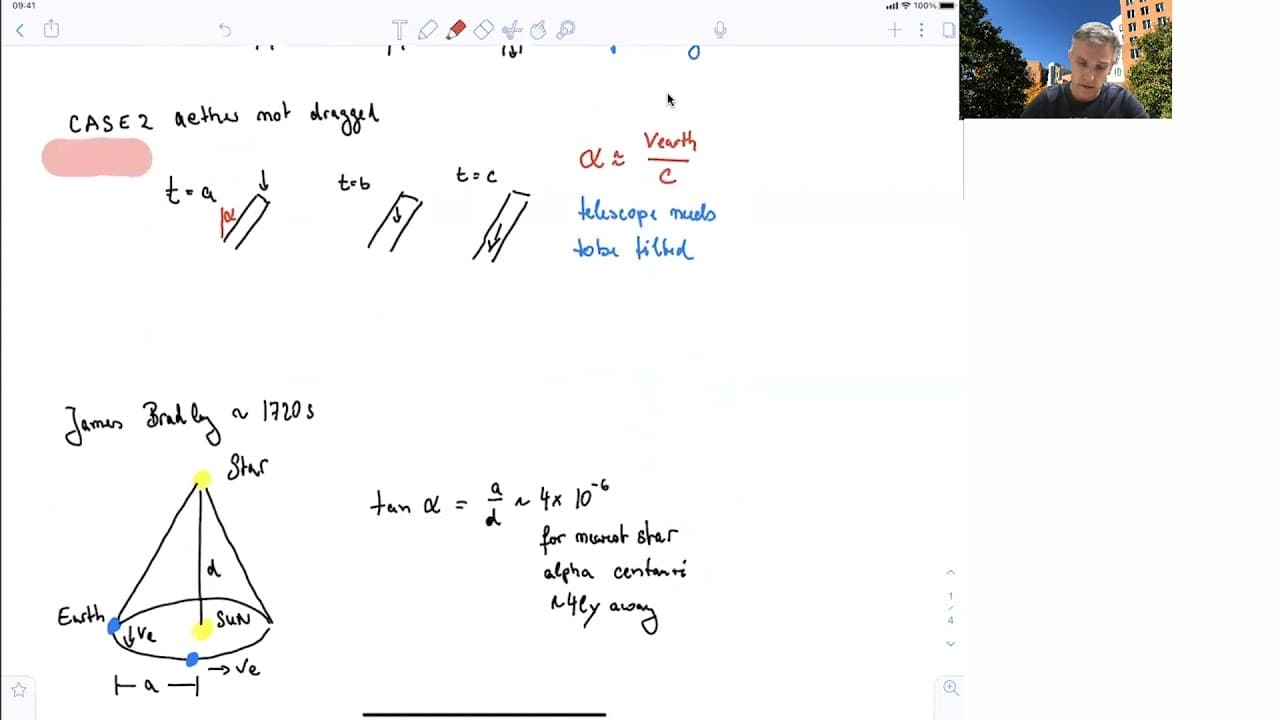
Ether's existence alters how we perceive light from distant stars, requiring telescope adjustments. When ether is considered, telescopes appear to point straight; without it, they must tilt due to Earth's movement. James Bradley's 1720s findings support this tilt, linking it to the particle nature of light.
Transcript
MARKUS KLUTE: Welcome back to 8.20, special relativity. So we're going to continue the discussion that makes a case against ether when discussing stellar aberration. So the problem we have in mind here is the ones where we use a telescope to look at a distant star. When we do this, the fact of ether might change the way we have to orient our telesc... Read More
Key Insights
- 🤩 The existence of ether and its drag with the Earth affects the orientation of telescopes when observing distant stars.
- 🙂 Without ether, telescopes need to be tilted slightly due to the Earth's movement in a different reference frame.
- 🙂 James Bradley's research in the 1720s supported the particle nature of light and the need for tilting due to the Earth's movement around the Sun.
Install to Summarize YouTube Videos and Get Transcripts
Explore YouTube Video Summarizer or Get YouTube Transcript Extractor
Questions & Answers
Q: What is the importance of ether in the discussion about stellar aberration?
Ether is believed to be the medium in which light travels and is dragged with the Earth. Its existence or absence affects the way telescopes need to be orientated to observe distant stars.
Q: Why are telescopes tilted when there is no ether?
Without the presence or drag of ether, the Earth's movement in a different reference frame causes the telescope to move after the light enters the top. Therefore, tilting the telescope is necessary to align with the incoming light.
Q: How does James Bradley's research relate to the discussion?
James Bradley's studies in the 1720s on stellar aberration supported the particle nature of light. His research showed that the Earth's movement around the Sun affected the tilting angle required for observing stars.
Q: What are the implications of the wave and particle models for ether?
The video highlights that stellar aberration and the Michelson-Morley experiment are consistent with both the particle and wave models of light, creating a dilemma about the nature of ether.
Summary & Key Takeaways
-
The video explores the hypothesis that ether exists as the medium for light but is dragged along with the Earth. In this scenario, telescopes do not require tilting as the light appears to go straight down.
-
Without the presence of ether or its drag, telescopes need to be slightly tilted because the Earth's movement in a different reference frame causes the telescope to move after the light hit.
-
James Bradley's research in the 1720s on stellar aberration supported the need for tilting and the particle nature of light, as the Earth's movement around the Sun affected the tilting angle.
Read in Other Languages (beta)
Share This Summary 📚
Summarize YouTube Videos and Get Video Transcripts with 1-Click
Try YouTube Summary with ChatGPT & Claude or YouTube Transcript Generator
Explore More Summaries from MIT OpenCourseWare 📚


Summarize YouTube Videos and Get Video Transcripts with 1-Click
Try YouTube Summary with ChatGPT & Claude or YouTube Transcript Generator