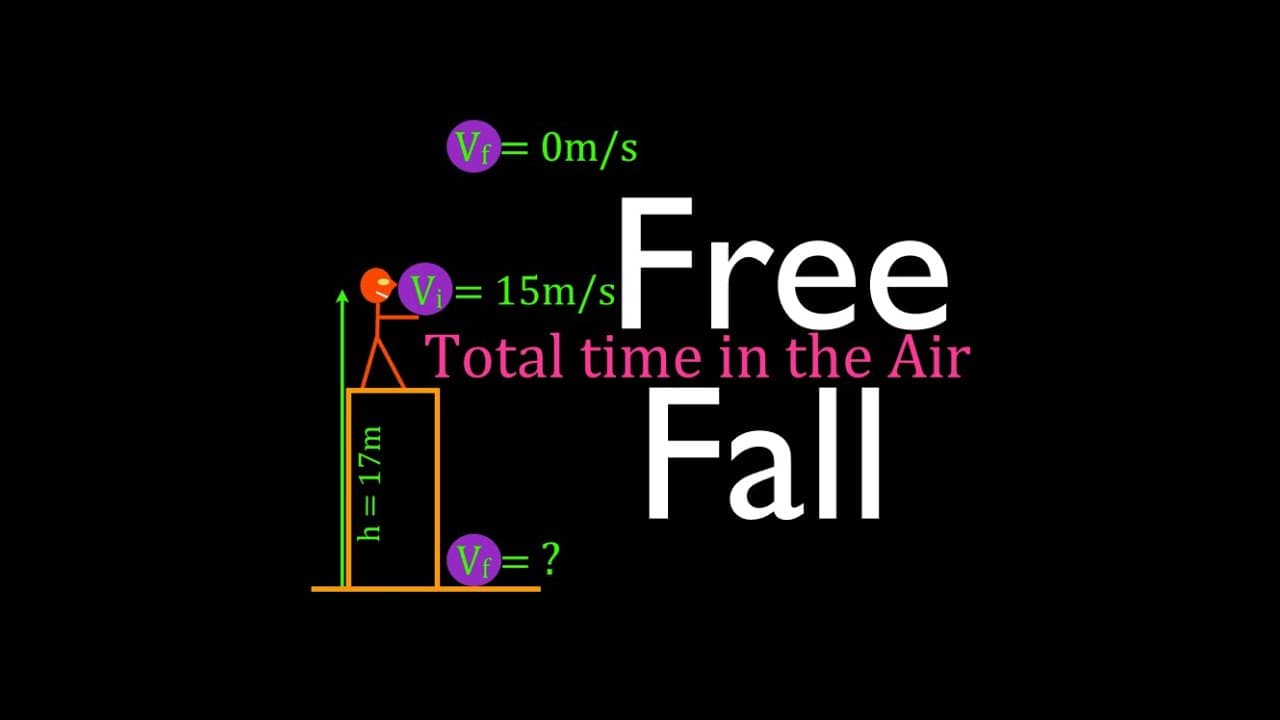
Physics, Kinematics, Free Fall (11 of 12) Total Time In the Air
TL;DR
Calculating the total time for an object launched with known height and initial velocity in free fall.
Transcript
okay in today's video we're gonna go over another problem involving free fall kinematics and this video is part two of the three part series and in this video we're going to determine the total time it takes for an object when this launch from unknown height with a known initial velocity to go up and come straight back down to earth in part one we ... Read More
Key Insights
- 🥶 Free fall kinematics involve calculating total time for an object launched with known initial velocity and height.
- ⌛ Quadratic formula is utilized to solve for time in scenarios with multiple variables in kinematic equations.
- 🥶 Negative acceleration sign signifies Earth's gravitational pull in free fall, influencing calculations.
- ⌛ Systematic approach of identifying and filling in variables is crucial for accurate time calculations.
- 🥶 Understanding the role of kinematic equations and quadratic formulas is essential for solving free fall problems.
- 🤘 Correct interpretation of signs and units is necessary for accurate results in kinematic problems.
- ❓ Following step-by-step processes and applying mathematical formulas ensure precise calculations in physics.
Install to Summarize YouTube Videos and Get Transcripts
Explore YouTube Video Summarizer or Get YouTube Transcript Extractor
Questions & Answers
Q: How is the total time for an object in free fall calculated?
The total time is calculated using kinematic equations and variables like initial velocity, acceleration, change in position, and time, following a step-by-step process to solve for the time taken.
Q: What role does the quadratic formula play in determining the total time in free fall?
The quadratic formula is used to solve for time in scenarios involving unknown heights and initial velocities, providing a method to obtain accurate results for the total time taken by the object.
Q: Why is it important to consider the negative sign in acceleration for free fall kinematic problems?
The negative sign indicates the direction of acceleration, which in free fall problems points towards the Earth, influencing the calculations and ensuring the correct interpretation of the results.
Q: How does the process of filling in known and unknown variables aid in solving for the total time?
By systematically identifying variables like initial velocity, acceleration, and change in position, and using the correct kinematic equation, the process ensures an organized approach to finding the total time in free fall scenarios.
Summary & Key Takeaways
-
Video explains determining total time for an object in free fall from an unknown height with a known initial velocity.
-
Utilizes kinematic equations and variables to find the time taken by the object to go up and back down.
-
Demonstrates step-by-step process using quadratic formula to calculate the total time of 3.94 seconds.
Read in Other Languages (beta)
Share This Summary 📚
Summarize YouTube Videos and Get Video Transcripts with 1-Click
Try YouTube Summary with ChatGPT & Claude or YouTube Transcript Generator
Explore More Summaries from Step by Step Science 📚



Summarize YouTube Videos and Get Video Transcripts with 1-Click
Try YouTube Summary with ChatGPT & Claude or YouTube Transcript Generator