4 Monostable blocking oscillator with base timing
TL;DR
Explores monostable blocking oscillator with base timing and its characteristics.
Transcript
in this video we'll be discussing what is a monostable blocking oscillator with base timing so before we go into the classification of this blocking oscillator as a monostable and a stable so we'll uh slightly know what is this why does it we call them as a monostable or a stable so for blocking oscillator needs a single pulse to ch... Read More
Key Insights
- A monostable blocking oscillator requires a single pulse to change its state, unlike an astable oscillator, which changes states automatically.
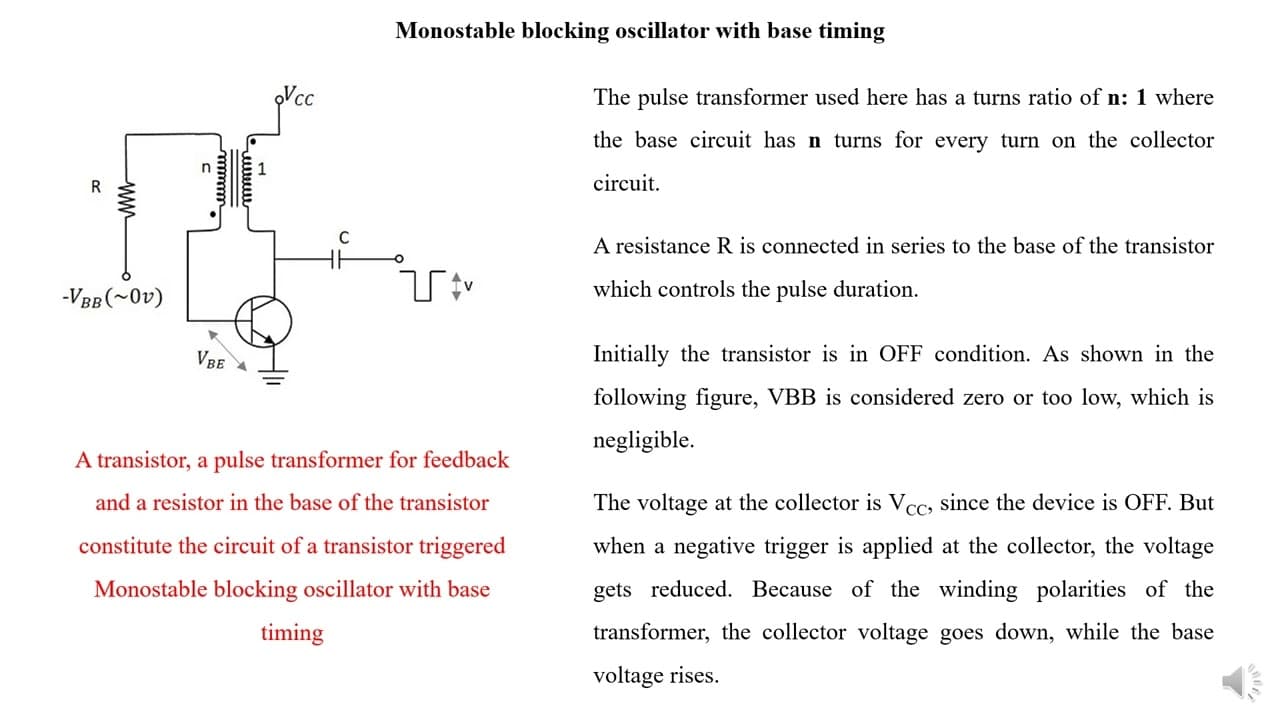
- The circuit discussed uses a pulse transformer between a transistor's collector and base, with the base circuit having more turns than the collector circuit.
- Base timing is controlled by a resistor in series with the base, which influences the pulse during operation, hence the name 'base timing.'
- Initially, the transistor is off. A positive pulse lowers the collector voltage, increases base voltage, and eventually turns the transistor on.
- The process of turning on the transistor involves a regenerative feedback loop, reducing collector potential and increasing base potential until saturation.
- To obtain a pulse amplitude, the wave shape of the circuit can be adjusted using an equivalent model circuit.
- The induced voltage in the transformer is proportional to the number of turns, and input voltage significantly impacts the transformer's coil utilization.
- A disadvantage of the monostable blocking oscillator is the instability in output pulse width, which cannot be maintained consistently.
Install to Summarize YouTube Videos and Get Transcripts
Explore YouTube Video Summarizer or Get YouTube Transcript Extractor
Questions & Answers
Q: What is a monostable blocking oscillator?
A monostable blocking oscillator is an electronic circuit that requires a single pulse to change its state. It is characterized by its ability to switch from an off to an on state when triggered by a pulse, unlike an astable oscillator, which changes states automatically without external input.
Q: How does base timing work in this oscillator?
Base timing in this oscillator is controlled by a resistor connected in series with the base of the transistor. This resistor influences the pulse during the operation, determining how the circuit responds to input pulses and ultimately affecting the timing of the oscillator's state changes.
Q: What role does the pulse transformer play in the circuit?
The pulse transformer in the circuit connects the transistor's collector and base. It serves to accept a pulse at one winding and produce a similar output on the other winding, albeit 180 degrees out of phase. This setup is crucial for the oscillator's operation and the regenerative feedback loop.
Q: How is the transistor turned on in this circuit?
The transistor is initially off. When a positive triggering pulse is applied, it lowers the collector voltage and increases the base voltage. Once the base voltage exceeds the transistor's cutoff voltage, it starts conducting, drawing current and turning on the transistor through a regenerative feedback loop.
Q: What is the regenerative feedback loop mentioned in the video?
The regenerative feedback loop is a process where the increase in collector current further lowers collector voltage and raises base voltage. This loop continues, allowing more current to pass and further dropping collector potential, eventually driving the transistor into saturation.
Q: How can pulse amplitude be adjusted in the circuit?
Pulse amplitude can be adjusted by modifying the wave shape of the circuit using an equivalent model circuit. This involves altering the circuit's configuration to achieve the desired amplitude, taking into account the transformer's properties and the relationship between induced voltage and turns.
Q: What impact does the number of transformer turns have?
The number of turns in the transformer significantly affects the induced voltage, as it is proportional to the turns. The input voltage also influences how the transformer's coils are utilized, impacting the circuit's overall performance and the output waveform.
Q: What is the main disadvantage of the monostable blocking oscillator?
The main disadvantage of the monostable blocking oscillator is the instability in output pulse width. The circuit cannot maintain a consistent pulse width, leading to variations in the output, which can be problematic for applications requiring precise timing and stability.
Summary & Key Takeaways
-
The video discusses the workings of a monostable blocking oscillator, focusing on base timing. It explains the role of a pulse transformer and how the circuit functions, including the regenerative feedback loop that leads to saturation.
-
Key components include a resistor controlling base timing and a pulse transformer that connects the transistor's collector and base. The circuit's operation involves changes in voltage that eventually turn the transistor on.
-
While the circuit can adjust pulse amplitude and waveform shape, a major drawback is the instability in output pulse width, making it challenging to maintain a consistent pulse output.
Read in Other Languages (beta)
Share This Summary 📚
Summarize YouTube Videos and Get Video Transcripts with 1-Click
Try YouTube Summary with ChatGPT & Claude or YouTube Transcript Generator