What Is Deliberate Practice and Why Is It Misunderstood?
TL;DR
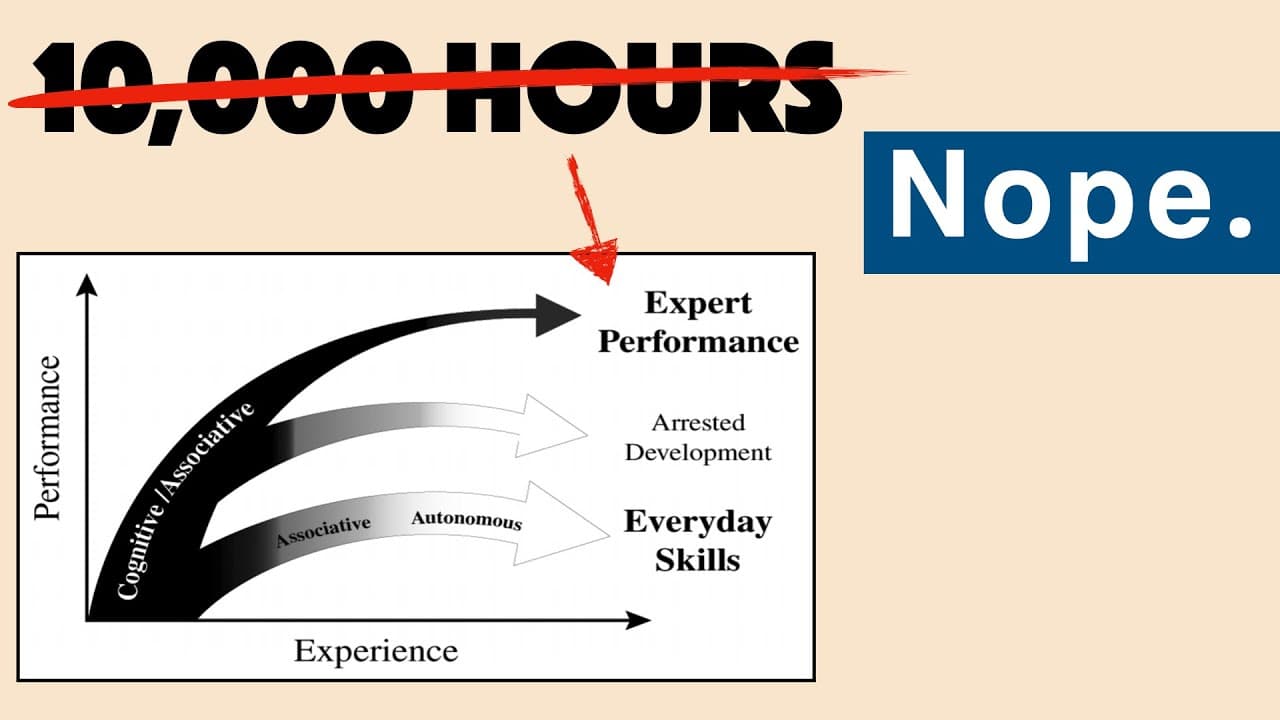
Deliberate practice focuses on the quality of practice, not the quantity of time spent. The 10,000-hour rule is a misconception; the time required to achieve expertise varies by skill complexity, competition, and available resources. A crucial first step in deliberate practice is identifying the specific skills of experts to guide training effectively.
Transcript
deliberate practice is one of the major most important ideas in learning and instruction yet a lot of people get this idea wrong and specifically there are three mistakes that i see people making over and over and over again so i'm making this video hopefully to address these mistakes or these misconceptions mistake number one is that there is noth... Read More
Key Insights
- ❓ Deliberate practice emphasizes the quality, not the quantity, of practice.
- 🧑🏭 The idea of 10,000 hours as a requirement for expertise is misleading and varies depending on the skill and other factors.
- 🎨 Identifying expert skills is crucial for designing an effective deliberate practice program.
- 🏍️ The focus in deliberate practice is on practice feedback cycles rather than the amount of time spent practicing.
- ⌛ Different skills require different amounts of practice time to reach expertise.
- ⌛ Competition and available resources also affect the time required to become an expert.
- 🧑🎓 Students need exposure to the expert skills and practices in their field to develop the desired expertise.
Install to Summarize YouTube Videos and Get Transcripts
Explore YouTube Video Summarizer or Get YouTube Transcript Extractor
Questions & Answers
Q: What is the main difference between deliberate practice and regular practice?
Deliberate practice emphasizes the quality of practice, focusing on specific expert skills and challenging oneself, while regular practice is often repetitive and lacks specific goals for improvement.
Q: Where did the idea of 10,000 hours come from?
The idea of 10,000 hours originated from an offhand comment in a paper on violin players, but it became associated with deliberate practice through Malcolm Gladwell's book. However, the number of hours required to become an expert varies depending on the skill and other factors.
Q: Why is it important to identify expert skills in the first step of deliberate practice?
Identifying expert skills is crucial because it allows for the creation of a targeted and effective training program. Without knowing what distinguishes experts from non-experts, it is difficult to design practice activities that lead to improvement.
Q: Why is the focus on time a misconception in deliberate practice?
The focus on time is a misconception because the key factor in deliberate practice is the practice feedback cycle. It is the process of challenging practice, receiving expert feedback, and continuous improvement that drives learning, not the amount of time spent practicing.
Key Insights:
- Deliberate practice emphasizes the quality, not the quantity, of practice.
- The idea of 10,000 hours as a requirement for expertise is misleading and varies depending on the skill and other factors.
- Identifying expert skills is crucial for designing an effective deliberate practice program.
- The focus in deliberate practice is on practice feedback cycles rather than the amount of time spent practicing.
- Different skills require different amounts of practice time to reach expertise.
- Competition and available resources also affect the time required to become an expert.
- Students need exposure to the expert skills and practices in their field to develop the desired expertise.
- Using the right metrics, such as practice feedback cycles, is essential for measuring progress and improvement in deliberate practice.
Summary & Key Takeaways
-
Deliberate practice is focused on the quality of practice, not the amount of time spent practicing.
-
The idea of 10,000 hours as a requirement for expertise is a misconception; practice time varies depending on the skill and other factors.
-
Identifying expert skills is the crucial first step in creating a deliberate training program.
Read in Other Languages (beta)
Share This Summary 📚
Summarize YouTube Videos and Get Video Transcripts with 1-Click
Try YouTube Summary with ChatGPT & Claude or YouTube Transcript Generator
Explore More Summaries from Benjamin Keep, PhD, JD 📚



Summarize YouTube Videos and Get Video Transcripts with 1-Click
Try YouTube Summary with ChatGPT & Claude or YouTube Transcript Generator