4.3.3 Healthcare Costs - Video 2: Claims Data
TL;DR
The healthcare industry has rich data sources, including claims data, eligibility information, and demographic information. However, some data may be hard to access due to differences in technology and privacy laws.
Transcript
Let us discuss data sources in the health care industry. So the industry is data-rich, but data may be hard to access. Sometimes it involves unstructured data like doctor's notes. Often the data is hard to get due to differences in technology. Hospitals in southern Massachusetts versus California might use different technologies and different platf... Read More
Key Insights
- 🤑 The healthcare industry is data-rich but faces challenges in accessing and utilizing the data due to various factors such as unstructured data, technological differences, and privacy laws.
- ℹ️ Claims data, eligibility information, and demographic information are major sources of healthcare data.
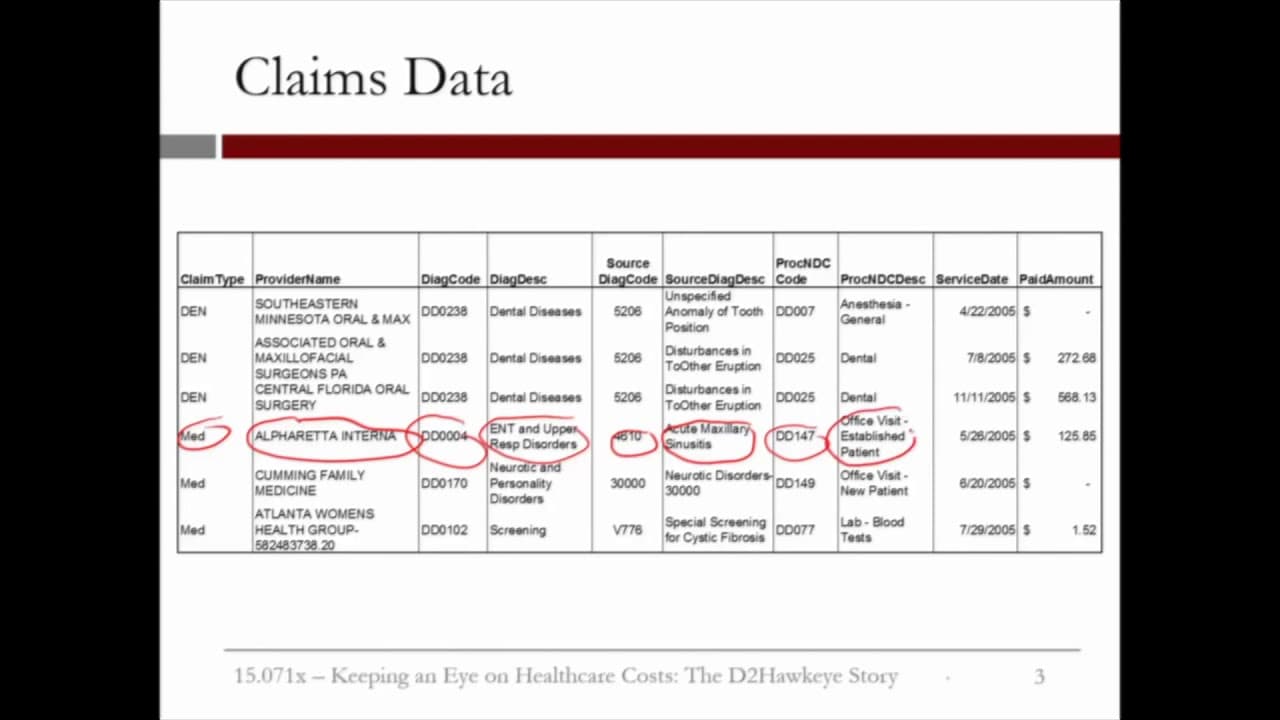
- 😷 Claims data provides detailed and high-dimensional information about medical diagnoses, procedures, and costs.
- 🧑 However, claims data alone cannot capture all aspects of a person's treatment or health, requiring inference and integration with other data sources.
- 👯 This specific lecture discusses an analytics approach using data from 2.4 million people over a three-year span and making predictions for a subsequent period.
- ❓ The observation period for the data was 2001 to 2003, with out-of-sample predictions made for 2003 and 2004.
Install to Summarize YouTube Videos and Get Transcripts
Explore YouTube Video Summarizer or Get YouTube Transcript Extractor
Questions & Answers
Q: What are the typical sources of data in the healthcare industry?
The healthcare industry relies on claims data, eligibility information for employees, and demographic data such as gender and age.
Q: Why is accessing healthcare data sometimes difficult?
Healthcare data can be hard to access due to unstructured data like doctor's notes, differences in technology between healthcare providers, and stringent privacy laws like HIPAA.
Q: What is claims data and why is it valuable?
Claims data consists of reimbursement requests from doctors, hospitals, and pharmacies to insurance companies. It is valuable because it provides detailed information about medical diagnoses, treatments, and costs.
Q: What are the limitations of claims data in healthcare analysis?
While claims data is rich and structured, it does not capture all aspects of a person's treatment or health. It often lacks specific test results and can only indicate that a test was administered.
Summary & Key Takeaways
-
The healthcare industry has abundant data, but accessing it can be challenging due to unstructured data, technological differences, and privacy laws.
-
Claims data, eligibility information, and demographic data are common sources of healthcare data.
-
Claims data provides detailed information about medical diagnoses, treatments, and costs.
Read in Other Languages (beta)
Share This Summary 📚
Summarize YouTube Videos and Get Video Transcripts with 1-Click
Try YouTube Summary with ChatGPT & Claude or YouTube Transcript Generator
Explore More Summaries from MIT OpenCourseWare 📚



Summarize YouTube Videos and Get Video Transcripts with 1-Click
Try YouTube Summary with ChatGPT & Claude or YouTube Transcript Generator