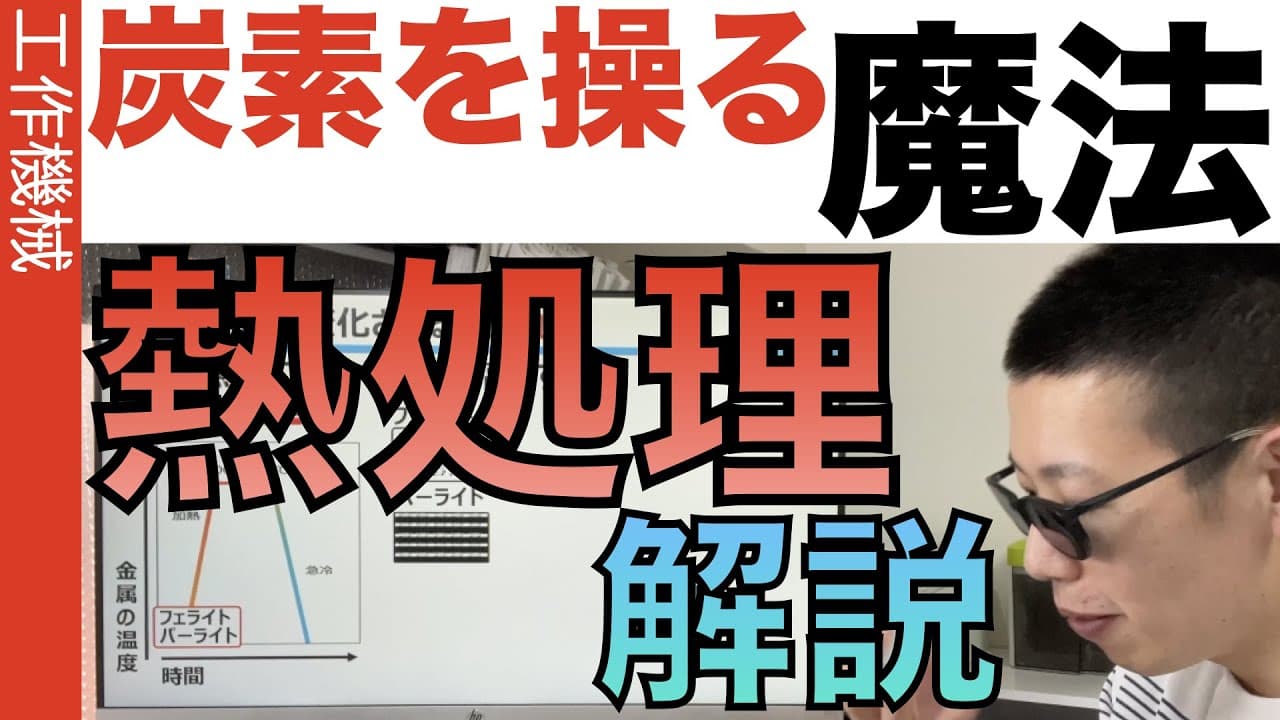
なぜ鉄を「強靭」にできるのか?熱処理の原理を解説
TL;DR
Explains the principles and importance of heat treatment in metal manufacturing.
Transcript
Hello, I'm Manufacturing man. Today we are going to talk about heat treatment. Last time, when I explained the types of metals, I said that heat treatment is very closely related to that. So, this time I will focus on heat treatment. Ms.Chiba also helped make the materials, so please hit the like button. Let's get started on it. The definition of h... Read More
Key Insights
- Heat treatment is crucial for enhancing the properties of metals, such as hardness, strength, and resistance to wear and fatigue.
- The process involves heating metal to a certain temperature and then cooling it, which changes its internal structure and properties.
- Carbon content in iron significantly affects its properties post-heat treatment, with higher carbon content generally increasing hardness.
- Different heat treatment methods, such as quenching and tempering, are used to achieve specific material properties.
- Surface heat treatment is used to enhance the surface properties of machine parts while keeping the core flexible.
- The history of heat treatment dates back to ancient civilizations, with significant developments occurring in China and Japan.
- Modern heat treatment processes can involve advanced techniques like SUBZERO processing to prevent unwanted structural changes.
- The video also discusses the role of various elements, like nickel and chromium, in forming alloy steels with desired characteristics.
Install to Summarize YouTube Videos and Get Transcripts
Explore YouTube Video Summarizer or Get YouTube Transcript Extractor
Questions & Answers
Q: What is the basic principle behind heat treatment?
Heat treatment involves heating a metal to a specific temperature and then cooling it. This process alters the metal's internal structure, enhancing its properties such as hardness, strength, and resistance to wear and fatigue. The precise temperature and cooling rate are crucial in determining the final properties of the metal.
Q: How does carbon content affect the properties of iron?
Carbon content significantly influences the properties of iron after heat treatment. Higher carbon content generally increases the hardness and strength of the iron by altering its internal structure. However, excessive carbon can lead to brittleness, so a balance must be achieved to ensure the desired properties are obtained.
Q: What are the different types of heat treatment methods mentioned?
The video discusses several heat treatment methods, including quenching, tempering, annealing, and surface heat treatment. Quenching involves rapid cooling to increase hardness, while tempering is used to improve toughness. Annealing softens the metal for better machinability, and surface heat treatment enhances surface properties while maintaining a flexible core.
Q: Why is surface heat treatment important for machine parts?
Surface heat treatment is crucial for machine parts because it enhances the surface properties such as toughness, wear resistance, and fatigue strength while keeping the core flexible. This ensures that the parts are durable and can withstand operational stresses without breaking or deforming.
Q: What historical developments in heat treatment are highlighted?
The video highlights the historical development of heat treatment, tracing back to ancient civilizations like the Hittites and significant advancements in China during the Qin and Ha dynasties. Japan also adopted and further developed heat treatment technologies, which played a crucial role in metal manufacturing.
Q: How does the cooling rate affect the structure of iron?
The cooling rate during heat treatment affects the internal structure of iron. Rapid cooling, such as in quenching, leads to a hard and brittle structure called martensite, while slow cooling results in a softer structure with more ferrite. The cooling rate must be controlled to achieve the desired balance of hardness and toughness.
Q: What is the role of elements like nickel and chromium in steel?
Elements like nickel and chromium are used to form alloy steels, which have enhanced properties compared to carbon steels. These elements improve characteristics such as corrosion resistance, toughness, and strength, making alloy steels suitable for specialized applications in various industries.
Q: What advanced techniques are used in modern heat treatment?
Modern heat treatment techniques include SUBZERO processing, which involves cooling the metal below 0 degrees Celsius to stabilize its structure and prevent unwanted changes over time. This process is essential for ensuring the long-term durability and performance of metal components used in critical applications.
Summary & Key Takeaways
-
The video provides an in-depth explanation of heat treatment, a process essential for improving the properties of metals used in manufacturing. It covers the historical development of heat treatment and its significance in creating strong and durable metal products.
-
Key aspects of heat treatment, such as quenching, tempering, and surface hardening, are discussed, highlighting their impact on metal properties like hardness, toughness, and resistance to wear and fatigue.
-
The role of carbon and other elements in altering the properties of iron and steel is explored, emphasizing the importance of precise control over heat treatment processes to achieve desired material characteristics.
Read in Other Languages (beta)
Share This Summary 📚
Summarize YouTube Videos and Get Video Transcripts with 1-Click
Try YouTube Summary with ChatGPT & Claude or YouTube Transcript Generator
Explore More Summaries from ものづくり太郎チャンネル 📚





Summarize YouTube Videos and Get Video Transcripts with 1-Click
Try YouTube Summary with ChatGPT & Claude or YouTube Transcript Generator