Facebook's Secret Psychological Experiment
TL;DR
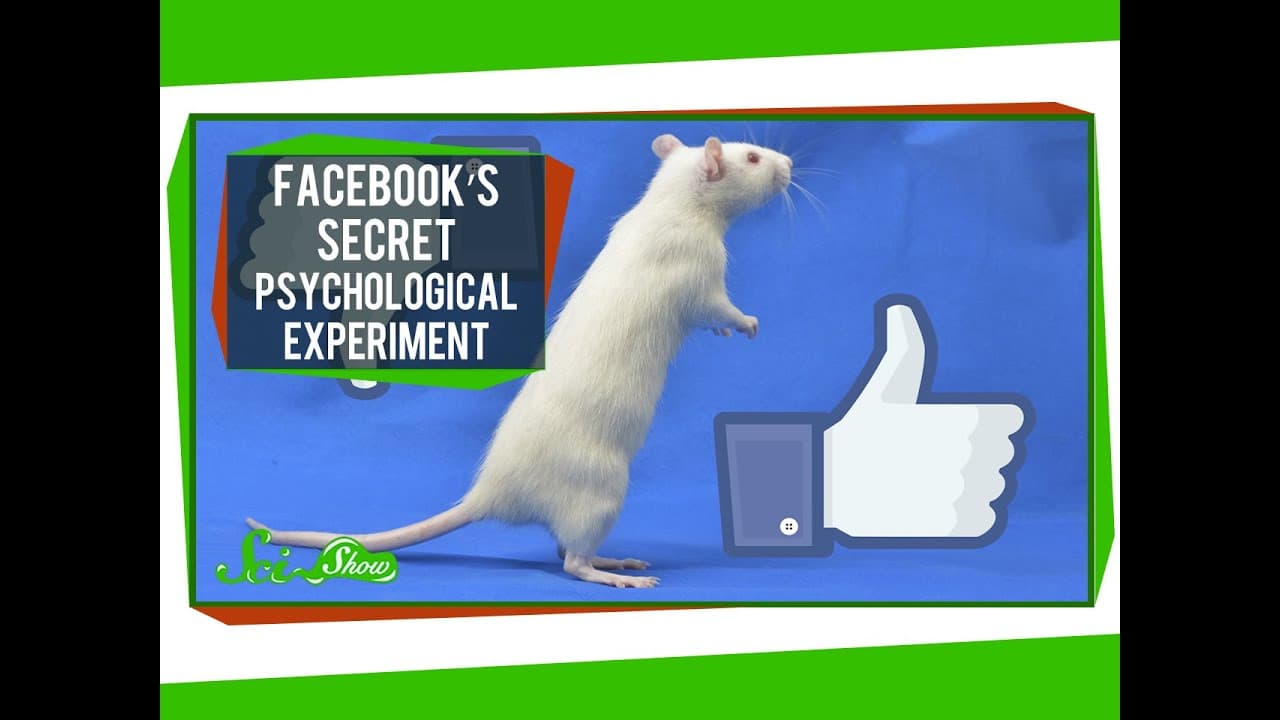
Facebook conducted a psychological experiment on 700,000 users, manipulating their news feeds to study emotional contagion, causing concerns about privacy and ethics.
Transcript
you've probably already heard about it in fact you might have been part of it Facebook caused an uproar last week when scientists from Cornell University working with Facebook's own data science team released the results of a psychological experiment that they performed on about 700,000 Facebook users none of which knew they were participating the ... Read More
Key Insights
- ❓ Facebook's experiment on emotional contagion caused controversy over privacy and ethical concerns.
- 👤 Exposing users to more positive or negative content had a minimal effect on their own posts.
- ❓ Similar experiments are conducted by other companies like Google to refine algorithms and collect valuable data.
Install to Summarize YouTube Videos and Get Transcripts
Explore YouTube Video Summarizer or Get YouTube Transcript Extractor
Questions & Answers
Q: What was the purpose of the Facebook experiment?
The purpose of the experiment was to study emotional contagion and understand how people's emotions can be influenced by the content they see on Facebook.
Q: How was the experiment conducted?
The experiment involved randomly selecting 683,000 English-speaking Facebook users and manipulating their news feeds to filter out posts containing positive or negative terms.
Q: Did the experiment have a significant effect on users' posts?
No, the experiment had only a small effect. Users who saw more positive posts were approximately 0.07 percent more likely to include positive words in their own posts.
Q: How did the public and regulators respond to the experiment?
The public expressed concerns about their privacy and felt that Facebook was intentionally manipulating their emotions. Regulators, such as the Data Protection Commissioner and the Information Commissioner's Office, questioned the legality of the experiment.
Summary & Key Takeaways
-
Scientists from Cornell University and Facebook's data science team conducted a week-long experiment in 2012, manipulating the news feeds of 683,000 English-speaking Facebook users without their knowledge.
-
The experiment aimed to understand emotional contagion and how people's emotions can be influenced by the posts they see.
-
The results showed that exposing users to more positive or negative content had only a small effect on what they posted.
Read in Other Languages (beta)
Share This Summary 📚
Summarize YouTube Videos and Get Video Transcripts with 1-Click
Try YouTube Summary with ChatGPT & Claude or YouTube Transcript Generator
Explore More Summaries from SciShow 📚


Summarize YouTube Videos and Get Video Transcripts with 1-Click
Try YouTube Summary with ChatGPT & Claude or YouTube Transcript Generator