2.2.4 Combinational Devices
TL;DR
Combinational devices are defined by having digital inputs and outputs, a functional specification, and a timing specification, and can be interconnected following composition rules to build larger combinational systems.
Transcript
We're now in a position to define our what it means to be a digital processing element. We say a device is a "combinational device" if it meets the following four criteria: First, it should have digital inputs, by which we mean the device uses our signaling convention, interpreting input voltages below V_L as the digital value 0, and voltages above... Read More
Key Insights
- 🔠 Combinational devices have digital inputs and outputs, a functional specification, and a timing specification.
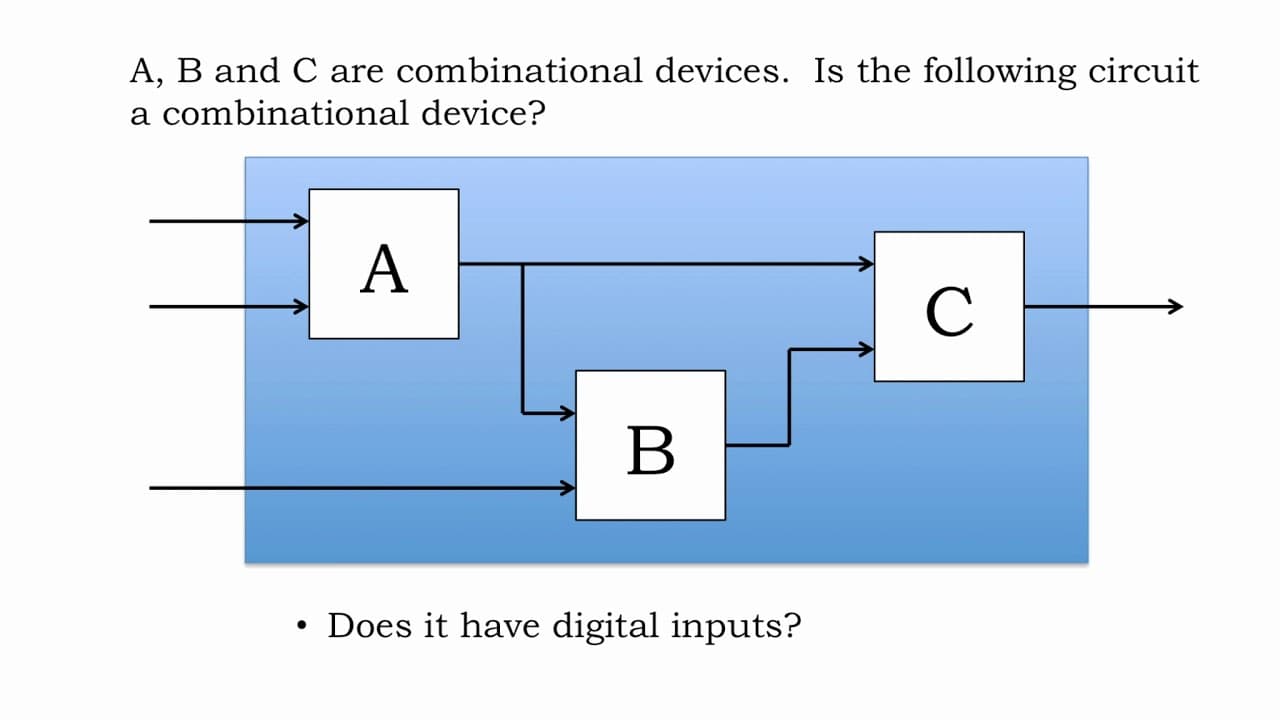
- 👷 Combinational systems can be constructed by following composition rules, ensuring the components are combinational devices, the inputs are properly connected, and there are no directed cycles.
- 👻 The composition of combinational devices allows for the construction of complex systems while maintaining the static discipline.
- 👷 Combinational systems inherit their properties from the combinational components used in their construction.
- 🪈 The behavior of internal signals in a combinational system can be determined by evaluating the behavior of the components in an order determined by the circuit topology.
- 🍹 The propagation delay of a combinational system is determined by summing the propagation delays of the components along the paths from inputs to outputs.
- 🏛️ Combinational systems are not limited in size and can be built with arbitrary complexity using the composition rules.
Install to Summarize YouTube Videos and Get Transcripts
Explore YouTube Video Summarizer or Get YouTube Transcript Extractor
Questions & Answers
Q: What are the criteria for a device to be considered a "combinational device"?
A device is considered a combinational device if it has digital inputs and outputs, follows the signaling convention for interpreting input voltages, has a functional specification defining output values, and has a timing specification including the propagation delay.
Q: How can combinational components be interconnected in a system?
Combinational components can be interconnected by ensuring that each component is itself a combinational device, each input is connected to a system input or another device's output, and the system does not have any directed cycles.
Q: What guarantees that the composition of combinational devices will still follow the static discipline?
Combinational devices built following the composition rules will still follow the static discipline because they have digital inputs and outputs inherited from the components, a functional specification determined by propagating input values through the modules, and a propagation delay determined by summing the delays along the paths from inputs to outputs.
Q: What advantages do combinational systems have over analog systems?
Combinational systems can be of any size and still adhere to the static discipline, unlike analog systems. Additionally, combinational systems allow for building larger devices of arbitrary complexity by using combinational components.
Summary & Key Takeaways
-
Combinational devices have digital inputs and outputs, with input voltages below V_L interpreted as 0 and voltages above V_H as 1.
-
A combinational device must have a functional specification that defines the output value for every possible combination of input values.
-
There is a timing specification, including the propagation delay, which is the time from when inputs become stable to when the output has a stable value.
-
Combinational systems can be built by following composition rules, which require components to be combinational devices, inputs to be connected properly, and the absence of directed cycles.
Read in Other Languages (beta)
Share This Summary 📚
Summarize YouTube Videos and Get Video Transcripts with 1-Click
Try YouTube Summary with ChatGPT & Claude or YouTube Transcript Generator
Explore More Summaries from MIT OpenCourseWare 📚



Summarize YouTube Videos and Get Video Transcripts with 1-Click
Try YouTube Summary with ChatGPT & Claude or YouTube Transcript Generator