What Are the Dangers of Unhealthy Competition in AI?
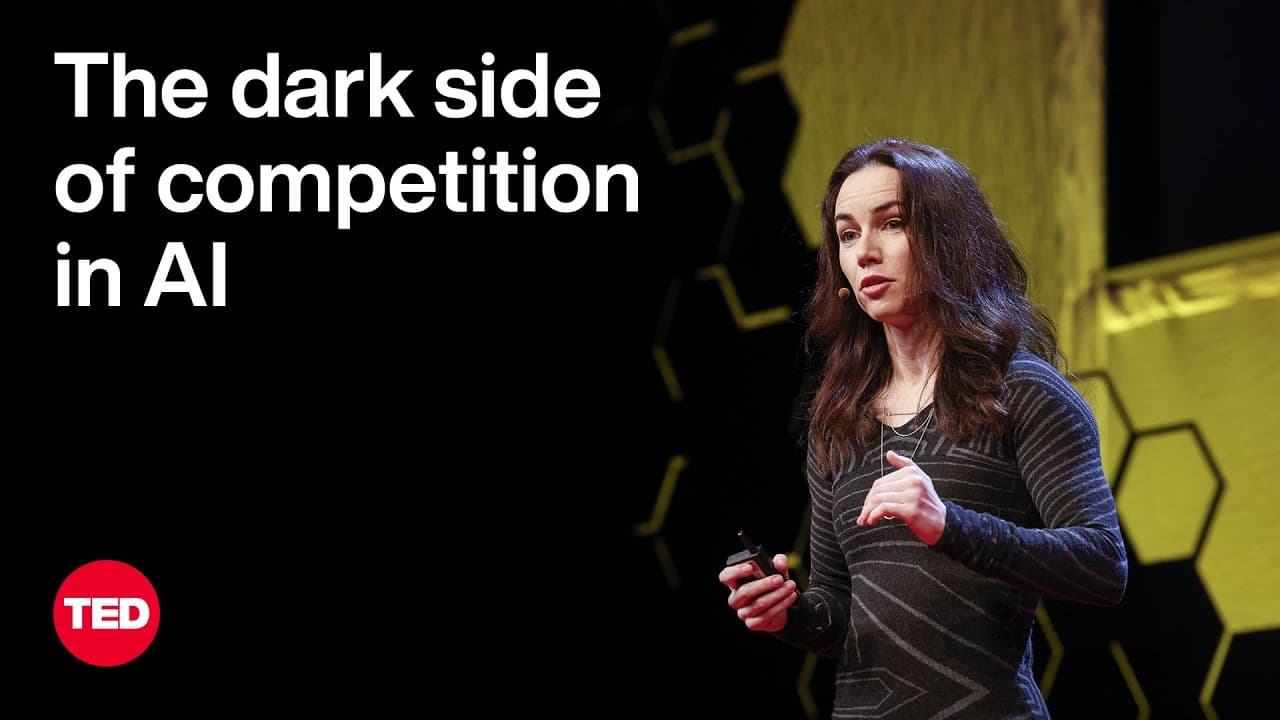
TL;DR
Unhealthy competition in AI leads to negative outcomes like body dysmorphia from beauty filters and distrust in news media due to clickbait. Misaligned incentives push companies to sacrifice long-term safety for short-term gains, creating a Moloch trap. To escape this, AI leaders must prioritize responsible practices and alignment research over profit-driven pressures.
Transcript
Competition. It's a fundamental part of human nature. I was a professional poker player for 10 years, so I've very much seen all the good, bad and ugly ways it can manifest. When it's done right, it can drive us to incredible feats in sports and innovation, like when car companies compete over who can build the safest cars or the most efficient sol... Read More
Key Insights
- 🔥 Healthy competition between companies can lead to beneficial outcomes, such as advancements in technology and safety measures. However, unhealthy competition can have negative consequences, as seen in the case of AI beauty filters leading to body dysmorphia.
- 🤳 Social media platforms are incentivized to provide AI beauty filters to increase engagement and ad revenue, while users are incentivized to use them to gain more followers. This creates a lose-lose situation for influencers who are stuck using the filters with little advantage.
- 📰 Increased competition between news outlets has led to a race to the bottom, with clickbait and polarization becoming more prevalent. Emotion-triggering headlines are more likely to go viral, eroding trust in the media and making it difficult to discern truth from fiction.
- 🌍 Many major issues, such as plastic pollution and greenhouse gas emissions, stem from poorly designed games that incentivize short-term gains at the expense of long-term harm.
- ⚙️ The misalignment of incentives is a fundamental issue rooted in game theory, impacting various industries and areas of society.
- 🧠 The AI industry is currently stuck in a Moloch trap, where the race for power and profit drives companies to prioritize speed over safety. Short-term incentives conflict with the development of safe and beneficial AI.
- 🌏 Coordination and regulation can help address the issues caused by misaligned incentives, as seen in past successes like the Montreal Protocol and Strategic Arms Reduction Treaty.
- 🏆 AI leaders need to recognize and address the destructive nature of current incentives. Responsible scaling policies, increased dedication to alignment research, and prioritizing science over commerce are steps in the right direction. A race to the top, focusing on security criteria and alignment efforts, can help overcome the Moloch trap.
Install to Summarize YouTube Videos and Get Transcripts
Explore YouTube Video Summarizer or Get YouTube Transcript Extractor
Questions & Answers
Q: How do AI beauty filters contribute to body dysmorphia and negative body image?
AI beauty filters, although impressive in their technology, can train users to hate their natural appearance by offering an unrealistic and enhanced version of themselves. This can lead to body dysmorphia and dissatisfaction with one's natural face.
Q: Why do news outlets resort to clickbait and partisan tactics?
News outlets are incentivized to use clickbait and polarizing tactics because they trigger emotions like fear and anger, making the headlines more likely to go viral. In a highly competitive media landscape, these tactics become necessary to grab attention and avoid being overshadowed by competitors.
Q: How does the misalignment of incentives affect the AI industry?
The intense competition in the AI industry, driven by factors like funding and talent, often leads to companies sacrificing safety testing and neglecting long-term considerations. Investor pressure and short-term incentives conflict with the need for responsible development, posing risks to the future deployment of AI.
Q: Can smart regulation help address the issues caused by misaligned incentives?
Smart regulation can certainly play a role in mitigating the negative impacts of misaligned incentives. However, the primary responsibility lies with the leaders and players within the industries to recognize the risks and actively work towards aligning their incentives with long-term goals.
Q: What steps are the leading labs taking to address the issues of misaligned incentives in the AI industry?
Some leading labs, like Anthropic, OpenAI, and DeepMind, are showing signs of prioritizing safety, alignment research, and responsible development. However, more concrete actions and commitments are needed to ensure a definitive race to the top instead of a reckless race driven by misaligned incentives.
Q: What are the potential consequences of getting AI wrong?
The consequences of getting AI wrong, especially AGI (Artificial General Intelligence), could be catastrophic. Uncontrolled development and deployment of AGI without proper safety measures could lead to unimaginable risks and harm. However, if AI is developed and utilized responsibly, it has the potential to help us navigate and escape the destructive influence of misaligned incentives in various industries.
Summary & Key Takeaways
-
Unhealthy competition can have negative outcomes, such as AI beauty filters leading to body dysmorphia and clickbait-driven news media decreasing trust and truthfulness.
-
The mechanism of misaligned incentives pushes companies and individuals to sacrifice the future for short-term gains in various industries, including plastic pollution, deforestation, and AI industry.
-
To escape the Moloch's trap, AI leaders need to prioritize responsibility, safety, and alignment research over the race for power and profit.
Read in Other Languages (beta)
Share This Summary 📚
Summarize YouTube Videos and Get Video Transcripts with 1-Click
Try YouTube Summary with ChatGPT & Claude or YouTube Transcript Generator
Explore More Summaries from TED 📚






Summarize YouTube Videos and Get Video Transcripts with 1-Click
Try YouTube Summary with ChatGPT & Claude or YouTube Transcript Generator