S07.1 The Inclusion-Exclusion Formula
TL;DR
The inclusion-exclusion formula is a generalization of the probability formula for unions of sets, allowing for the calculation of probabilities involving multiple sets.
Transcript
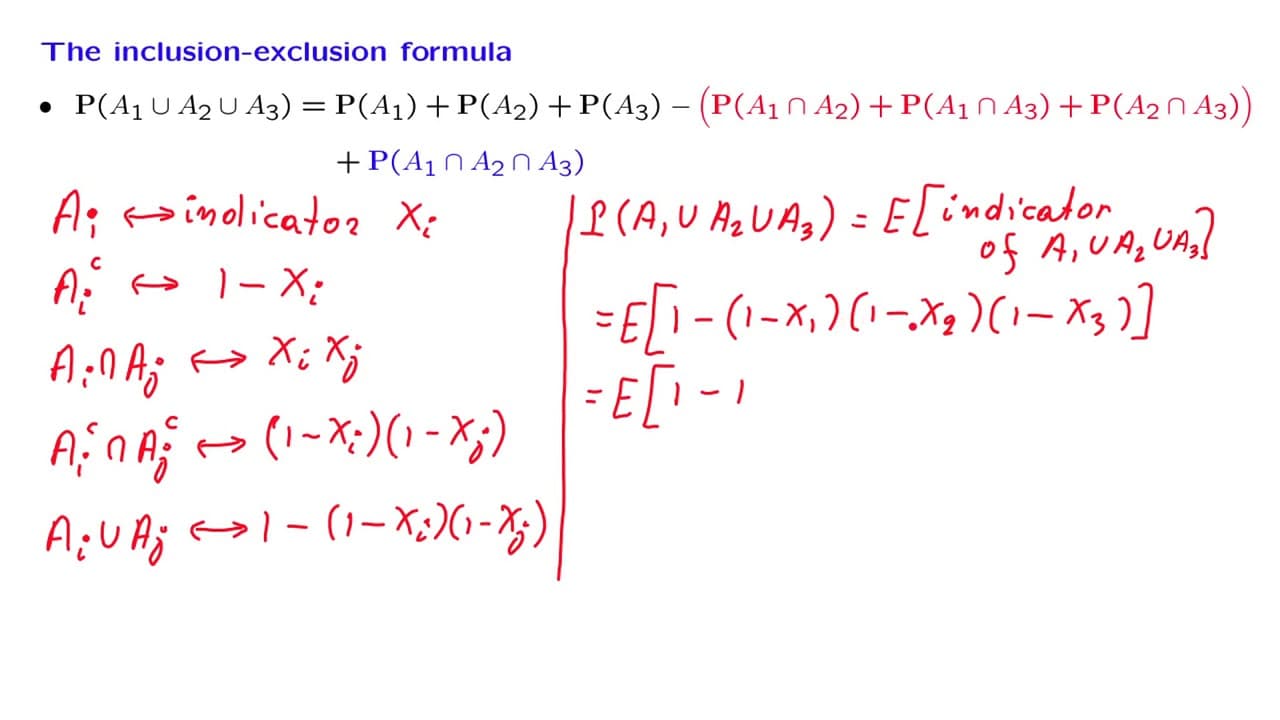
In this segment, we develop the inclusion-exclusion formula, which is a beautiful generalization of a formula that we have seen before. Let us look at this formula and remind ourselves what it says. If we have two sets, A1 and A2, and we're interested in the probability of their union, how can we find it? We take the probability of the first set, w... Read More
Key Insights
- 😫 The inclusion-exclusion formula is a powerful tool for calculating probabilities of unions of sets.
- 😫 The formula can be derived using indicator functions, which represent whether an outcome belongs to a set or not.
- 🪜 The formula involves adding, subtracting, and adding again probabilities to ensure correct calculation of overlapping elements.
Install to Summarize YouTube Videos and Get Transcripts
Explore YouTube Video Summarizer or Get YouTube Transcript Extractor
Questions & Answers
Q: How does the inclusion-exclusion formula work?
The formula involves adding the probabilities of the sets, subtracting the probabilities of the intersections of the sets, and adding back the probabilities of the intersections of three or more sets. This accounts for the overlapping elements and ensures that they are not double-counted.
Q: How can indicator functions be used to derive the inclusion-exclusion formula?
Indicator functions are associated with sets or events and can represent whether an outcome belongs to a set or not. By using indicator functions, the formula can be derived by manipulating and multiplying these functions, considering complements, intersections, and unions of sets.
Q: What is the purpose of the exponent in the inclusion-exclusion formula?
The exponent in the formula ensures that the last term, representing the probability of the intersection of all the events, has the correct sign. The exponent is determined by subtracting 1 from the total number of sets involved in the probability calculation.
Q: Can the inclusion-exclusion formula be applied to more than three sets?
Yes, the inclusion-exclusion formula can be applied to any number of sets. For each additional set beyond three, additional terms and combinations of indicator variables would be included in the formula to account for the intersections of the sets.
Summary & Key Takeaways
-
The inclusion-exclusion formula is a way to calculate the probability of the union of two or more sets, accounting for the overlapping elements.
-
The formula involves adding the probabilities of the individual sets, subtracting the probabilities of the intersections of the sets, and adding back the probabilities of the intersections of three or more sets.
-
The formula can be derived using indicator functions, which represent whether an outcome belongs to a particular set or not.
Read in Other Languages (beta)
Share This Summary 📚
Summarize YouTube Videos and Get Video Transcripts with 1-Click
Try YouTube Summary with ChatGPT & Claude or YouTube Transcript Generator
Explore More Summaries from MIT OpenCourseWare 📚


Summarize YouTube Videos and Get Video Transcripts with 1-Click
Try YouTube Summary with ChatGPT & Claude or YouTube Transcript Generator