Products
Features
YouTube Video Summarizer
Summarize YouTube videos
Web & PDF Highlighter
Highlight web pages & PDFs
Chat with PDF
Ask any PDF questions with AI
Ask AI Clone
Chat with your highlights & memories
Audio Transcriber
Transcribe audio files to text
Glasp Reader
Read and highlight articles
Kindle Highlight Export
Export your Kindle highlights
Idea Hatch
Hatch ideas from your highlights
Integrations
Obsidian Plugin
Notion Integration
Pocket Integration
Instapaper Integration
Medium Integration
Readwise Integration
Snipd Integration
Hypothesis Integration
Apps & Extensions
Chrome Extension
Safari Extension
Edge Add-ons
Firefox Add-ons
iOS App
Android App
Discover
Discover
Ideas
Discover new ideas and insights
Articles
Curated articles and insights
Books
Book recommendations by great minds
Posts
Essays and notes from readers
Quotes
Inspiring quotes collection
Videos
Curated videos and summaries
Explore Glasp
Glasp Newsletter
Weekly insights and updates
Glasp Talk
Interview series with great minds
Glasp Blog
Latest news and articles
Glasp Use Cases
Learn how others use Glasp
Build & Support
Glasp API
Access Glasp's API for developers
MCP Connector
Connect Glasp to Claude & ChatGPT
Community
Glasp Reddit Community
Students
Student discount and benefits
FAQs
Frequently Asked Questions
AboutPricing
DashboardLog inSign up

19. Principal Component Analysis
August 17, 2017
by
MIT OpenCourseWare
YouTube video player
19. Principal Component Analysis

TL;DR

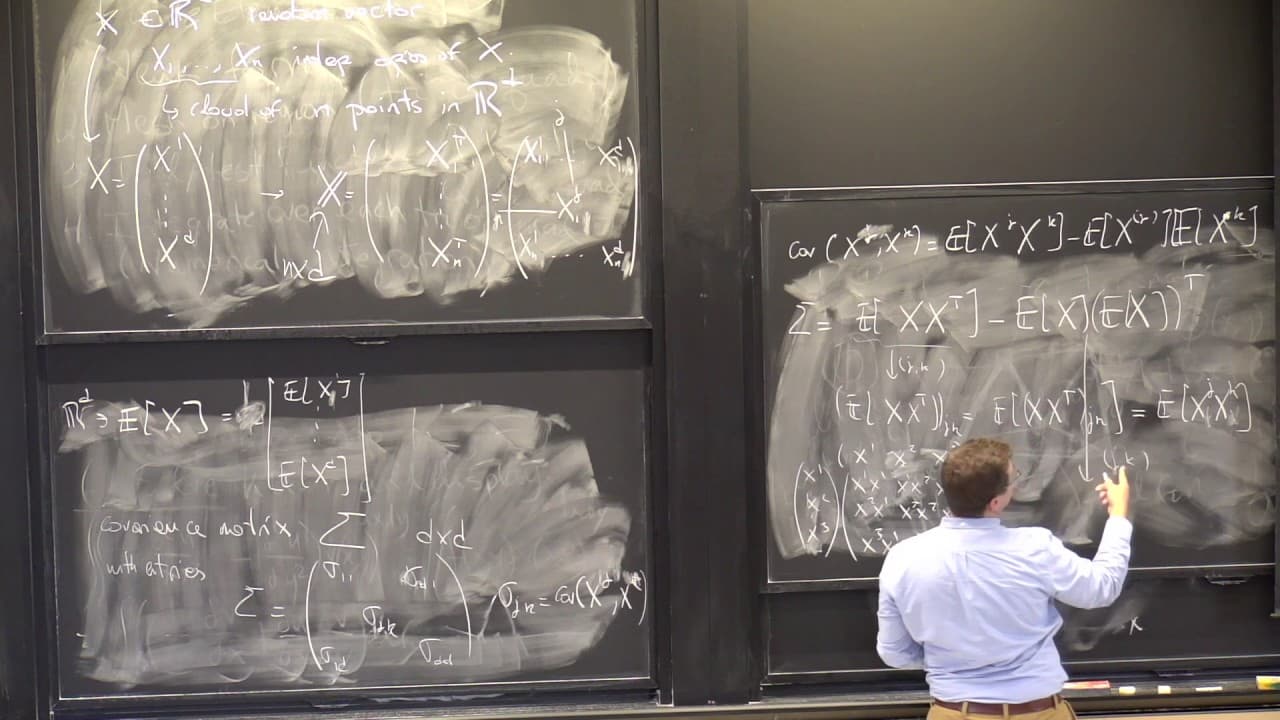
Principal Component Analysis (PCA) analyzes a dataset to find the directions with the most variance, allowing for dimension reduction and data compression.

Transcript

The following content is provided under a Creative Commons license. Your support will help MIT OpenCourseWare continue to offer high quality educational resources for free. To make a donation or to view additional materials from hundreds of MIT courses, visit MIT OpenCourseWare at ocw.mit.edu. PHILIPPE RIGOLLET: --bunch of x's and a bunch of y's. T... Read More

Key Insights

  • 💁 PCA aims to reduce the dimensionality of a dataset while preserving the maximum amount of information.
  • ❓ The covariance matrix is used to analyze the relationships between variables and measure the spread of the data.

Install to Summarize YouTube Videos and Get Transcripts

Explore YouTube Video Summarizer or Get YouTube Transcript Extractor

Questions & Answers

Q: What is the purpose of PCA?

PCA aims to reduce the dimensionality of a dataset while preserving the maximum amount of information.

Q: How does PCA work?

PCA analyzes the covariance matrix of a dataset to find the directions (principal components) that capture the most variance. It then projects the dataset onto these principal components to obtain a lower-dimensional representation.

Q: What does a covariance matrix capture?

A covariance matrix captures the relationships between the variables of a dataset. It can be used to measure the spread or variability of the data.

Q: How do eigenvalues and eigenvectors relate to PCA?

Eigenvalues and eigenvectors play a key role in PCA. The eigenvectors represent the principal components, and the eigenvalues represent the amount of variance captured by each principal component.

Summary & Key Takeaways

  • PCA is a technique used to identify the directions with the most variance in a dataset.

  • It aims to find a lower-dimensional representation of a dataset while preserving the maximum amount of information.

  • PCA is based on the concept of eigenvalues and eigenvectors, which allow for the diagonalization of a symmetric matrix.


Read in Other Languages (beta)

English

Share This Summary 📚

Summarize YouTube Videos and Get Video Transcripts with 1-Click

Download browser extensions on:

Try YouTube Summary with ChatGPT & Claude or YouTube Transcript Generator

Explore More Summaries from MIT OpenCourseWare 📚

Laplace Equation thumbnail
Laplace Equation
MIT OpenCourseWare
L13.8 A Simple Example thumbnail
L13.8 A Simple Example
MIT OpenCourseWare
Recitation 10: Quiz 1 Review thumbnail
Recitation 10: Quiz 1 Review
MIT OpenCourseWare

Summarize YouTube Videos and Get Video Transcripts with 1-Click

Download browser extensions on:

Try YouTube Summary with ChatGPT & Claude or YouTube Transcript Generator

Apps & Extensions

  • Chrome Extension
  • Safari Extension
  • Edge Add-ons
  • Firefox Add-ons
  • iOS App
  • Android App

Key Features

  • YouTube Video Summarizer
  • Web & PDF Summarizer
  • Web & PDF Highlighter
  • Chat with PDF
  • Ask AI Clone
  • Audio Transcriber
  • Glasp Reader
  • Kindle Highlight Export
  • Idea Hatch

Integrations

  • Obsidian Plugin
  • Notion Integration
  • Pocket Integration
  • Instapaper Integration
  • Medium Integration
  • Readwise Integration
  • Snipd Integration
  • Hypothesis Integration

More Features

  • APIs
  • MCP Connector
  • Blog & Post
  • Embed Links
  • Image Highlight
  • Personality Test
  • Quote Shots

Company

  • About us
  • Blog
  • Community
  • FAQs
  • Job Board
  • Newsletter
  • Pricing
Terms

•

Privacy

•

Guidelines

© 2026 Glasp Inc. All rights reserved.